More bad news in Europe, INR not impressed by new measures

Nervousness or simply just impatience is growing ahead of the EU Summit beginning on Thursday. The formal application by Spain for a banking bailout of up to EUR 100 billion has started the process while Greece is looking to renegotiate the terms of its bailout following the formation of a new government in the country.

European equities are not reacting well, however, with sharp declines registered yesterday following by drops in US stocks. Risk assets have come under pressure as noted by the sharp 12.5% jump in the VIX index overnight while the USD index continued to strengthen.

Interestingly despite the rise in risk aversion, many high beta currencies are holding up reasonably well. Indeed, those with the biggest sensitivities to risk such as ZAR, MXN, PLN and EUR have failed to drop while implied currency volatility has been falling over recent weeks. This may reflect the beginning of summer trading conditions rather than resilience in currency markets but nonetheless, it suggests a dose of FX calm ahead of the EU summit.

EUR/USD came under pressure hitting a low around 1.2471 failed to extend losses. The bad news intensified and included the formal Spanish bank aid request, Moody’s downgrade of 28 Spanish banks’ ratings, Fitch’s decision to cut Cyprus’ ratings to junk status, lack of concessions from German Chancellor Merkel who maintained her strong stance against common Eurobonds and inflexibility about the use of rescue funds. As a result it looks increasingly unlikely that a concrete plan will emerge from this week’s EU summit. EUR/USD will find technical support around 1.2442 and resistance around 1.2584.

One currency that has failed to perk up is the Indian rupee. New measures announced yesterday to shore up the INR including a $5 billion increase in the foreign investment cap in government bonds and an increase in the limit for domestic firms to borrow from overseas of up to $40 billion, failed to have more than a fleeting impact on the currency.

What were missing were measures to increase exports and cut excise duties. The measures left markets who had expected much more, with a taste of disappointment. While the measures are a decent starting point clearly much more will need to be done to appease markets and reverse the gloom among INR bears.
Caution ahead of EU Summit

Risk appetite has continued to firm over the last few weeks although notably risk is still elevated compared to the the levels seen in May, suggesting that there is some way to go before risk appetite normalises. Improving risk appetite perhaps reflects rising expectations of a credible set of solutions to the Eurozone crisis but various summits and official meetings including the G20 meeting have failed to deliver anything of this nature.

Attention will turn to the EU Summit on 28-29 June where various issues ranging from debt mutualisation to fiscal and banking union as well as a potential renegotiation of Greece’s bailout terms, will be discussed. Markets are likely to remain relatively range bound ahead of the Summit.

There are also plenty of data releases to contend with over coming days including new home sales, consumer confidence and durable goods orders in the US as well as flash CPI inflation estimates, economic confidence gauges and Italian debt auctions in the Eurozone. Japan will release inflation data too and industrial production data.

On balance US data will continue to outperform although consumer confidence is likely to slip in June. In Europe, confidence indices will reveal some further deterioration in June, while in Japan weak industrial production and a drop in monthly inflation will maintain the pressure on policymakers to act in the country.

The USD will continue to find support from the fact that the Fed did not implement more quantitative easing but firmer risk appetite will cap the ability of the USD to strengthen much from current levels. It is notable that the USD long positions dropped sharply according to IMM data ahead of the Fed meeting but it is likely that Fed QE inaction will result in some rebuilding of USD longs.

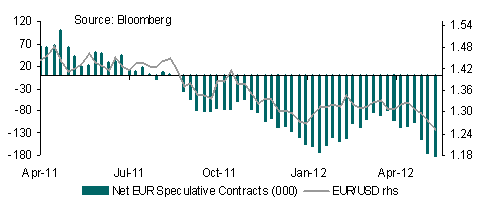
In any case, given the uncertainty ahead of the EU Summit it is unlikely that the EUR will break out of its current ranges. Notably there was a major bout of EUR short covering last week, with EUR/USD shorts dropping sharply according to the IMM data. Hopes ahead of the EU Summit may encourage more short covering but as usual scope for disagreement and disappointment on many fronts, suggests that investors should not become overly bullish. EUR/USD will find some initial resistance around 1.2583 to any upside.

Euro gives up its gains, GBP tracks lower

Although attention may briefly turn to the Fed FOMC outcome tomorrow the lack of progress to resolve’s Europe’s crisis threatens to inflict much more severe damage onto global markets. Against this background the European summit at the end of the week will be particularly important but the scope for disappointment remains high.

As with news of Spain’s banking bailout the positive EUR reaction to the Greek elections has faded even more quickly than I anticipated. EUR/USD’s inability to build on gains above 1.2700 despite extreme short market positioning, highlights the lack of confidence in resolving the crisis. EUR/USD appears to be increasingly following the moves in peripheral bond spreads and the news here is not good either especially in Spain, with spreads continuing to widen out.

The G20 communiqué offered no support to the EUR, with little by way of concrete measures while Germany continues to stick to its stance of no renegotiation of Greece’s bailout terms. The EU finance ministers summit in a couple of days time may provide some relief but only if concrete measures are outlined. In the meantime EUR/USD will continue to remain under pressure. As noted yesterday, I look for a test of EUR/USD 1.2515 which could happen as early as today.

Considering that the prospects of a further round of Bank Of England quantitative easing has grown as hinted at by BoE Governor King, GBP has shown some resilience. Indeed, it is not clear that GBP will weaken if and when the BoE expands its balance sheet again. My analysis reveals that the reaction of GBP has been mixed both to the announcement and implementation of asset purchases.

Inflation data will provide some clues to the room for further monetary stimulus while the minutes of the last MPC meeting two weeks ago will provide some inkling of the support within the Committee for fresh QE. CPI is likely edge higher but this will be due to seasonal factors, while the minutes will likely reveal two dissenters.

GBP meanwhile, will continue to track the EUR with the currency pair trading in a 0.80-0.81 range. EUR’s drop overnight has taken the wind out of GBP’s sails, but strong technical support will be found around GBP/USD 1.5601.

Germany feeling the pressure

Stocks fell back into negative territory following yet more soft US economic data. The 0.4% drop in US retail sales ex-autos was particularly disappointing, once again raising expectations that the Fed may need to deliver another round of quantitative easing. The rally in gold prices overnight was in part related to such expectations. Continued pressure on peripheral Eurozone debt reflects another angle of market pressure, not helped by the downgrading of Spain’s credit ratings by Moodys which effectively highlighted that Spain’s call for external help was a sign of weakness.

A further test of sentiment will be in the form of Italian bond auctions today. Perhaps more worrying is the sell off in German debt over recent sessions, indicating that investors are finally realising that Germany will not be spared from a “Grexit”. Whether this prompts Mrs Merkel into some form of action to help stem the crisis is another question entirely. Ahead of Greek elections on June 17 markets will enter into a state of limbo but the bias remains for elevated risk aversion.

FX markets are similarly rangebound, with the USD capped by hopes/expectations of more Fed QE and the EUR capped by peripheral Eurozone tensions. As a result EUR/USD has struggled to sustain break above resistance around 1.2624 and will continue to fail to the topside given the uncertainty around the Greek elections on June 17th. Bad news in the form of the Spanish debt downgrade and peripheral debt pressures, suggest that the EUR will remain under pressure over coming sessions, making it increasingly difficult to hold above the psychologically important 1.25 level.

The main focus today will be on the Swiss National Bank policy decision. While no policy action is expected attention will focus on the SNB’s stance on its 1.20 EUR/CHF floor. Upward pressure on the CHF has intensified over recent weeks as the situation in the Eurozone has worsened, and latest reserves data highlighted a big jump in reserves during May as the SNB had to buy EUR against the CHF. A shift in the EUR/CHF floor looks unlikely but the recent upward pressure on CHF could pale into insignificant compared to any upward pressure following a Greek Euro exit.

Sell Euro into rallies

There was limited respite for markets in yesterday’s thin market trading, with any bounce in risk appetite sold into quickly. This is exactly the pattern of trading that is likely to take place over coming weeks as Greece remains in the spotlight while Spanish banking woes garner more attention.

Taken together with rising global growth worries (note the Baltic Dry Index is turning over again) suggests that it will be very difficult for markets to drag themselves out the quagmire. The lack of major data releases today, with only German inflation and US consumer confidence of note, suggests that there will be little for markets to take their minds off the Eurozone debt crisis.

EUR/USD hit a high around 1.2625 helped no doubt by the fact that positioning was at record short levels. However, the bounce was quickly sold into leaving the EUR vulnerable to a drop below 1.2500 today. A renewed sell off in Spanish debt as banking sector concerns intensify dented any positive impact from weekend polls in Greece showing more support for pro bailout parties.

There is little on the data front today aside from German CPI leaving markets to continue to ponder on peripheral country woes. “Grexit’ fears have by no means been quelled as the reduction in bank deposits continues to show. EUR/USD will struggle to make any headway against this background, with further probing below 1.2500 likely in coming days.

The job of the Swiss National Bank has become increasingly tougher. Speculation of a ‘Grexit’ and continued flight of capital from Greece as well as other peripheral countries means that there is more prospect of upside for the CHF than downside versus EUR. The EUR/CHF 1.2000 floor has not deterred investors from parking such capital in CHF much to the chagrin of the SNB which has even warned about implementing capital restrictions.

Elevated risk aversion means that inflows of capital to Switzerland from the Eurozone periphery will persist. As a result EUR/CHF looks set to trade around the 1.2000 floor for some time to come, with the risk that the SNB has to increasingly buy EUR to protect the floor.