US dollar tracking Treasury yields

Despite the firmer tone to risk appetite the USD index moved higher tracking the move in US Treasury yields. Indeed, the USD’s reaction was actually opposite to what would be expected given the rally in risk assets but its move clearly reflects the growing influence of yields.

The surprisingly robust April ISM manufacturing survey following the disappointing Chicago PMI for the same month highlights that recovery is not straightforward, suggesting that USD gains will also not be straightforward.

March factory orders are on tap today but the bigger focus will be on the April ADP jobs report, which will give important clues to Friday’s payrolls data. Expectations centre on a 170k outcome for the ADP report, a smaller increase than the 209k registered in March. In the meantime I expect the USD to hold its gains.

As noted at the start of the week EUR/USD was poised to edge higher despite the bad economic news emerging from the region. EUR/USD has continued to strengthen over recent weeks despite the release of data showing Eurozone economic underperformance relative to the US. A case in point is the April Eurozone purchasing manager’s data to be released today, which will reveal further weakness, especially in peripheral countries.

Some easing in peripheral bond yields has helped to support sentiment for the EUR leading to further short covering in the currency but further gains are expected to be limited. EUR/USD now sits around the middle of its 1.30-1.35 range but further upside will be restricted ahead of the key US jobs data on Friday. EUR/USD resistance is seen around the 1.3385 level.
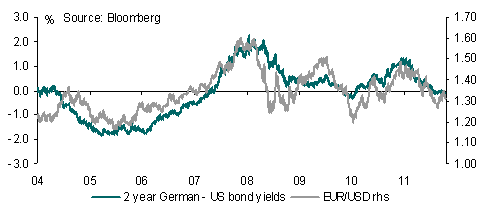
Yuan band widening, Euro still under pressure, Yen firm

The big news over the weekend was the widening in China’s CNY trading band to 1% from 0.5% previously. It is unlikely to have much of an impact on global markets, with the move not particularly surprising.

China clearly wants to add more two-way risk to the market and in this way the it allows the CNY to better reflect daily market conditions. Nonetheless, CNY is currently seen around equilibrium and appreciation pressure is limited , suggesting that intra day volatility will remain limited.

The USD index is trading around the middle of its range for the year and FX volatility has declined. Recent data disappointments have taken the shine off the USD and revitalized the debate on more Fed quantitative easing. Bouts of risk aversion have given some support to the USD but this has to be balanced against weaker US data.

It will require a renewed rise in US bond yields and an increase in risk aversion before the USD can strengthen anew. Data over coming days may offer some support but whether releases including retail sales, manufacturing surveys and industrial production prove sufficiently strong to boost US bond yields is debatable, suggesting another week of benign USD action.

EUR/USD remains close to its recent lows and is showing little inclination to move back up towards the top of its 1.30-1.35 range. Renewed worries about Spain’s fiscal/debt position as well as opposition to reforms in Italy threaten to keep the EUR restrained.

Data releases may actually regain some attention over coming days however, with the key April German ZEW and IFO surveys scheduled for release. The former is expected to fall slightly while the latter is expected to remain close to the March level.

Given that both surveys have been rising over recent months the outcomes will not prove particularly worrying. However, little change expected in both surveys suggests that the EUR will find little support either. EUR/USD technical support is seen around 1.2974.

Another trade deficit expected in March in Japan will support a JPY bearish view but in reality much of the reason for the deficit is not related to the strength of the JPY but rather external demand weakness and strong energy imports.

Nonetheless, the rise in the JPY over recent days will have fuelled renewed concerns among Japanese policy makers while piling on the pressure on the Bank of Japan to be more aggressive on its policy stance.

I suspect USD/JPY may have further to fall in the short term as its move corresponds with the narrowing in the US yield advantage over Japan. A drop below USD/JPY 80 looks increasingly on the cards.

Euro decline limited, AUD under pressure

EUR looks like it’s going nowhere fast, with the currency failing to break above 1.33 versus the USD. Nonetheless any drop will be limited as there will be plenty of support for EUR/USD around the 1.30 level. Such support may be required following the disappointing reading for the Eurozone March flash purchasing managers index (PMI) and renewed growth worries even in Germany.

Moreover, there have been plenty of scare stories about ongoing problems in the Eurozone, centring on Portugal and Spain and even speculation of a third Greek bailout being needed at some point.

However, the reality is that the market has reduced its attention on Eurozone debt issues for the time being. Once the latest bout of risk aversion passes, this ought to allowing the EUR some room to push higher, with my short term models highlighting the scope for EUR/USD to edge back towards 1.35 over coming weeks.

AUD has been pummelled this week, alongside its neighbour NZD. Growth worries in China compounded by a weaker than expected March China PMI has piled on the pressure, especially on AUD where economic conditions are increasingly linked with China. My quantitative models highlight ongoing short term downside risks to both AUD and NZD.

However, declines in these currencies will provide better levels to eventually buy as I remain bullish in the medium term even though my valuation metrics reveal that both currencies remain overvalued. My view is built on the prediction that risk appetite will improve further this year, a boon to high beta currencies such as AUD and NZD. Additionally as yield gains importance and carry trades gain attraction AUD will look particularly attractive.

GBP on a rollercoaster, NOK to bounce back

GBP has had a rollercoaster ride both against the USD and the EUR. On balance, it has fared better than the EUR vs. USD. News that Fitch ratings put the UK’s AAA ratings on negative watch had little impact although it may yet restrain GBP. If anything the news will likely help UK Chancellor Osborne formulate a relatively austere budget next Wednesday. Unlike the beleaguered JPY, GBP has not suffered from a widening in the yield differential with the US.

In fact 2-year UK Gilt yields have echoed the rise in US 2-year bond yields over recent days. This suggests that GBP ought to face less downward pressure compared to other currencies. Although I continue to see further GBP strength against the EUR over the medium term, the near prospects look volatile. Instead, I suggest playing a GBP positive view via the AUD.

It is worth commenting, albeit belatedly, on the outlook for the NOK following the surprise decision by Norway’s central bank, Norges Bank, which cut its policy rate by 25bps on Wednesday. Does it significantly change the outlook for the NOK? I believe it doesn’t and the recent drop in the NOK will provide a good opportunity to reinstate long positions.

Although the central bank may ease policy once again over coming months this will not undermine the NOK given that the influence of interest rate differentials on the currency is limited. Moreover, lower interest rates threaten to push already high property prices even higher suggesting that the Norges Bank may have limited room to cut rates further. Elevated oil prices continue to provide solid support for the currency and unless oil prices correct lower, the NOK will remain well supported versus EUR, with a drop to around 7.45 on the cards.

Posted in FX, Norway, UK. Tags: , , , , , . 1 Comment »

Euro and Swiss franc under pressure

Positive momentum in risk assets slowed, with higher core bond yields in the US and Europe weighing on sentiment. The USD in particular has been buoyed by higher US bond yields, with the move in line with my long held medium term view of a firmer yield led gain in the USD. Commodity prices in contrast have come under growing pressure, with gold and copper prices sliding in particular. Risk measures continue to improve including my risk barometer, suggesting that the overall tone to risk assets will remain positive.

The main focus today will be on a plethora of US data releases including industrial production, Philly Fed and Empire manufacturing confidence while in Europe attention will be on Spanish and French bond auctions. US data will likely remain upbeat, while the auctions should be well received.

EUR has pulled back sharply over recent not just against the USD but also on the crosses, with EUR/GBP finally playing some catch up yesterday. It’s interesting that the drop in the EUR has occurred despite generally improving conditions for peripheral Eurozone as reflected in narrowing yield spreads between peripheral countries and Germany.

The bottom line is that the EUR is suffering from a widening in the US / Europe (Germany) bond yield differential as it is becoming increasingly clear that the US economy will strongly outperform the Eurozone economy this year. As noted at the beginning of the week EUR/USD was set to drop to below support around 1.3055. Having hit this level, strong support around the 1.2974 level moves into sight.

Ahead of today’s quarterly Swiss National Bank meeting at which no change in policy is widely expected, EUR/CHF has taken a sharp lurch higher, finally moving away from around the 1.2050 level it has been trading at over recent weeks. While I am bearish on the CHF over the medium term further upside in EUR/CHF will be limited over the short term given that the move in the currency is at odds with interest rate differentials which have actually narrowed between the Eurozone and Switzerland. Technical resistance around 1.2298 will cap gains over coming sessions.

As for USD/CHF the picture remains a bullish one, with general USD strength driven by higher yields, pushing the currency pair higher. I look for a test of resistance around 0.9393 over coming sessions.