EUR range, CAD looks good versus AUD

Ahead of the European Central Bank (ECB) meeting and outcome of the Greek private sector involvement (PSI) debt swap it is very difficult to see the EUR moving out of ranges. I expect no surprises from the ECB and therefore little FX impact. Downward revisions to ECB growth forecasts will however, underpin the more negative tone to the EUR exhibited over recent days.

The bigger risk is the outcome of the PSI. Reports that Greece is nearing the minimum level of PSI participation of 66% will help erase market concerns of a complete collapse of the debt deal, but the risk of forcing a collection action clause and triggering credit default swaps (CDS) remains very much alive. EUR/USD is unlikely to recoup much of its recent losses against this background but will also not sustain any drop below technical support around 1.3055.

The CAD has pivoted around the parity level with the USD over recent weeks, showing little inclination to undertake a significant move in either direction. Notably USD/CAD has failed to sustain gains above its 200-day moving average level around 0.9997. Nonetheless, the CAD has held up relatively well compared to its commodity currency peers, specifically the AUD and NZD, which have both fallen over recent days.

The breakdown in correlation highlights the fact that CAD is regaining some of its old allure as a ‘turbo dollar’. My quantitative estimates show that USD/CAD has some further downward potential but I prefer to play potential CAD upside versus the AUD. The Bank of Canada (BoC) meeting today will do little to derail the CAD, with an unchanged policy decision in prospect, leaving the CAD to maintain gains against AUD.
Anxious wait for Greek PSI

An anxious wait for the outcome of the Greek private sector involvement in a debt swap taken together with a bout of risk aversion and confirmation of weak growth in the Eurozone (Q4 GDP dropped by 0.3%) have set the scene for nervous trading in EUR/USD. Confirmation of the Greek debt swap deadline on Thursday has done little to stead nerves.

The EUR has lost plenty of ground over recent days but will likely consolidate ahead of the outcome of the PSI. Direction will then depend on whether there has been sufficient voluntary participation by bond holders to avoid forcing private sector involvement. In the event of strong participation the EUR will rally but I suggest selling into any such rally.

Another factor that is playing a role in dampening EUR demand is the fact that the European Central Bank (ECB) balance sheet continues to expand at a rapid rate, to a record EUR 3.02 trillion last week following the second ECB long term refinancing operation (LTRO). Overall, expect little respite for the EUR. Effectively the ECB is undertaking quantitative easing via the back door, which is weighing on the EUR in the process.

USD/JPY has pulled back from its highs in the wake of an increase in risk aversion. As I have been noting over recent days the move in USD/JPY had overshot its short term ‘fair value’ estimate according to my quantitative models. The drop in USD/JPY fits into line with this view. The fact that US bond yields have pulled back from recent highs has also played into the drop in USD/JPY.

While I remain bearish on the JPY over the medium term, there is scope for a further move to technical support the 80.00 level in the short term. Further out, much will depend on the ability of Japanese officials to follow through on more aggressive policy to reflate the economy.

The Bank of Japan’s inflation goal will need a determined effort in terms of more aggressive monetary policy to enable it to succeed. This will ensure that Japanese government bond yields remain suppressed at a time when I expect US bond yields to move higher. Consequently USD/JPY will likely move higher too, with my year end target remaining at 85.00.

Risk currencies buoyed

Positive developments helped to buoy markets. Although US durable goods orders were weaker than forecast a jump in US consumer confidence to its highest since February 2011 gave equity markets and risk assets in general a lift. Even in Europe the news was encouraging as Italy managed to auction 10-year debt at a cheaper rate than previously while Portugal passed a third review of its bailout programme and noted that unlike Greece it would need a second bailout.

There was some negative news however, with the European Central Bank (ECB) temporarily suspending the eligibility of Greek bonds as collateral for its funding operations and Ireland calling a referendum on the European fiscal compact. Nonetheless, hopes of a healthy take up at today’s ECB second 3-year Long term refinancing operation (LTRO) will keep markets in positive mood in the short term.

The USD index continues to look restrained when risk assets are rallying. Given the positive equity market mood overnight it is no surprise that the USD came under further pressure while the EUR looks firm ahead of today’s 3-year LTRO by the ECB. Fed Chairman Bernanke’s testimony will give the USD some direction but we do not expect him to deliver any big surprises. EUR/USD will continue to rally if we are correct about a strong EUR 600-700 billion take up at the LTRO but the currency pair will meet resistance around 1.3550.

JPY has lost ground against various cross including USD, EUR and AUD. Much of its weakness is related to widening yield differentials but our models reveal that USD/JPY in particular has overshot its implied value. Unless US yields widen further versus Japan, JPY could even rebound over coming days. EUR/JPY has breached its 200 day moving however, which is a bullish signal for the currency pair. A generally firm EUR tone likely to be maintained in the short term will also be exhibited versus JPY.

Warnings by Swiss National Bank head Jordan reiterating his stance of defending the EUR/CHF floor of 1.20 has done little to push the currency pair higher. EUR/CHF has enjoyed a strong relationship with movements in interest rate differentials. This implies that it will take a relative rise in German yields versus Swiss yields for EUR/CHF to move higher. This is certainly viable given the deterioration in Swiss economic data over recent months. Eventually EUR/CHF will move higher but over the short term it is unlikely to move far from the 1.20 level.

Euro pain, Australian and New Zealand dollars vulnerable

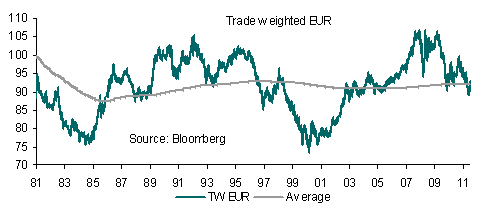
EUR appreciation has been painful for many, especially those looking for a turn in the currency over recent days. Unfortunately, for these investors, the EUR may yet strengthen further in the short term before any reversal is seen. Indeed, using valuations to justify a bearish view may not be a particularly strong argument at present given that the EUR trade weighted index is trading close to its historical average level while IMM data reveals that the speculative market remains significantly short EUR.

Additionally, my quantitative models reveal that the short term ‘fair value’ for EUR/USD is close to 1.40. While longer term fair value is undoubtedly much lower, it could take some time before the EUR declines to such levels. This is not encouraging news for EUR bears but there are some signs that the upmove in EUR/USD may not persist. Currently EUR/USD is trading above its 100-day moving average but since July last year, it has failed to remain above its 100 day moving average level for more than a few days.

There are definite signs that commodity currencies are topping out. Both the AUD and NZD have failed to extend gains over recent weeks. Perhaps valuation concerns are finally begging to catch up with these currencies (both are close to 2 standard deviations from average purchasing power parity while my quantitative models reveals a divergence with short term fair value) while speculative positioning according to IMM data remains at high levels. AUD and NZD even look stretched relative to interest rate differentials.

A wider than forecast January trade deficit in New Zealand did not bode well for the NZD but near term direction for both currencies will still depend on the gyrations in risk appetite given the strong correlation that both AUD and NZD have with risk aversion. Notably the the improvement in risk appetite has stalled in February, leaving AUD and NZD exposed to lofty valuations.

Euro on the front foot

The G20 meeting of leaders in Mexico over the weekend did not make much progress in terms of increasing the size of the International Monetary Fund (IMF) or increasing support for the Eurozone. A decision on this has been delayed until the next meeting on 19-20 April. Instead attention has turned to the various bailout votes across Eurozone countries and discussions over increasing the firewall (by boosting the size of the bailout fund) around the Eurozone periphery. Germany continues to oppose any increase in the firewall. Sentiment will hinge this week on the outcome of these events rather than data releases.

The USD has come under growing pressure but this is as reflection of a stronger EUR rather than inherent USD weakness. Data releases in the US have continued on a positive track yet the USD has failed to benefit as higher US bond yields have been matched elsewhere. Business and consumer confidence measures over coming days are also likely to reveal some encouraging outcomes while the Beige Book will report improvement in economic activity but the USD will continue to be restrained.

The EUR is looking increasingly stretched from a fundamental perspective yet technical indicators show it to be on a stronger footing. EUR/USD will find strong resistance around the 1.3550 level and the currency could still stumble over coming days depending on the outcome of Wednesday’s ECB Longer term refinancinf operation (LTRO).

Various policy events will also help dictate EUR direction including national parliamentary votes on the Greek bailout and the EU Summit. Theoretically a large uptake by banks at the LTRO could result in more EUR liquidity and a weaker EUR but the reality is quite different. Improved sentiment in peripheral bond markets as LTRO funds are used to buy local debt are helping the EUR to push higher, with its short covering rally gaining more traction.

GPB has come under pressure in the wake of a stronger EUR, but we still expect EUR/GBP’s charge to falter. My quantitative models show that the currency pair is overbought and we will likely struggle to break above 0.85. If it does, EUR/GBP 0.8562 will prove to be a strong resistance level. UK data this week will likely give some support to GBP, with the manufacturing purchasing managers index (PMI) set to strengthen further. However, the release of a relatively dovish set of Bank of England (BoE) Monetary Policy Committee (MPC) minutes has helped to undermine GBP for the time being, meaning that any recovery will be limited in the near term.