Resisting Asian FX Appreciation

The upward momentum in Asian currencies has continued unabated over recent weeks the gyrations in risk appetite. Most Asian currencies have registered gains against the USD over 2010 with the notable exception of one of last year’s star performers, KRW which after gaining by close to 9% last year has weakened slightly this year. Last year’s best performer the IDR which raked in close to 20% gains over 2009 versus USD has continued to strengthen this year, albeit to a smaller degree. Another currency that has extended gains this year has been the THB, which is on track to beat last year’s 4% appreciation against the USD.

The strength in Asian currencies has in part reflected robust inflows into Asian equity markets. For example Indonesia has been the recipient of around $1.7 billion in equity inflows so far this year. However, India and Korea have registered even larger inflows into their respective equity markets, at around $13 billion and $7.7, respectively, yet both the INR and KRW have underperformed other Asian currencies. The explanation for this is largely due to deteriorating current account positions in both countries. Further deterioration is likely.

The fact that equity flows have had only a small impact on the INR and KRW is reflected in their low correlations with their respective equity market performance. For most other Asian currencies the correlation with equity performance has been quite high, with the THB and MYR having the strongest correlations with their respective equity market indices over the past 3-months although the SGD, PHP and IDR have also maintained statistically significant correlations.

Clearly, for many but not all Asian currencies equity market gyrations are important drivers but at a time when growth is slowing more than many had expected in the US and governments in the eurozone are implementing austerity measures which will likely result in slowing growth and a worsening trade picture in the region, central banks in Asia will become increasingly wary of allowing their currencies from strengthening too quickly.

Increasingly Asian currency strength is being met with intervention by central banks in the region buying USDs against a host of Asian currencies. Over recent weeks this intervention appears to have become more aggressive. Nonetheless, any FX intervention led weakness in Asian FX is likely to prove short lived, with renewed appreciation likely over the coming months unless risk aversion increases dramatically. In other words a drop in Asian currencies will provide better opportunities to go long.

The CNY will play an important role on the pace and pattern of Asian currency movements. Investors in the region will also have one eye on developments on the visit of US National Economic Council director Larry Summers to Beijing. The CNY has firmed over recent days but this appears to be the usual pattern when a senior US official is in town and ahead of a G20 meeting. The fact is however, that the lack of CNY appreciation since the June CNY de-pegging remains a highly sensitive issue.

China is unlikely to yield to US pressure and is set to continue to act at its own pace and comments from officials in China over the past couple of days suggest no shift in FX stance. Although the CNY has not appreciated by as much as many had hoped for or expected since the June de-pegging the path is likely to be upwards, albeit at a gradual pace. For Asian currencies a slow pace of CNY appreciation implies further reluctance to allow a fast pace of appreciation so expect plenty of FX intervention in the weeks and months ahead.
China’s gradual renminbi move

China’s decision to “proceed further with reform” of the CNY exchange rate regime will dictate market activity at the turn of the week. The decision to act now reflects the fact that China is no longer in crisis mode policy. Although the eurozone sovereign crisis may have delayed China’s move, the authorities in China clearly felt that conditions had improved sufficiently enough to act. The decision will pre-empt some of the criticism that China would have faced at the G20 meeting next weekend, leaving attention firmly on Europe.

Before we all get too excited it should be noted that it is unlikely that China’s announcement presages aggressive action on the CNY. Stability appears to be the name of the game, a fact that has already drawn criticism from some in the US Senate who may still push for legislation over China’s exchange rate.

China will likely allow some, albeit gradual appreciation of the CNY. In this respect, it’s worth noting that the CNY appreciated by around 6.6% against the USD during 2007 and around the same amount in 2008 prior to the formal peg with the USD. Appreciation at a similar pace of coming months is unlikely.

The initial impact on the USD was an echo of the July 2005 move but to a far smaller degree. The USD was sold off across the board as market players reacted to the likelihood of the USD playing a less important role in China’s exchange rate mechanism. The USD rallied when China maintained its CNY fixing but lost ground as the CNY appreciated against the fixing.

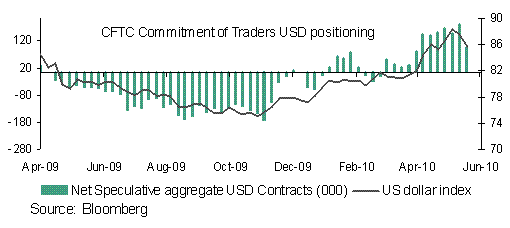
The fact that net USD speculative positions halved over the past week according to the CFTC IMM data, suggest that the USD is far less vulnerable this week to selling pressure from a positioning perspective. In other words there will be no repeat of the sharp FX moves that were seen post the July 2005 CNY revaluation. Whilst the major currency impact is likely to prove muted, Asian currencies are set to benefit more significantly, with further strengthening likely this week.

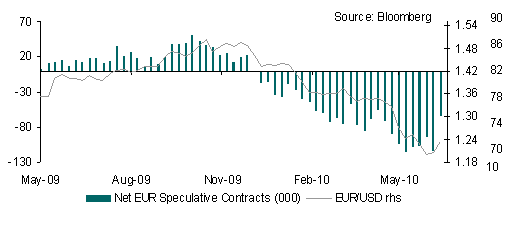
China’s announcement will play into the tone of firmer risk appetite at the beginning of the week but the move in some risk currencies, especially the EUR is looking increasingly stretched. The EUR and risk appetite may have benefited from recent positive news flow including the announcement of European bank stress tests and the relatively positive reception to Spain’s bond auction, but speculative positioning (IMM) data reveals that there was already a strong short-covering rally over the past week, which saw net EUR short positions almost halve.

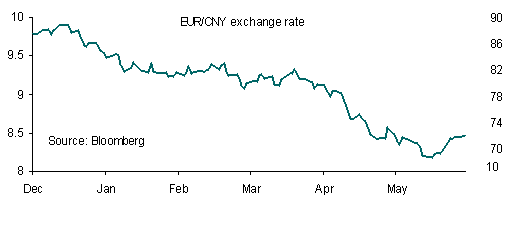
Further EUR/USD gains will be harder to come by, with an immediate obstacle around 1.2500. Perhaps another reason for China to be cautious about the pace of CNY appreciation is the likelihood of further EUR weakness and the impact that this would have on China’s trade with Europe. As it is EUR/CNY has already dropped by over 13% so far this year and China will not want to enact measures that will accelerate the pace of the move in the currency pair.

Wait And See

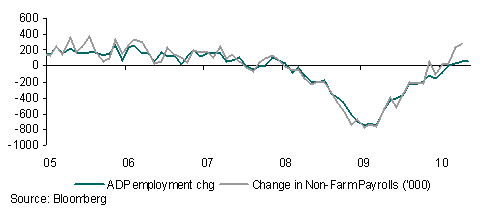
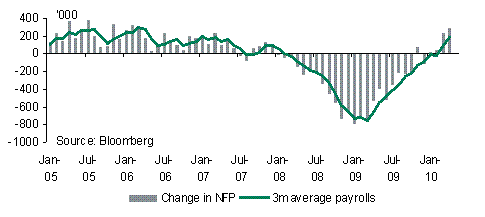
It’s difficult to be too conclusive in my blog post today given that markets are in waiting mode for a number of events to pass. First and foremost is the US May jobs report. The consensus forecast is for a gain of 536k in nonfarm payrolls and a slight drop in the unemployment rate to 9.8%. Payrolls estimates range from a high of 750k to a low of 220k, the wide margin likely reflecting the uncertainty of the amount of census hiring.

On the face of it a 500k+ gain in payrolls looks strong, but the bulk of this, probably about three-quarters, will made up of census hiring which by its nature is transitory. Therefore, only about 100k in payrolls will be due to private sector jobs growth, which is still not bad. Most of the clues leading up to the jobs data are consistent with the consensus, including the 55k increase in the May ADP.

The second event is the change in Prime Minister in Japan. Naoto Kan, the previous Finance Minister is set to take over the helm. His job is going to tough, with all eyes on how and when the government begins to get to grips with Japan’s burgeoning debt burden which is approaching 200% of GDP. Most of this, around 96% is held by domestic investors, so Japan is less exposed to foreign investor sentiment.

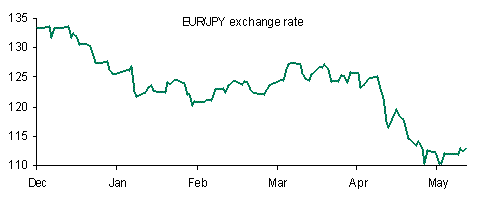
Nonetheless, even domestic investors including many large life insurance companies are increasing their overseas investments at the expense of Japanese debt. Kan is also a supporter of weaker JPY so at the least the rhetoric from Japanese officials to weaken the JPY will step up, especially given the very painful move in EUR/JPY over recent months.

Finally, the G20 meeting beginning today in South Korea will garner attention. Topics will include bank regulation and capital requirements, the European debt crisis, and policy tools such as the recent suggestion by South Korea to make permanent the currency swap agreements between central banks. Aside from a commitment to keep policy supportive, and likely talking up the efforts to combat the crisis in Europe, it is difficult to see anything particularly market moving emerge from the meeting.

Volatility Within Ranges

Most investors will likely be happy to see the tail end of May given the sharp losses in many asset classes over the month. At least over the last few days there was a sense of some healing, particularly in risk assets though it is questionable how long this can continue given the still many and varied uncertainties afflicting markets. A reminder of this came late on Friday, with Fitch downgrading Spain’s sovereign credit ratings despite the passage of austerity measures.

The Fitch decision highlights that Spain is rapidly becoming the new epicenter of the crisis; focus on the savings banks or Cajas is intensifying ahead of the June 30 deadline for mergers to qualify for government money, the minority government’s popularity is in further decline, whilst unions are threatening more strikes across the country. Unions in Greece and Italy are also pushing for coordinated strikes, highlighting the difficulties in pushing through austerity measures.

At least economic data is providing some solace to markets. Releases last week in the US highlighted the fact that consensus expectations are underestimating the pace of recovery; consumer confidence, durable goods orders and new home sales all came in above expectations. The same story is likely this week, but there is really only one piece of data that attention will focus on and that’s the May jobs report. The consensus is for a strong 508k increase in non-farm payrolls following a 290k increase in April, though around three-quarters of this will be related to census hiring. The unemployment rate is likely to dip slightly to 9.8%.

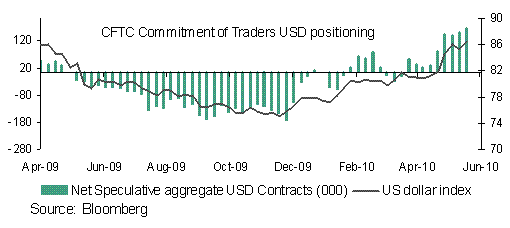
Markets are likely to be in limbo, with volatility in ranges likely this week. USD sentiment remains strong as reflected in the CFTC IMM data where net aggregate positioning is at an all time high, but further USD gains may be harder to come by ahead of the US jobs report and G20 meeting this weekend. Stretched USD positioning has proven no barrier to USD strength over recent weeks but the fact that markets are very long USDs could at the least result in a slower pace of further appreciation.

EUR speculative sentiment remains close to all time lows although there are signs of some relative stability over recent weeks. EUR/USD is likely to range between 1.2134 and 1.2475 this week. There was a sharp drop in net short JPY positions over the week (ie short-covering) though this appears at odds with the fall in the JPY. GBP speculative positions showed little improvement, languishing close to all time lows, whilst net longs in commodity currencies were pared back sharply, especially in AUD where net longs were cut by around half though sharp declines in positioning were also registered for NZD and CAD.

GBP could suffer due to worries about the UK government’s plans to reduce its burgeoning budget deficit following the resignation of Treasury Minister David Laws, following an expense scandal. The resignation hits the coalition just three weeks before the emergency budget and could result in complications on the negotiations between the Liberal Democrats and Conservatives on the substance of the deficit cutting measures. GBP/USD is likely to find support around 1.4260 and resistance around 1.4612 this week.

Pandemonium and Panic

Pandemonium and panic has spread through markets as Greek and related sovereign fears have intensified. The fears have turned a localized crisis in a small European country into a European and increasingly a global crisis.  This is reminiscent of past crises that started in one country or sector and spread to encompass a wide swathe of the global economy and financial markets such as the Asian crisis in 1997 and the recent financial crisis emanating from US sub-prime mortgages.  

The global financial crisis has morphed from a credit related catastrophe to a sovereign related crisis. The fact that many G20 countries will have to carry out substantial and unprecedented adjustments in their fiscal positions over the coming years means the risks are enormous as Greece is finding out. The IMF estimate that Japan, UK, Ireland, Spain, Greece, and the US have to adjust their primary balances from between 8.8 in the US to 13.4% in Japan. Such a dramatic adjustment never been achieved in modern history.

Equity markets went through some major gyrations on Thursday in the US, leading to a review of “unusual trading activity” by the US Securities and Exchange Commission in the wake of hundreds of billions of USDs of share value wiped off in the market decline at one point with the Dow Jones index recording its biggest ever points fall before recouping some of its losses. Safe haven assets including US Treasuries, USD and gold have jumped following the turmoil in markets whilst risk assets including high equities, high beta currencies including most emerging market currencies, have weakened. Playing safe is the way to go for now, which means long USDs, gold and Treasuries.

There is plenty of expectation that the G7 teleconference call will offer some solace to markets but this line of thought is destined for disappointment. Other than some words of comfort and support for Greece’s austerity measures approved by the Greek government yesterday, other forms of support are unlikely, including intervention to prop up the EUR. The ECB also disappointed and did not live up to market talk that the Bank could embark on buying of European debt and it is highly unlikely that the G7 will do so either. Into next week it looks like another case of sell on rallies for the EUR.   Remember the parity trade, well it’s coming back into play. 

Aside from the turmoil in the market there has been plenty of attention on UK elections. At the time of writing it looks as though the Conservatives will win most seats but fall short of a an overall majority. A hung parliament is not good news for GBP and the currency is likely to suffer after an already sharp fall over the last few days. GBP/USD may find itself back towards the 1.40 level over the short-term as concerns about the ability of the UK to cut its fiscal deficit grow. A warnings by Moody’s on Friday that the “UK can’t postpone fiscal adjustments any longer” highlights the risk to the UK’s credit ratings and to GBP.