Greek Confusion, India Tightening

It is highly interesting that markets could take fright from a rate hike in India but this appears to be what has happened. India’s surprise 25bps rate hike has provoked another bout of risk aversion whilst the lack of any concrete agreement on a framework for a Greek bail out dealt a further blow to confidence. FX tensions between the US and China have not helped, with China threatening retaliation to any US move to name the country as a currency manipulator in the mid April US Treasury report.

Should we really be worried by a rate hike in India or China? Whilst the India rate move reflects the fact that emerging market central banks are moving far more aggressively to raise rates than their G7 counterparts, global fears that India’s move will dampen recovery prospects are unfounded. Monetary tightening in India and China and other economies is taking place against the backdrop of economic strength not weakness.

As such the global impact on growth should be limited. Rising inflation pressure in Asia is reflection of the much quicker economic recovery, relatively low rates and undervalued currencies in the region. Not only will central banks in Asia have to raise interest rates but will also have to allow further currency appreciation.

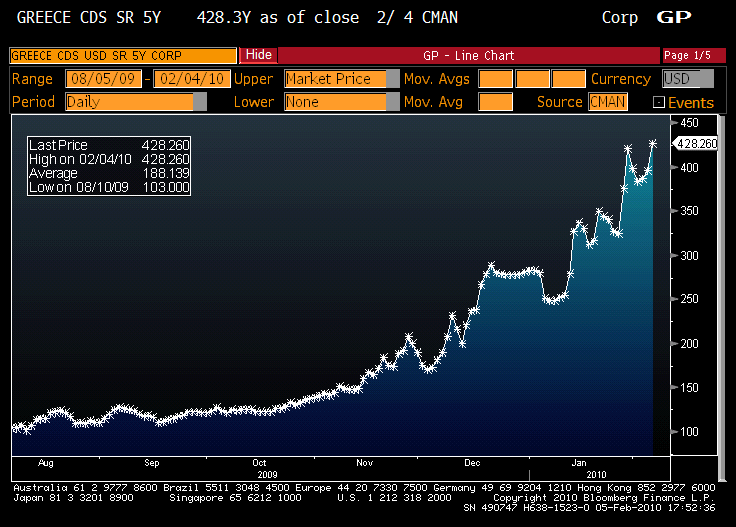
There is still plenty of confusion about a bail out for Greece ahead of the 25-26th March EU summit. German Chancellor Merkel dampened expectations of a bailout by stating that it was not even on the agenda for the summit. In contrast, EU President Barroso has pushed EU members to agree on an explicit stand-by aid agreement for Greece as soon as possible.

There is also disagreement about whether there should be any IMF involvement, with Germany favouring some help from the Fund whilst France opposes it. Meanwhile, the Greek Prime Minister has reportedly given an ultimatum that should no aid plan be forthcoming at the EU summit, Greece will turn to the IMF for assistance.

All of this suggests more downside for EUR/USD, with a test of support around 1.3422 looming. In the event that the EU summit offers good news for Greece, EUR/USD sentiment could turn quickly so a degree of caution is warranted. Speculative sentiment for the EUR has improved according to the latest CFTC Commitment of Traders (IMM) data for the week to 16th March, with net short EUR positions at their lowest since the beginning of February. Nonetheless, the short covering seen over the past week could come to an abrupt end should there be no aid package for Greece.

The most volatile currency over the past week was GBP/USD and after hitting a high of around 1.5382 it has slid all the way back to around the 1.5000 level. Much of this was related to the gyrations in EUR/USD but GBP took on a life of its own towards the end of the week and has not been helped by comments by BoE MPC member Sentence who highlighted the risk of a “double-dip” recession in the UK.

GBP is highly undervalued and market positioning is close to a record low but a sustainable recovery looks unachievable at present. Attention this week will centre on the 2010 UK Budget announcement and markets will scrutinise the details of how the government plans to cut the burgeoning budget deficit. Failure to restore some credibility to the government’s plans will dent GBP sentiment further and lead to a sharper decline against both the EUR and USD.
What To Watch This Week

As usual the G7 meeting will leave markets with little to chew on. G7 officials maintained their commitment to stimulus measures and timely exit strategies but there was little of note for FX markets aside from the usual comments about wanting to avoid excess FX volatility. There was certainly know step up in pressure on China to strengthen though a report prepared for the meeting did push for countries with inflexible currencies to make adjustments. Meanwhile US officials mouthed the usual “strong dollar” mantra.

Where does this leave markets this week? Well I must admit my bullish view on risk currencies is clearly suffering after a positive start to the year. The pullback in high beta currencies (those with the highest sensitivity to risk aversion) has been dramatic. I have highlighted many of the factors weighing on sentiment in previous posts and whilst I still think the US dollar will find itself under renewed pressure over coming months the current environment remains conducive to more USD and JPY buying and selling of currencies such as the AUD, NZD, CAD, GBP, NOK, SEK, ZAR etc.

Ironically the US and Japan have arguably more severe deficit/debt concerns than some of the European countries under pressure but as most of Japan’s debt is held domestically there is little worry of a collapse in JGBs. Unlike Japan foreign investors hold over half of US debt but are not yet losing confidence with US Treasuries though this may not last unless there is some tangible sign that the burgeoning US budget deficit is being reduced. For now, attention remains firmly focussed on Greece, Spain, Portugal and to a lesser extent Italy.

Like the G7 meeting the US January jobs report released at the end of last week will give little direction for markets. Although the 20k drop in payrolls and revisions to past months were slightly disappointing the surprise drop in the unemployment rate was better news. This week’s data highlights include the January US retail sales report and December trade balance. The sales data is likely to help allay some concerns about faltering economic recovery, with retail sales forecast to rise over the month despite a likely pull back in autos spending.

How will this play out for currencies this week? Overall, the risk off tone is set to continue though the moves are looking increasingly stretched. The USD, JPY and CHF will remain on the front foot whilst risk currencies will remain under pressure. The EUR is set to continue to struggle against the background of eurozone deficit concerns and after its dive through 1.40 last week 1.35 now looms large. Meanwhile, the AUD may also struggle following the recent reassessment of interest rate expectations after the recent Reserve Bank of Australia (RBA) meeting in which interest rates were left unchanged.

UK markets will focus on the Quarterly Inflation Report from the Bank of England though the political situation may hold some interesting implications for GBP if polls continue to show that the gap between the governing Labour party and Conservative opposition continues to narrow. Prospects of a hung parliament will hardly hold any positive implications for GBP, a prospect which could limit any potential for GBP to recover ahead of May elections. The drop below 1.60 for Cable (GBP/USD) could extend further, especially as the BoE has kept the door open to further asset purchases if needed.

Currency Tensions Intensify Ahead of G7

Portugal, Greece and Spain remain firmly in the spotlight but it may not be long before the light broadens to include UK, US and many other countries facing similar difficulties on the fiscal front. Portuguese, Greek and Spanish equities were smashed in the wake of growing concerns and sentiment looks like it will get worse before it gets any better.

Events in each of these countries are not helping matters. In Portugal, parliament began to vote on a bill on financial transfers to the regions, which could damage the ability of the government to reduce the deficit whilst speculation that the Prime Minister is about to resign has intensified. In Greece tax collectors have started a 48-hour strike as social unrest worsens in the wake of the implementation of deficit cutting measures.

Although European officials pour cold water on the idea that the whole EMU Project could unravel bond markets are not taking any chances whilst the EUR looks destined to languish at ever weaker levels until there is a semblance of calm. Meanwhile. the European Central Bank (ECB) has clearly stated that does not want to get involved.

The G7 meeting in Canada will move rapidly into focus this weekend, with a joint press conference expected on Saturday. Sovereign debt concerns and restrictions and banks will likely be addressed whilst the not insignificant matter of China’s currency will also likely be discussed.

US pressure on China to strengthen the CNY has increased as has tensions between the two countries following US arms sales to Taiwan and a scheduled meeting between President Obama and the Dalai Lama.

There is growing speculation that the upcoming US Treasury report in April will label China as a currency manipulator which could result in tensions ratcheting up to a higher level. China holds the cards given the US reliance on Chinese money but with mid-term elections looming in the US and Obama’s promise to double US exports within five years, US pressure on China will intensify as will likely resistance from China.

Talking about currencies

It’s always the same story.  Ahead of the G7 (or G8 and now more important G20) meetings speculation of decisive action on currencies intensifies.  Traders and investors become cautious on the off chance that something significant will happen but the majority of times nothing of note emerges.

There was no difference this time around.  The G7 Finance Ministers meeting in Istanbul failed to deliver anything substantive on currencies, repeating the usual mantra about the adverse impact of “excess volatility and disorderly movements”.  Although the group pledged to monitor FX markets there was no indication of imminent action. 

The lack of action is perhaps surprising in one respect as there were plenty of central bankers and finance officials talking about currencies in the run up to the G7 meeting, most of which were attempting to talk the dollar higher against their respective currencies.  Given the increase in rhetoric ahead of the meeting, the relatively weak statement now leaves the door open to further dollar weakness.

The strongest indication of any FX action or intervention came from the country that was supposedly the least concerned about currency strength; Japanese Finance Minister Fujii warned that Japan “will take action” if “currencies show some excessive moves”.  The shift in stance from Japan since the new government took power has been stark (considering that the new government was supposedly in favour of a stronger yen).  Markets will likely continue to test the resolve of the Japanese authorities and buy yen anyway.

Although the G7 statement said little to support the dollar and the overall tone to the dollar likely remains negative over coming months, the softer tone to equity markets and run of weaker economic data in the US – the latest data to disappoint was the September US jobs report – may give some risk aversion related relief to the dollar this week. 

Weaker data and equities alongside the impact of official rhetoric is being reflected in CFTC Commitment of Traders’ data (a good gauge of speculative market positioning) which revealed a sharp drop in short dollar positions, by around a quarter, highlighting for a change, an improvement in dollar sentiment over the last week. 

The biggest losers in terms of speculative positioning were the British pound, where the net short position reached its most extreme since mid September 2008, and Canadian dollar where the net long position was cut by almost half.  Again this may reflect official views on currencies, with Canadian officials expressing concern about the strength of the Canadian dollar in contrast to the perception that UK officials favour a weaker pound.
Central bank meetings (BoE, ECB, RBA) will dominate the calendar this week and more comments on currencies are likely even if interest rates are left unchanged.  Meanwhile FX markets will continue to watch equities, and the start of the US Q3 earnings season will give important signals to determine the sustainability of the recent equity market rally.  Recent weak economic data has already cast doubt about a speedy recovery and if earnings disappoint risk aversion could once again be back on the table.