JPY pullback risks, GBP to slip versus USD

A combination of market friendly comments by Fed Chairman Bernanke, a better than expected outcome for the German IFO business confidence survey in March and hopes of a bolstering of the Eurozone bailout fund, have managed to lift risk assets while pressuring the USD. Markets appear to have shaken off, at least for now, growth worries emanating from weaker manufacturing confidence surveys in China and Europe last week.

Nonetheless, while Bernanke maintained that accommodative monetary policy is still required especially given concerns about the jobs market, he did not hint at more quantitative easing, suggesting that market optimism may be tempered in the days ahead. Data and events today include US and French consumer confidence as well as bill auctions in Spain and Italy. US consumer confidence is likely to slip slightly while the bill auctions are likely to be well received.

While I remain bearish on the JPY in the medium term (beyond 1 month), over the near term I believe there is scope for a pull back. The move in USD/JPY has gone beyond what would be expected by the shift in relative yields. This is corroborated by my short term quantitative model which shows that USD/JPY should be trading around 80.

The speculative market is positioned for JPY weakness but also points to some scope for short covering; both CFTC IMM data and Japanese TFX data (a gauge of local margin trading positioning) reveal significant short JPY positions. If as I expect, USD/JPY does pull back it will offer better levels for investors to initiate medium term JPY bearish trades.

Ultimately the JPY will regain its attraction as a funding currency for carry trades and the bigger the shift in relative yield with the US, the more the potential for capital outflows from Japan into higher yielding assets.

GBP has failed to sustain gains above 1.59 against the USD over recent weeks let alone manage to test the psychologically important 1.60 level. The current bounce above 1.59 is unlikely to last. It will require a renewed downtrend in the USD in general provoked by a sharp improvement in risk appetite and/or a drop in US bond yields for GBP to move much higher. Neither seems likely.

Indeed, GBP will be vulnerable to a general firmer USD over the remainder of the year. While I would not suggest playing a bullish call on GBP versus the USD I think there is much more juice in holding GBP versus EUR, with downside risks to this currency pair likely to open up. Indeed, my quantitative models reveal that GBP is mispriced against both EUR and AUD.
GBP on a rollercoaster, NOK to bounce back

GBP has had a rollercoaster ride both against the USD and the EUR. On balance, it has fared better than the EUR vs. USD. News that Fitch ratings put the UK’s AAA ratings on negative watch had little impact although it may yet restrain GBP. If anything the news will likely help UK Chancellor Osborne formulate a relatively austere budget next Wednesday. Unlike the beleaguered JPY, GBP has not suffered from a widening in the yield differential with the US.

In fact 2-year UK Gilt yields have echoed the rise in US 2-year bond yields over recent days. This suggests that GBP ought to face less downward pressure compared to other currencies. Although I continue to see further GBP strength against the EUR over the medium term, the near prospects look volatile. Instead, I suggest playing a GBP positive view via the AUD.

It is worth commenting, albeit belatedly, on the outlook for the NOK following the surprise decision by Norway’s central bank, Norges Bank, which cut its policy rate by 25bps on Wednesday. Does it significantly change the outlook for the NOK? I believe it doesn’t and the recent drop in the NOK will provide a good opportunity to reinstate long positions.

Although the central bank may ease policy once again over coming months this will not undermine the NOK given that the influence of interest rate differentials on the currency is limited. Moreover, lower interest rates threaten to push already high property prices even higher suggesting that the Norges Bank may have limited room to cut rates further. Elevated oil prices continue to provide solid support for the currency and unless oil prices correct lower, the NOK will remain well supported versus EUR, with a drop to around 7.45 on the cards.

Posted in FX, Norway, UK. Tags: , , , , , . 1 Comment »

Euro on the front foot

The G20 meeting of leaders in Mexico over the weekend did not make much progress in terms of increasing the size of the International Monetary Fund (IMF) or increasing support for the Eurozone. A decision on this has been delayed until the next meeting on 19-20 April. Instead attention has turned to the various bailout votes across Eurozone countries and discussions over increasing the firewall (by boosting the size of the bailout fund) around the Eurozone periphery. Germany continues to oppose any increase in the firewall. Sentiment will hinge this week on the outcome of these events rather than data releases.

The USD has come under growing pressure but this is as reflection of a stronger EUR rather than inherent USD weakness. Data releases in the US have continued on a positive track yet the USD has failed to benefit as higher US bond yields have been matched elsewhere. Business and consumer confidence measures over coming days are also likely to reveal some encouraging outcomes while the Beige Book will report improvement in economic activity but the USD will continue to be restrained.

The EUR is looking increasingly stretched from a fundamental perspective yet technical indicators show it to be on a stronger footing. EUR/USD will find strong resistance around the 1.3550 level and the currency could still stumble over coming days depending on the outcome of Wednesday’s ECB Longer term refinancinf operation (LTRO).

Various policy events will also help dictate EUR direction including national parliamentary votes on the Greek bailout and the EU Summit. Theoretically a large uptake by banks at the LTRO could result in more EUR liquidity and a weaker EUR but the reality is quite different. Improved sentiment in peripheral bond markets as LTRO funds are used to buy local debt are helping the EUR to push higher, with its short covering rally gaining more traction.

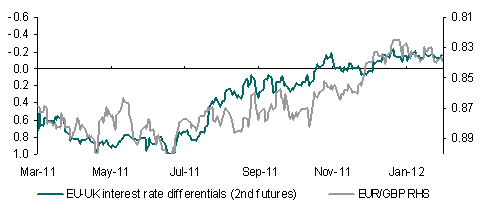
GPB has come under pressure in the wake of a stronger EUR, but we still expect EUR/GBP’s charge to falter. My quantitative models show that the currency pair is overbought and we will likely struggle to break above 0.85. If it does, EUR/GBP 0.8562 will prove to be a strong resistance level. UK data this week will likely give some support to GBP, with the manufacturing purchasing managers index (PMI) set to strengthen further. However, the release of a relatively dovish set of Bank of England (BoE) Monetary Policy Committee (MPC) minutes has helped to undermine GBP for the time being, meaning that any recovery will be limited in the near term.

EUR/GBP upside overdone, CHF overly strong

Disappointing Eurozone service sector and manufacturing purchasing managers’ confidence indices as well as a contraction in Chinese manufacturing confidence sets the scene for a drop in risk assets. In addition in the US, existing home sales rose less than expected taking into account revisions to previous data.

Meanwhile scepticism over Greece’s ability to implement agreed upon reforms and reported resistance from Germany to increasing the firewall around peripheral Eurozone countries has delivered a further dose of negativity to markets. The market was probably looking for an excuse to sell after a strong rally and found plenty in yesterday’s news.

GBP has followed on the coat tails of the EUR over recent weeks, with the currency showing little independent direction. Reflecting this is the fact that EUR/GBP had until recently been trapped in a 0.83-0.84 range. As with the EUR I see downside risks to GBP over the short term against the USD.

Against the EUR, GBP will largely track the movement in yield differentials as it has done over recent months. Relatively dovish MPC minutes, with two members voting for bigger amounts of quantitative easing helped to put GBP under further pressure but the move higher in EUR/GBP look overdone.

My medium term view continues to show GBP appreciation versus EUR and current levels highlight a good opportunity to go short EUR/GBP. Markets are rewarding central banks that are proactive in their policy prescriptions. I exect this to result in some GBP resilience even if the BoE announces more QE.

EUR/CHF has continued to hug the 1.2000 line in the sand enforced by the Swiss National Bank. Ongoing Eurozone doubts even after the agreement of a second bailout for Greece mean that the CHF remains a favoured destination for European money. This is reflected by the fact that EUR/CHF has been highly correlated with Risk Aversion over the past 3-months.

It will take also take a relative rise in German yields versus Swiss yields for EUR/CHF to move higher. This is certainly viable given the deterioration in Swiss economic data over recent months. Indeed, as reflected in the KoF Swiss leading indicator and manufacturing PMI data, the economy is heading downwards. Assuming that there will be an eventual improvement in risk appetite, CHF will weaken given the strong correlation between EUR/CHF and risk aversion over the past 3-months.

Still waiting for Greece

The USD has taken a steady path of recent days, with little move in either direction, reflecting the general malaise in currency markets waiting for an outcome to the Greek debt talks. However, hopes that an agreement will be announced shortly saw the USD lurch lower overnight. The conflicting forces of firming US economic data on the one hand and uncertainties in Greece on the other have left market participants in a bind.

The USD has at least purchased some solace from reduced expectations of quantitative easing but as we noted earlier in the week the Fed may still carry out QE despite of better data. The USD could also suffer from the fact that US bond yields remain relatively low compared to some other major countries.

Indeed, the Fed’s commitment to maintain accommodative monetary policy until the end of 2014 suggests that the USD’s use as a funding currency could continue for a while longer. We look for the USD index to consolidate around the 78.50-79.00 level over the short term.

GBP’s recovery from its lows around 1.5233 on 13 January has been impressive. GBP’s gains are not as strong as that of commodity and Scandinavian currencies but it has outperformed the EUR. We expect this to continue.

Like other currencies GBP has benefited from a widening yield gap between the UK and the US. This has little to do with UK policy expectations given that the Bank of England is expected to initiate more quantitative easing this week. The move in relative US–UK yield differentials has more to do with the rally in US interest rate futures since the start of the year, supported by the recent dovish FOMC statement, which has put the USD under a degree of pressure.

GBP gains will be limited ahead of the BoE meeting tomorrow, with technical resistance seen around 1.5931 vs USD. Against the EUR much will depend on Greek debt talks but eventually we look for a retest of the EUR/GBP January lows around 0.82213.