What To Watch This Week

The end of last week proved to be a calmer affair than the preceding few days. There was some encouraging news on the Greek front, with Germany finally approving its share of the European Union (EU) aid package whilst Greece appeared to be on track with its budget deficit reduction as the country recorded a cash deficit of EUR 6.3billion in the first four months of the year, a 42% reduction compared to a year earlier. EU officials also agreed on tougher sanctions for countries breaching austerity rules.

There were plenty of negatives to offset the good news however, as European business surveys including the German IFO index and flash eurozone purchasing managers indices (PMIs) revealed some loss of momentum in growth as well as increased divergence. European banking sector concerns intensified as the Bank of Spain was forced to take control of CajaSur, a small savings bank holding 0.6% of total Spanish banking assets, which faced difficulties due to distressed real estate exposure. Its woes highlighted the problems faced by many Spanish savings banks due to property market exposure.

US data releases this week will confirm that economic recovery gathered steam in Q2. May consumer confidence data is likely to record a small gain, due in large part to improving job market conditions, whilst the Chicago PMI is set to retrace slightly in May, albeit from a healthy level. Both new and existing home sales are set to record gains in April, the former following a sizeable gain in March although the drop in house prices likely to be revealed by the Case-Shiller index will continue to fuel doubts about the veracity of the turnaround in the US housing market.
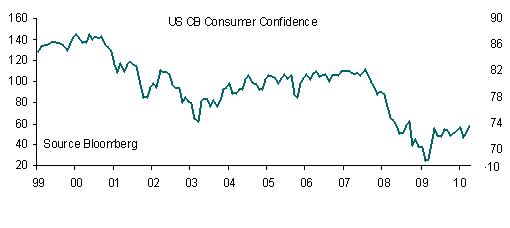
In Europe there is not much in terms of first tier releases and highlights include sentiment data such as German Gfk and French consumer confidence indices, and the May French business confidence indicator. The data are likely to be mixed, and as indicated by last week’s surveys will reflect a relatively healthy Q2 2010, but a worsening outlook for the second half of the year.

In the absence of UK data today there will be plenty of attention on the details of plans by Chancellor Osborne to cut GBP 6 billion from the budget deficit. The measures will be small change ahead of the emergency budget package on June 22nd when much bigger cuts are expected. Nonetheless, the first step today will be a crucial test of the new government’s ability to convince ratings agencies and markets that it is serious about reducing the burgeoning fiscal deficit.

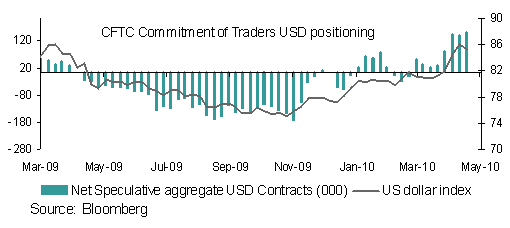
Following the massive positioning adjustments of the last week markets will look somewhat calmer over coming days but risk aversion is likely to remain elevated, suggesting little respite for most currencies against the USD. The recent moves have left net aggregate USD positioning registering an all time high according to the CFTC Commitment of Traders data, in the latest week, but after the slight retracement lower in the USD index, it is set to make further gains over coming days.
It was notable that EUR and GBP looked more composed at the tail end of the week whilst attention turned to the liquidation of long positions in CHF, AUD, NOK and SEK. These risk currencies are set to remain under pressure but there will be little respite for EUR which is set to drift lower, albeit a less aggressive pace than over recent weeks and a re-test of EUR/USD technical support around 1.2296 is likely. GBP/USD has showed some resilience over recent days but remains vulnerable to further downside pressure, with 1.4310 immediate support.
Criminals Favouring The Euro

It says a lot for a currency when banks stopped accepting it as a means of exchange. The EUR’s woes continue to pile up and the currency received more bad news unrelated to Europe’s fiscal woes when it was announced that banks and foreign exchange bureax in the UK have stopped exchanging EUR 500 banknotes. The rationale was not because the currency is dropping sharply in value though this is also a credible reason, but due to the fact that 90% of the notes were found to be linked to tax evasion, terrorism and other crimes.

EUR/USD came close to the technical support level around 1.2510. Options barriers will likely provide some strong support around this level, temporarily delaying an inevitable drop to the next support at 1.2457. It was not just the EUR that suffered, with GBP faring even worse, in part due to a wider than expected trade deficit, with GBP/USD heading for a test of 1.4500. Sovereign woes continue to depress the EUR in what is turning into a no-win situation. Fresh austerity measures in Greece, Spain and Portugal failed to assuage market fears, and instead the measures have only heightened concerns about social unrest and a weakening growth outlook.

Pandemonium and Panic

Pandemonium and panic has spread through markets as Greek and related sovereign fears have intensified. The fears have turned a localized crisis in a small European country into a European and increasingly a global crisis.  This is reminiscent of past crises that started in one country or sector and spread to encompass a wide swathe of the global economy and financial markets such as the Asian crisis in 1997 and the recent financial crisis emanating from US sub-prime mortgages.  

The global financial crisis has morphed from a credit related catastrophe to a sovereign related crisis. The fact that many G20 countries will have to carry out substantial and unprecedented adjustments in their fiscal positions over the coming years means the risks are enormous as Greece is finding out. The IMF estimate that Japan, UK, Ireland, Spain, Greece, and the US have to adjust their primary balances from between 8.8 in the US to 13.4% in Japan. Such a dramatic adjustment never been achieved in modern history.

Equity markets went through some major gyrations on Thursday in the US, leading to a review of “unusual trading activity” by the US Securities and Exchange Commission in the wake of hundreds of billions of USDs of share value wiped off in the market decline at one point with the Dow Jones index recording its biggest ever points fall before recouping some of its losses. Safe haven assets including US Treasuries, USD and gold have jumped following the turmoil in markets whilst risk assets including high equities, high beta currencies including most emerging market currencies, have weakened. Playing safe is the way to go for now, which means long USDs, gold and Treasuries.

There is plenty of expectation that the G7 teleconference call will offer some solace to markets but this line of thought is destined for disappointment. Other than some words of comfort and support for Greece’s austerity measures approved by the Greek government yesterday, other forms of support are unlikely, including intervention to prop up the EUR. The ECB also disappointed and did not live up to market talk that the Bank could embark on buying of European debt and it is highly unlikely that the G7 will do so either. Into next week it looks like another case of sell on rallies for the EUR.   Remember the parity trade, well it’s coming back into play. 

Aside from the turmoil in the market there has been plenty of attention on UK elections. At the time of writing it looks as though the Conservatives will win most seats but fall short of a an overall majority. A hung parliament is not good news for GBP and the currency is likely to suffer after an already sharp fall over the last few days. GBP/USD may find itself back towards the 1.40 level over the short-term as concerns about the ability of the UK to cut its fiscal deficit grow. A warnings by Moody’s on Friday that the “UK can’t postpone fiscal adjustments any longer” highlights the risk to the UK’s credit ratings and to GBP.

For A Few Dollars More…

…or should I say a few EUR more.   This is what the Greek authorities must be wondering.  Once again Greek worries weighed on equities and risk appetite as a whole.  Although the saga is turning into one big yawn, markets have not had their fill with the bad news coming from this small eurozone economy.  Talks between Greek officials, International Monetary Fund (IMF), European Central Bank (ECB) and European Union (EU) began yesterday but are expected to go on for several days or weeks until a joint text is issued on May 15, just days ahead of a EUR 8.5 billion bond redemption by Greece. 

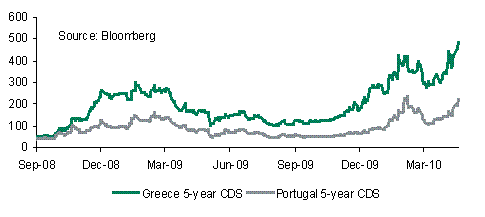
The talks have done nothing to prevent Greece’s bond yields moving higher, with the yield on 10-year bonds pushing well over 8% whilst the spread with Germany debt also blew out to over 500bps.  The main fear in the market is that Greece will ultimately end up restructuring its debt.  Moreover, contagion fears have dealt a blow to southern European sovereign CDS especially Portugal.  It wasn’t plain sailing for German bonds either, with yesterday’s auction of EUR 3 billion of 30-year Bunds failing to sell the full amount. 

Another casualty of ongoing Greece concerns is the EUR, with the currency under performing other majors and still on its path towards EUR/USD 1.3300 in the near term and onto 1.3150 after.   EUR also looks vulnerable on the crosses and EUR/GBP in particular is one to watch, with the 28 January low around 0.86029 likely to be targeted over the near term.  UK employment data gave some relief to GBP yesterday, with further direction coming from retail sales data today and the next televised leaders’ debate.  

At some point the market will become fatigued with consensus beating earnings and the positive impact on equities will become less marked.  This point is approaching but we’re not quite there yet.  Apple, Morgan Stanley and Boeing did not disappoint, with earnings easily beating forecasts.  Boeing’s earnings in particular helped industrials to be the best performing sector on the S&P 500 although the overall index closed marginally lower.

Earnings today include Amazon.com, American Express, Credit Suisse, Microsoft, Nokia, and PepsiCo.  It is becoming plainly obvious that market expectations for earnings are too pessimistic but as noted above the positive market impact of good earnings is likely to wane. 

On the data front, highlights include March existing home sales, jobless claims and Producer Price Index (PPI).   There will be less focus on PPI given that the Consumer Price Index (CPI) over the month has already been released whilst claims are likely to resume a path lower following the jump over the past couple of weeks.   Existing home sales are likely to post an impressive gain as indicated by firm pending home sales data.   

Overall, it appears that risk appetite is creeping back into the market psyche but the ongoing battle between positive earnings/data versus European/Greek woes suggests that there will be no clear direction for markets.  Improving risk appetite will ultimately win but current conditions will leave currencies trading within well worn ranges, with the exception of the underperforming EUR. In contrast the USD index is likely to remain supported, taking solace from positive data releases.

Greek Saga Rumbles On – Does Anybody Care?

The debate over Greece continues to rumble on. France and Spain requested a separate summit meeting of the 16 heads of eurozone countries immediately before the full 27-member EU summit starting tomorrow but this was met with resistance. Meanwhile, Germany has called for “a substantial contribution” from the IMF towards a Greek aid package, whilst maintaining that no EU deal will be reached for Greece at the summit.

Frankly, the whole Greek saga has become extremely boring, with the lack of agreement about how to fix it doing little to inspire confidence. In particular the fractured opinion amongst EU leaders highlights the difficulties in reaching an agreement in a union made up of so many conflicting interests. At most the summit may agree on the conditions for a rescue package for Greece rather than a package itself. This will leave markets unimpressed,

US new home sales data today is likely to paint a slightly better picture with a small gain expected, albeit following the 11.2% plunge in the previous month. Sales will be helped by the extension of the home buyer tax credit. The US February durable goods orders report is also released today, with a small increase expected. A smaller gain in transport orders suggests that the 2.6% jump last month will not be repeated.

In Europe, the key release is the March German IFO business climate survey and a rebound is likely following February’s decline, helped by warmer weather and a weaker EUR. Flash readings of Eurozone March purchasing managers indices (PMIs) are also released but these are unlikely to extend gains from the previous month. Despite expectations of firmer data the EUR/USD is vulnerable to a further decline, with support around 1.3432 in sight for an imminent test.

Attention in the UK will turn to the pre-election Budget and particularly the government’s plans to cut spending and reduce the fiscal deficit. Failure to provide a credible blue print to restore fiscal credibility will damage confidence, heightening the risks of an eventual sovereign ratings downgrade and more pressure on GBP which appears destined for another drop below 1.50 versus USD.

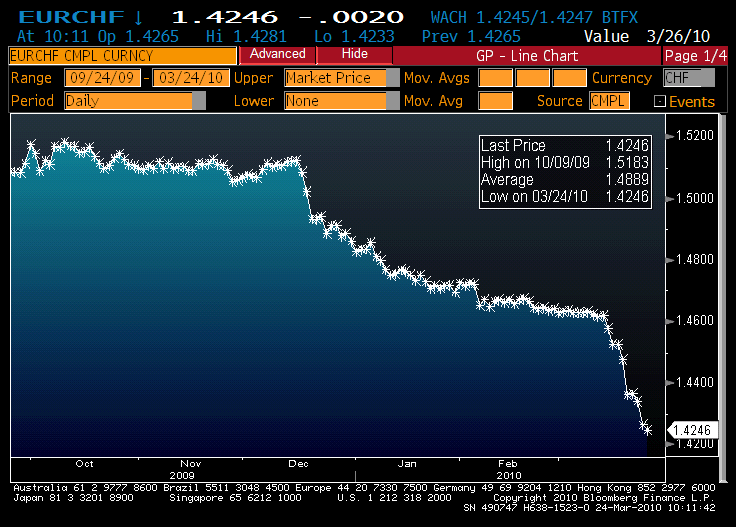
Most currencies have remained within ranges and the most interesting currency pair is EUR/CHF having failed to react to verbal warnings from the Swiss National Bank (SNB) about excessive CHF strength. EUR/CHF looks vulnerable to a further decline unless the SNB follows up rhetoric with action. Even if there is FX intervention by the SNB it may prove to be a temporary barrier to a market with an eye on the psychologically important 1.4000 level.

Despite the pressure on the Japanese government and Bank of Japan (BoJ) to engineer a weaker JPY, export performance has proven resilient, with exports jumping 45.3% on the year in February, helped by the strength of demand from Asia. Unfortunately this is doing little to end Japan’s deflation problem and even if there is less urgency for a weaker JPY to boost exports, JPY weakness will certainly help to reduce deflationary pressures in the economy. USD/JPY is stubbornly clinging to the 90.00 level, with little inclination to move in either direction.