Euro Has That Sinking Feeling

The reaction to the US May jobs report shows that markets are particularly susceptible to negative US news at a time when growth fragilities in Europe are becoming increasingly apparent. Coupled with worries about Hungary, risk aversion has jumped.

Unsurprisingly the EUR took the brunt of pressure. Rhetoric over the weekend may help to assuage some fears but I suspect it is too late now that the cat is out of the bag. Hungary’s government maintained that it will meet this year’s budget deficit target of 3.8% of GDP. European Union officials also attempted to calm market concerns, downplaying any comparison of Hungary to Greece.

The overall EUR/USD downtrend remains intact. Renewed doubts about German participation in the EU/IMF rescue package, with the German constitutional court potentially blocking its contribution, will add to pressure as well as a UK press report titled EUR ‘will be dead in five years’ . The January 1999 EUR/USD introduction level around 1.1830 has now moved squarely into sight.

It is unlikely that data and events this week will do much to reverse the market’s bearish tone. Highlights include the ECB, BoE and RBNZ meetings in Europe, UK and New Zealand, respectively. The ECB (Thursday) is highly unlikely to shift its monetary policy stance. Given some opposition to bond purchases from within the ECB council the comments in the accompanying statement will be closely monitored. The BoE will also leave policy unchanged on the same day but the RBNZ is set to begin its hiking cycle with a 25bps move.

On the data front the US slate includes the Fed’s Beige Book, April trade data, May retail sales and June Michigan confidence. The Beige Book is likely to reveal some improvement in activity with little sign of inflation, whilst the trade deficit is set to widen further due to a higher oil import bill. Retail sales will reveal an autos led increase in the headline reading but more subdued core sales, whilst consumer confidence is set to rise for a second straight month.

There will be more attention on rhetoric from EU officials rather than eurozone data, with the Eurogroup of Finance Minister’s and Ecofin meetings garnering more interest. In Japan, politics will take centre stage, with the new cabinet line up in focus following the confirmation of Naoto Kan as Prime Minister. Comments by the new PM himself will be of interest, especially with regard to combating deflation and in particular any elaboration on his penchant for a weaker JPY.

All-in-all, the week is unlikely to see a let up in pressure on risk trades and will start much as the last week ended. Although the market’s attention is on the EUR, it should be noted that the AUD has lost even more ground so far this month although the EUR remains the biggest loser in terms of major currencies so far this year (vs USD). In the case of the AUD the move reflects a massive unwinding of long positioning (as reflected in the latest CFTC IMM data which shows that speculative AUD positioning has dropped to its lowest since March 2009).
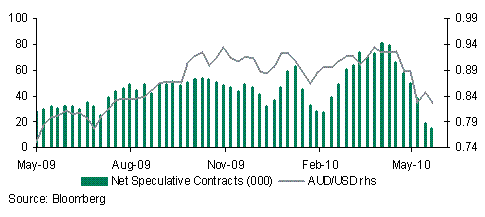
In contrast in the case of the EUR where positioning is already very negative, the move simply reflects deteriorating fundamentals. The fact that European officials are showing little concern about the decline in the EUR (why should they given that the currency is now trading around fair value) and in some cases encouraging it, suggests that there is little to stop EUR/USD from dropping much further and parity is looming a lot closer.

Will the ECB intervene to support the Euro? (Part 1)

The EUR has lost around 23% since it all time high in April 2008 when it traded close to 1.6000. The EUR failed to rally even in the wake of the EUR 750 billion European Union / International Monetary Fund support package, a fact that has highlighted the weight of negative sentiment towards the currency. The latest blow to the currency came from the announcement of unilateral measures from Germany to ban naked short selling on sovereign debt and some financial stocks, actions that only highlighted the lack of policy co-ordination within the eurozone.

The rationale for further EUR/USD weakness is clear and justified partly by growth divergence within the eurozone countries, with Germany on the one extreme and weaker Southern European countries on the other. Moreover, relatively weaker overall growth in the eurozone compared to the US economy, a delay in interest rate hikes by the European Central Bank (ECB) and ongoing concerns about implementation and execution of deficit cutting plans, will also weigh on the EUR.

The EU/IMF support package and in particular ECB interventions in the Eurozone bond market have managed to alleviate some of the strain on European bond markets, but without similar intervention in the FX markets the EUR has become the release valve for Europe’s fiscal and debt problems. As a result the EUR’s fall has accelerated over recent weeks, only showing any sign of stability as fears of currency intervention increased.

The quickening pace of EUR depreciation has led to growing speculation of FX intervention by the ECB and other central banks to support the currency. I believe intervention is highly unlikely and see little reason for panic about the drop in the EUR. Once markets realise that there is indeed little risk of intervention the EUR will resume its downtrend.

One of the main reasons behind this view is that the EUR is not particularly “cheap” at current levels. In fact, “fair value” estimates based on the OECD measure of purchasing power parity (PPP) suggest that EUR/USD is around 5.6% overvalued at current levels, based on an implied PPP rate of around 1.17. Therefore, the drop in the EUR over recent months has only brought it back close to PPP fair value estimates.

Moreover despite the fact that there has been a large nominal depreciation of the EUR its trade weighted exchange rate has declined by much less, around 8.5% since the beginning of the year and around 11.3% since its high in October 2009. Although the trade weighted EUR is around its lowest level since October 2008, taking a longer term view shows that it is slightly above its average over the past 20-years.

EUR/USD to test 1.2510, GBP/USD heading for 1.4500

Following on from the EUR 750 billion EU / IMF package European governments are starting to hold up to their end of the bargain. Spain announced a bunch of austerity measures. The measures aim at cutting the country’s budget deficit by an additional EUR 15 billion from 11.2% of GDP in 2009 to close to 6% in 2011. This was accompanied by some better economic news as Spain edged out of a close to 2-year recession in Q1 2010.

Evidence that some action is being taken on the fiscal front in Europe accompanied a slightly stronger than expected reading for Eurozone GDP in Q1 2010, helping risk appetite to improve overnight. Portugal was also able to find some success in its sale of EUR 1 billion of 10-year bonds, with a bid to cover ratio of 1.8 and a premium of only 18bps above the yield at April’s sale. Portugal has also pledged to cuts its budget deficit further than initially planned, aiming for a deficit of 7.3% of GDP this year.

Of course, pledges need to be followed by action and implementation and execution will be essential to bring markets back on side given the likely damage inflicted on confidence in the whole EUR project. Continued skepticism explains why EUR/USD has failed to take much notice to the developments in Spain and Portugal, with the currency continuing to languish, heading towards technical support around 1.2510 in the short-term.

The new UK coalition government is also moving quickly to appease markets, with plans to cut the budget deficit in the country by GBP 6 billion this year. The plans failed to have a lasting impact on GBP, which was dealt a blow by the dovish interpretation of the Bank of England’s quarterly inflation report released yesterday. GBP/USD continues to struggle to gain a foothold above 1.5000 and technical indicators suggest the currency pair is still heading lower, with a move to 1.4500 likely over the short-term.

The Dust Settles

As the dust settles on the massive “shock and awe” package announced over the weekend it is become painfully apparent that markets are not at all convinced that underlying issues surrounding Europe’s woes are on the path to being resolved. Undoubtedly the EUR 750 billion provided by the European Union (EU) and International Monetary Fund (IMF) will go a long way towards fixing the symptoms of the crisis but it will take a lot more action to convince markets that the measures to cut budget deficits, improve productivity and enact structural reforms are being carried out.

As a result of ongoing skepticism EUR/USD dropped to its lowest level since March 2009. The currency pair shows little sign of turning around and over the short-term EUR/USD is likely to test its 2010 low around 1.2510. Market positioning remains heavily short EUR suggesting some scope for short covering but any rebound in EUR/USD is being met with plenty of sellers and the upside is likely to be restricted to around 1.2885.

The size of the EU/IMF package means that financing issues for eurozone peripheral countries will not be a major concern and spreads are likely to continue to narrow against core debt. However, attention has turned to the next step in the process, in particular the path of fiscal consolidation necessary in the months ahead and the negative impact on the economies in Europe that this will entail. As US Fed Chairman Bernanke noted, the package from the EU/IMF is “not a panacea”.

Overall, the measures may have cheapened the long term value of the EUR rather than boost it as it has highlighted the many problems in having a single currency to encompass a wide variety of countries. The stark reality in having differing fiscal policies across the euro region whilst maintaining a single monetary policy has proven to be highly problematic.

At least for now, the economic data in the eurozone is providing some support, though it is questionable how long this will continue. Eurozone GDP grew by 0.2% in the first quarter of 2010 compared to the previous quarter, which was stronger than expected and growth in the second quarter actually looks like it will have picked up from this pace based on the indications from recent monthly data.

Further out, the real damage will begin and in particular economic activity in southern European countries will slow sharply even as the German economy remains resilient due to relatively strong export performance. Deficit cutting measures in Portugal, Spain and Italy will begin to bite into growth later this year and into 2011. The weakness in growth in Europe relative to the US economy, which is likely to perform relaitvely better, will provide further rationale to sell EUR/USD, though at some point markets may just shift their attention back to the burgeoning US fiscal deficit.

Shock and Awe

The Greek crisis spread further last week, not only to Portugal and Spain, but in addition to battering global equity markets, contagion spread to bank credit spreads, OIS-libor and emerging market debt. In response, European Union finance ministers have rushed to “shock and awe” the markets by formulating a “crisis mechanism” package with the International Monetary Fund (IMF). The package includes loan guarantees and credits worth as much as EUR 750 billion. The support package can be added to the EUR 110 billion loan package announced last week.

In addition, the US Federal Reserve (Fed) announced the authorisation of temporary currency swaps through January 2011 between the Fed, European Central Bank (ECB), Bank of Canada (BoC), Bank of England (BoE) and Swiss National Bank (SNB) in order to combat in the “the re-emergence of strains” in European markets. Separately, the ECB will conduct sterilised interventions in public and private debt markets, a measure that was hoped would be announced at the ECB meeting last week, but better late than never. The ECB did not however, announce direct measures to support the EUR.

The significance of these measures should not be underestimated and they will go a long way to reducing money market tensions and helping the EUR over the short-term. Indeed, recent history shows us that the swap mechanisms work well. The size of the package also reduced default and restructuring risks for European sovereigns. However, the risk is that it amounts to a “get out of jail free card” for European governments. A pertinent question is whether the “crisis mechanism” will keep the pressure on governments to undertake deficit cutting measures.

The Greek crisis has gone to the heart of the euro project and on its own the package will be insufficient to turn confidence around over the medium term. In order to have a lasting impact on confidence there needs to be proof of budget consolidation and increasing structural reforms. Positive signs that the former is being carried out will help but as seen by rising public opposition in Greece, it will not be without difficulties whilst structural reforms will take much longer to implement. Confidence in the eurozone project has been shattered over recent months and picking up the pieces will not be an easy process.

Some calm to markets early in the week will likely see the USD lose ground. There was a huge build up of net USD long positioning over the last week as reflected in the CFTC IMM data, suggesting plenty of scope for profit taking and/or offloading of USD long positions. In contrast, EUR positioning fell substantially to yet another record low. Some short EUR covering is likely in the wake of the new EU package, but EUR/USD 1.2996 will offer tough technical resistance followed by 1.3114.

The EU/IMF aid package will help to provide a strong backstop for EUR/USD but unless the underlying issues that led to the crisis are resolved, EUR/USD is destined to drop further. Perhaps there will be some disappointment for the EUR due to the fact that the package of support measures involves no FX intervention. This could even limit EUR upside given that there was speculation that “defending the EUR” meant physically defending the currency. In the event the move in implied FX volatility over the last week did not warrant this.