 MarketWatch.com – MarketPulse
- Jobless claims fall to lowest level since mid-May
- Jobless claims stay low in latest week
- Consumer credit growth soars in December
- U.S. productivity slows down in fourth quarter while unit labor costs accelerate
- Beyond to buy rights to Buy Buy Baby brand and reunite it with Bed Bath & Beyond
- Trump asks Supreme Court to pause TikTok ban
- Amazon says it had best-ever Thanksgiving Holiday week with record sales and number of items sold
- U.S. stock futures and bond yields drop on reports Putin has updated nuclear doctrine
- Charter Communications announces buyout deal for Liberty Broadband at terms above its previous proposal
- General Motors unveils new all-electric Cadillac called the Vistiq with 300-mile range
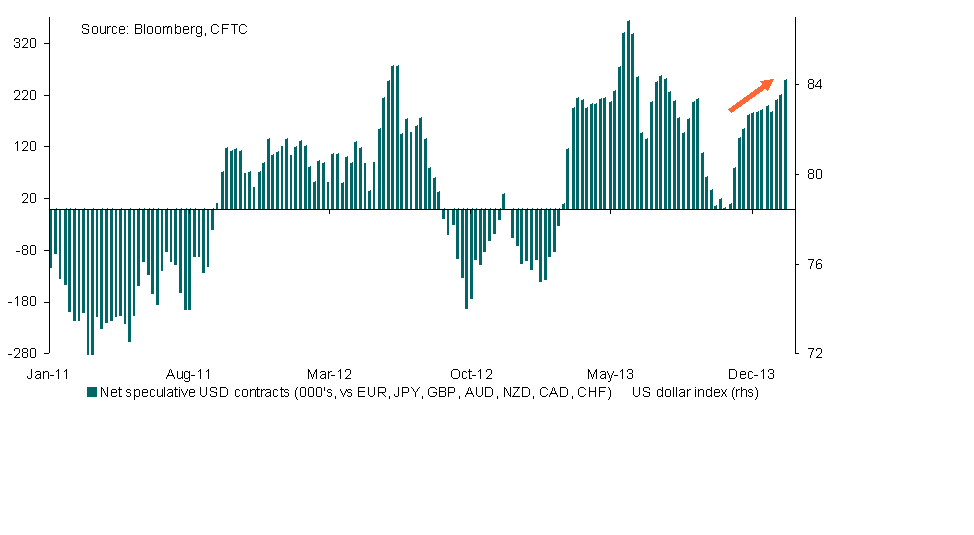
US dollar speculative positioning had increased prior to its sell off
January 27, 2014 — Mitul Kotecha
Risk and carry attraction increasing
July 4, 2012 — Mitul KotechaThe outcome of the EU Summit together with hopes of monetary stimulus has definitely helped to put a floor under risk appetite. Indeed, such monetary stimulus expectations are reflected in the price of gold which continued to rise overnight. Risk assets in general have maintained a positive tone recently and even forward looking indicators of global activity such as the Baltic Dry Index have been trending higher.
Although it is difficult to become too positive given the still very significant downdraft to global growth officials in Europe have bought some time to get their collective house back in order. Whether they will use it wisely is another question entirely. It is difficult to see much of a market move ahead of the ECB Council meeting and US June jobs report this week. Moreover, the US Independence Day holiday will keep trading subdued today.
My Risk Barometer has moved back into ‘risk neutral’ territory following several weeks of remaining in ‘risk hating’ territory. Consequently the backdrop for risk currencies has turned positive. Although FX trading has become more subdued amid summer conditions and a US holiday today as reflected in the drop in implied volatilities, there is a clear sense that investors are increasingly moving into carry trades.
My Yield Appetite Index {YAI) has surged over recent weeks, now at its highest in several months. I remain concerned that markets are addicted to stimulus while underlying economic conditions remain weak as likely revealed in today’s releases of June service sector purchasing managers’ indices in Europe.
Nonetheless, it seems likely according to my risk measures that the current tone of risk / carry attraction will persist for some weeks to come. The currencies that will benefit in an environment of improving risk appetite / yield attraction are the ZAR, MXN, PLN, CAD & NOK by order of magnitude of correlation with our risk barometer.
However, the beneficiaries are by no means limited to these currencies. Almost every currency except the ARS and PHP has a statistically significant correlation with the risk barometer. The only currencies that come under pressure as risk appetite improves are the USD and JPY given their negative correlations.
Currencies with healthy carry such as the AUD, which broke above its 200 day moving average versus USD overnight, will be even bigger beneficiaries as investors pile into carry trades over coming weeks as indicated by the jump in our YAI.
Notably there is plenty of scope to build carry positions as our speculative measure of yield attraction (based on CFTC IMM data) remains relatively low, suggesting that leveraged investors have still not jumped on the carry bandwagon.
Euro pain, Australian and New Zealand dollars vulnerable
February 28, 2012 — Mitul KotechaEUR appreciation has been painful for many, especially those looking for a turn in the currency over recent days. Unfortunately, for these investors, the EUR may yet strengthen further in the short term before any reversal is seen. Indeed, using valuations to justify a bearish view may not be a particularly strong argument at present given that the EUR trade weighted index is trading close to its historical average level while IMM data reveals that the speculative market remains significantly short EUR.
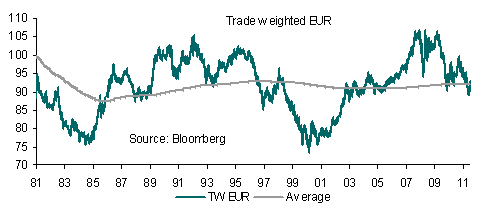
Additionally, my quantitative models reveal that the short term ‘fair value’ for EUR/USD is close to 1.40. While longer term fair value is undoubtedly much lower, it could take some time before the EUR declines to such levels. This is not encouraging news for EUR bears but there are some signs that the upmove in EUR/USD may not persist. Currently EUR/USD is trading above its 100-day moving average but since July last year, it has failed to remain above its 100 day moving average level for more than a few days.
There are definite signs that commodity currencies are topping out. Both the AUD and NZD have failed to extend gains over recent weeks. Perhaps valuation concerns are finally begging to catch up with these currencies (both are close to 2 standard deviations from average purchasing power parity while my quantitative models reveals a divergence with short term fair value) while speculative positioning according to IMM data remains at high levels. AUD and NZD even look stretched relative to interest rate differentials.
A wider than forecast January trade deficit in New Zealand did not bode well for the NZD but near term direction for both currencies will still depend on the gyrations in risk appetite given the strong correlation that both AUD and NZD have with risk aversion. Notably the the improvement in risk appetite has stalled in February, leaving AUD and NZD exposed to lofty valuations.
EUR capped, NOK strength overdone
February 22, 2012 — Mitul KotechaThe positive reaction to the Greek bailout deal failed to gain traction leaving risk assets under a degree of pressure. The fact that the deal was highly expected played a role in the unenthusiastic reaction but markets may also be cautious given the major tasks that still like ahead including a tough reform timetable for Greece, parliamentary approvals in various countries and implementation of the debt swap.
EUR looks stretched. The lack of follow through in terms of EUR upside suggests that the currency will struggle. The news of the deal came as a relief to markets but after so many days of negotiations failure to agree would have been inconceivable. However, the aftermath has seen renewed doubts creep into the market especially given the short time horizon (just nine days) for Greece to implement reform measures.
Market positioning suggests that there is still scope for some EUR upside but I doubt that the deal will be sufficient to prompt a big wave of short covering. Eurozone fundamentals remain weak and if anything the exercise in forming an agreement about Greece has revealed various splits within the Eurozone. Superior US growth expectations plus relatively higher US bond yields suggest EUR will struggle to extend gains in the medium term. Short term EUR/USD gains are likely to be capped at 1.3322.
EUR/NOK has dropped sharply over recent weeks, with NOK strength accelerating in February. The currency has been the second best performer versus EUR so far this year much to the chagrin of Norwegian officials who feel that the strength in the currency will weigh on the economy. Such concerns should be taken at face value. The NOK is highly overvalued according to various measures of ‘fair value’ but I do not expect the strength in NOK to persist over the short term.
Last week, warnings from Norway‘s central bank that they are ready to act to curb NOK strength may provoke some hesitation to enter long NOK positions especially as weakening economic growth will only strengthen the resolve of officials to prevent excessive currency strength. The NOK is sensitive to risk aversion and any correction in the recent rally in risk appetite could render the NOK highly vulnerable to renewed weakness.
EUR/JPY set to slip further
January 9, 2012 — Mitul KotechaThe EUR looks set to plumb lower over coming weeks but how quickly will it fall given that market positioning is already at record low levels? The absence of official investors such as central banks who are normally strong buyers of EUR on dips, helped to pull the rug from under the EUR, resulting in a fairly sharp lunge lower. While it is easy to jump on the bandwagon expecting a further sharp fall this week, it may be worth taking some caution given the extent of short market positioning.
Admittedly officials in Europe are not too worried, and quite rightly so, given that the currency remains overvalued and still far too strong. Moreover, FX options market have also not reacted too much to the move, suggesting that for most, the decline in the EUR is not something to be too excited about. The underperformance of European data releases relative to the US over recent weeks adds further ammunition to those calling for a weaker EUR and assuming this divergence in data performance continues, the EUR will find it difficult to sustain much of a recovery.
Meanwhile the JPY continues to remain firm despite the generally firm USD tone this year. The JPY did give up some ground at the end of last week but shows little inclination to head back above the 78.0 level. Japanese official worries about JPY strength were evident in comments from Finance Minister Azumi who rolled out the usual mantra that they were watching FX market closely. He also expressed growing concerns about the drop in the EUR, highlighting concerns about the impact on Japanese exports as EUR/JPY drops to multi year lows.
Unfortunately for Japanese officials it appears that the EUR will get weaker and at least over the short term, the JPY stronger. EUR/JPY looks set to drop to its October 2000 low around 89.00 over coming weeks against the background of continued pressure in the Eurozone and elevated risk aversion.
Share this blog

 ECONOMETER