Risk trade rally fizzles out

The risk trade rally spurred by China’s decision to de-peg the CNY fizzled out. The realization that China will only move very gradually on the CNY brought a dose of reality back to markets after the initial euphoria. The fact that unlike in July 2005 China ruled out a one off revaluation adds support to the view that China will move cautiously ahead with CNY reform. In addition, renewed economic worries have crept back in, with particular attention on a potential double dip in the US housing market following a surprise 2% drop in existing home sales in May.

European banking sector woes have not disappeared either with S&P raising the estimate of writedowns on Spanish bank losses, whilst Fitch ratings agency noted that there is an increased chance of the eurozone suffering a double-dip recession. The net impact of all of these factors is to dampen risk appetite and the EUR in particular.

The UK’s announcement of strong belt tightening measures in its emergency budget did not fall far outside of market expectations. The budget outlined a 5-year plan of deficit reduction, from 11% of GDP in 2009-10 to 2.1% of GDP in 2014-15. The main imponderable was the response of ratings agency and so far it appears to have been sufficient not to warrant a downgrade of the UK’s credit ratings. Fitch noted that the “ambitious” plan ensured that the UK would keep its AAA credit rating. The emergency budget and reaction to it has been mildly positive for GBP, which has shown some resilience despite the pull back in risk currencies.

The recent rally in Asian currencies is looking somewhat overdone but direction will come from gyrations in risk appetite and the CNY rather than domestic data or events. Encouragingly equity capital flows into Asia have picked up again over recent weeks, with most countries with the exception of the Philippines registering capital inflows so far this month, led by India and South Korea.

China’s CNY move may attract more capital inflows into the region, suggesting that equity capital flows will continue to strengthen unless there is a relapse in terms of sovereign debt/fiscal concerns in Europe. Nonetheless, central banks in the region will continue to resist strong FX gains via FX interventions, preventing a rapid strengthening in local currencies.

Although India and Korea have registered the most equity inflows this month, both the INR and KRW have had a low correlation with local equity market performance over recent weeks. In fact the most highly sensitive currencies to their respective equity market performance have been the MYR and IDR both of which have reversed some of their gains from yesterday. USD/MYR will likely struggle to break below its 26th April low around 3.1825 whilst USD/IDR will find a break below 9000 a tough nut to crack.
Renewed concerns

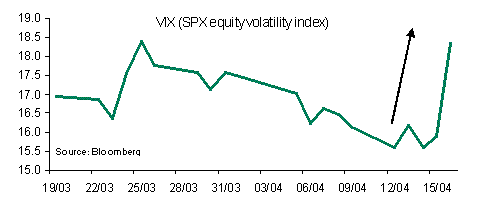
Despite some positive US data, with both the May ISM manufacturing index and April construction spending coming in stronger than forecast, market sentiment soured. The relative calm that was exhibited at the end of May is giving way to renewed fears as equity markets weaken, volatility increases and risk aversion intensifies. Risk trades are set to remain on the back foot, with the EUR likely to remain the weakest link. After testing support close to 1.2110 EUR/USD bounced but remains vulnerable to a fresh test of this level in the short-term.

A combination of concerns including rumours of ratings downgrades, with France the new target, Middle East tensions, weaker Chinese manufacturing activity and worries about increasing bank writedowns in Europe, have conspired to drag markets lower. The failure to stem the hue oil-leak in the US contributed to the malaise as the US government announced a criminal probe.

For the most part, data releases were unhelpful to risk appetite as the majority of global purchasing managers indices (PMIs) slipped in May, led by China. Only a few increased, including India and notably Ireland, whilst the Spanish and Greek PMIs fell. Although the US ISM index slipped the components looked positive, especially the employment component which moved higher, suggesting some upside potential for Friday’s May payrolls data for which we look for a 500k increase.

A picture of divergence appears to be growing in the eurozone, which will act as another source of pressure on the EUR. Germany’s outperformance is widening as reflected by the fact the German unemployment dropped to 7.7% in May in contrast to a rise in eurozone unemployment, to 10.1%. Moreover, Germany was the only country where its PMI was actually revised higher relative to the flash reading. There are also growing divisions within the European Central Bank (ECB), in particular towards the purchase of government bonds, with German ECB members particularly critical.

What To Watch This Week

Well so much for a “risk on” week. Market sentiment soured at the end of last week following The US Securities and Exchange Commission (SEC) civil action against Goldman Sachs, in which they accused the bank of fraud. The impact reverberated across markets and risk trades were pulled back as a consequence. Bulls shouldn’t be too downhearted though as the drop in risk trades followed several days of gains and part of the pullback could be attributed to profit taking.

Speculation of similar probes in Europe by financial regulators will cast a shadow over markets early this week. Nonetheless, direction will at least in part come from earnings. So far the run of earnings looks upbeat, with around 83% of the 48 S&P 500 companies reporting, beating analysts’ estimates. Overall profits are forecast to increase by around 30% from a year ago but are on track to easily beat this estimate. Bellwether names including IBM, Apple, Coca-Cola, Boeing, Microsoft, and AT&T report this week.

The meeting between Greek officials, ECB, IMF and EU has been delayed until Wednesday. There is little likelihood of Greece seeing any loan money soon as the need for parliamentary approval in some EU countries and upcoming regional elections in Germany on 9 May will put a spanner in the works. An issue of EUR 1.5bn of 3-month Greek debt tomorrow will act another test of market confidence but the recent widening in Greek debt spreads suggests a less positive reception than the previous sale.

There are also a few central bank meetings to contend with this week including Canada, Sweden, India, Philippines and Thailand. The only Bank likely to hike interest rates out of this bunch is the RBI in India with another hike expected, following closely on the heels of the March move. Canada and Sweden are unlikely to shift policy until at last after the end of Q2 whilst protests in Bangkok, Thailand, and the knock on impact on consumer confidence, have effectively sealed the case for no rate move there.

On the data front, attention will turn to US housing market activity. Markets will be able to gauge further clues to whether recovery in the housing market has stalled. An increase in both existing (Thu) and new home sales (Fri) in March is expected, which may allay some concerns although any improvement is likely to continue to fragile against the background of tight credit and high foreclosure levels.

In Europe, aside from the ongoing Greek sage, sentiment surveys will garner most attention, with the release of the German ZEW (Tue) and IFO (Fri) surveys as well as manufacturing and service sector purchasing managers indices (PMIs) across Europe. On the whole the surveys are likely to reveal some improvement as confidence.

Risk aversion will be slightly elevated at the beginning of this week but strong earnings and improving data will help to prevent too much damage. Consequently Risk currencies will start the week under pressure but any pullback will be limited. Given that speculative positioning in risk currencies such as the AUD, NZD and CAD is well above their three-month average according to the latest Commitment of Traders’ IMM data there will be some scope for profit taking. EUR speculative sentiment has seen some improvement but EUR/USD remains vulnerable to a further pull back to technical support around 1.3302 this week.

Shaping up to be a “risk on” week

It’s most definitely turning into a “risk on” week. On the earnings front both JP Morgan Chase and Intel beat forecasts whilst data releases did not disappoint either. In particular, US retail sales came in much stronger than expected. The Fed’s Beige Book also gave markets some good news to chew on. The reports from the twelve Federal Reserve Districts noted that economic activity “increased somewhat” since the March 3rd report.

The positive tone will continue today with the release of the March industrial production data, expected to show a strong gain over the month (consensus 0.7%), whilst both the Empire State and Philly Fed manufacturing surveys are set to post small gains in April, consistent with strengthening manufacturing activity in the months ahead.

Fed speakers have also been helpful for market sentiment. Fed Chairman Bernanke sounded a little more upbeat on the economy but highlighted the “significant restraints” remaining in the US economy. Bernanke maintained the “extended period” of low rates statement despite some speculation that the Fed was verging on removing this. The net impact of the testimony, improved data and earnings and firmer risk appetite is to keep the USD on pressure. In contrast, commodity currencies including AUD, NZD and CAD, will benefit, both from firmer risk appetite and an upturn in commodity prices.

Despite the positive reception to Greece’s debt auction there is not a lot of faith in the ability of Greece to weather the storm. Reports that Greece will need far more funding than has been initially promised by the EU/IMF – potentially as high as EUR 90 billion over coming years – together with worries about selling the loan package to the public in Germany and other eurozone countries, as well EU comments that Portugal will need further fiscal consolidation, have not done much good for confidence. Technically EUR/USD will see plenty of resistance around 1.3692.

After Singapore’s move to tighten monetary policy via the SGD revaluation, and following close on the heels of India, Malaysia and Vietnam, attention has turned to who’s next in line. South Korea must be a prime candidate, especially following data yesterday revealing a drop in the unemployment rate. Of course, China is very much in the spotlight and is set to embark on monetary tightening measures as well as CNY revaluation soon.

India is set to move again as early as next week, with inflation data today likely to seal the case for another hike (consensus 10.37% in March). The risk remains however, that many Asian central banks are moving too slowly to curb building inflation pressures and may find that they ultimately need to tighten more than they otherwise would have done.

China’s heavy slate of data released will if anything fuel greater expectations of an imminent CNY revaluation as well as monetary tightening. China’s economy grew a very strong 11.9% in Q1, above already strong consensus expectations, whilst CPI rose 2.4% YoY in March.

The growth data alongside further evidence of accelerating real estate prices highlight the risks of overheating in the economy and the need to act quickly to curb inflation threats. Given this expectation, firm risk appetite, and more follow through from Singapore’s FX move, the outlook for other Asian currencies remains positive.

Q1 Economic Review: Elections, Recovery and Underemployment

I was recently interview by Sital Ruparelia for his website dedicated to “Career & Talent Management Solutions“, on my views on Q1 Economic Review: Elections, Recovery and Underemployment.

Sital is a regular guest on BBC Radio offering career advice and job search tips to listeners. Being a regular contributor and specialist for several leading on line resources including eFinancial Careers and Career Hub (voted number 1 blog by ‘HR World’), Sital’s career advice has also been featured in BusinessWeek online.

As you’ll see from the transcript of the interview below, I’m still cautiously optimistic about the prospects for 2010 and predicts a slow drawn out recovery with plenty of hiccups along the way.

Sital: Mitul, when we spoke in December to look at your predictions for 2010, you were cautiously optimistic about economic recovery in 2010. What’s your take on things after the first quarter?

Click here to read the rest…