For A Few Dollars More…

…or should I say a few EUR more.   This is what the Greek authorities must be wondering.  Once again Greek worries weighed on equities and risk appetite as a whole.  Although the saga is turning into one big yawn, markets have not had their fill with the bad news coming from this small eurozone economy.  Talks between Greek officials, International Monetary Fund (IMF), European Central Bank (ECB) and European Union (EU) began yesterday but are expected to go on for several days or weeks until a joint text is issued on May 15, just days ahead of a EUR 8.5 billion bond redemption by Greece. 
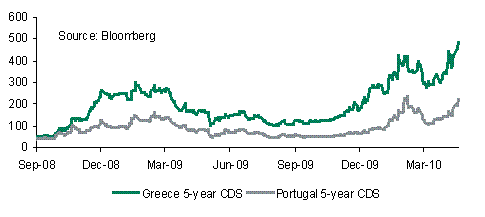
The talks have done nothing to prevent Greece’s bond yields moving higher, with the yield on 10-year bonds pushing well over 8% whilst the spread with Germany debt also blew out to over 500bps.  The main fear in the market is that Greece will ultimately end up restructuring its debt.  Moreover, contagion fears have dealt a blow to southern European sovereign CDS especially Portugal.  It wasn’t plain sailing for German bonds either, with yesterday’s auction of EUR 3 billion of 30-year Bunds failing to sell the full amount. 

Another casualty of ongoing Greece concerns is the EUR, with the currency under performing other majors and still on its path towards EUR/USD 1.3300 in the near term and onto 1.3150 after.   EUR also looks vulnerable on the crosses and EUR/GBP in particular is one to watch, with the 28 January low around 0.86029 likely to be targeted over the near term.  UK employment data gave some relief to GBP yesterday, with further direction coming from retail sales data today and the next televised leaders’ debate.  

At some point the market will become fatigued with consensus beating earnings and the positive impact on equities will become less marked.  This point is approaching but we’re not quite there yet.  Apple, Morgan Stanley and Boeing did not disappoint, with earnings easily beating forecasts.  Boeing’s earnings in particular helped industrials to be the best performing sector on the S&P 500 although the overall index closed marginally lower.

Earnings today include Amazon.com, American Express, Credit Suisse, Microsoft, Nokia, and PepsiCo.  It is becoming plainly obvious that market expectations for earnings are too pessimistic but as noted above the positive market impact of good earnings is likely to wane. 

On the data front, highlights include March existing home sales, jobless claims and Producer Price Index (PPI).   There will be less focus on PPI given that the Consumer Price Index (CPI) over the month has already been released whilst claims are likely to resume a path lower following the jump over the past couple of weeks.   Existing home sales are likely to post an impressive gain as indicated by firm pending home sales data.   

Overall, it appears that risk appetite is creeping back into the market psyche but the ongoing battle between positive earnings/data versus European/Greek woes suggests that there will be no clear direction for markets.  Improving risk appetite will ultimately win but current conditions will leave currencies trading within well worn ranges, with the exception of the underperforming EUR. In contrast the USD index is likely to remain supported, taking solace from positive data releases.

Disappointments Galore

Well the calm at the beginning of the week did not last very long.  Although the overnight price action can hardly be labelled as panic given both FX and equity volatility remain relatively well behaved, there is no doubt that worries are creeping back into the market psyche.  It seems that markets are once again trading on each piece of news and for the most part the news is not encouraging.  

A plethora of disappointments will set a negative tone for markets today.   Risk has come off the table in the wake of the worse than expected February German IFO business confidence survey and US Conference Board consumer confidence.   Cautious comments by Bank of England Governor King in which he kept the door open to further quantitative easing and a ratings downgrade of four of the largest Greek banks has added to the damage.

The German IFO was likely dealt a temporary blow by severe weather conditions.   The 10.5 point fall in US consumer confidence from an already relatively low level had no mitigating factors however, and revealed a deterioration in job market conditions, which combined with renewed weakness in jobless claims, does not bode well for next week’s US payrolls report, pointing to a decline of around 40k in February payrolls.

Overall, the market mood has darkened and there is little to turn sentiment around in the near term.  In prospect of likely weak reading for US payrolls next week and continuing worries about European fiscal/debt problems any improvement in risk appetite is likely to be limited.  This will help bond markets, the USD and JPY but most risk trades will face pressure. 

It is still worth being selective in FX markets.  The EUR remains the weak link and is set to struggle to make any headway, with upside likely to be restricted to resistance around 1.3747.  Similarly GBP is set to struggle in the wake of King’s comments as well as ongoing economic and deficit concerns, with GBP/USD vulnerable to a drop to around 1.5293.   In contrast, Asian currencies and commodity currencies look far more resilient.

What to watch this week

The 85k drop in US non-farm payrolls in December was obviously disappointing given hopes/expectations/rumours of a positive reading over the month.  There was a small silver lining however, as November payrolls were revised to show a positive reading of +4k, the first monthly gain in jobs since December 2007.  Overall, the US labour market is still gradually improving as the trend in jobless claims and other indicators show. 

The fact that the market took the drop in US payrolls in its stride highlights the fact that recovery is becoming more entrenched despite the occasional set back.  More significantly weaker US jobs disappointment has been countered by strong Chinese trade data, which showed both strong imports and exports growth in December.  Whilst the data, especially the strength in exports, will support calls for a stronger CNY, it also highlights China’s growing influence on world trade and the important role that the country is providing for global economic recovery.

Market resilience in the wake of the drop in US payrolls and positive reaction to Chinese trade data will maintain a “risk on” tone to markets this week.  In particular, the USD is set to start the week on the back foot and despite data last week showing that Eurozone unemployment reached an 11-year high of 10% and growing evidence that the Eurozone economy is falling behind the pace of recovery seen elsewhere, EUR/USD held above technical support (200 day moving average) around 1.4257, and is setting its sights on the 16 December 2009 high of 1.4591 helped by renewed Asian sovereign interest.  

The main event in the Eurozone is the ECB meeting on Thursday no surprises are expected, with the Bank set to keep policy unchanged whilst maintaining current liquidity settings.  The bigger concern for European markets is ongoing fiscal woes in the region, with press reports warning of a ratings downgrade for Portugal and still plenty of attention on Greece and its attempts at deficit reduction.  Fiscal concerns are not going to go away quickly and will clearly act as a restraint on market sentiment for European assets. 

In a holiday shortened week in the US as markets close early on Friday ahead of the 3-day MLK holiday, there are a number of data this week that will shed further light on the shape of US recovery. The main event is the December advance retail sales report on Thursday, which is expected to record a reasonable gain, helped by firm autos sales. 

Preceding this, tomorrow there is expected to be a renewed widening in the US trade deficit in November whilst on Wednesday the Fed’s Beige Book as well as various Fed speakers this week including Bullard, Lockhart, Fisher, Plosser, Evans and Lacker, will give important clues ahead of the January 27 Fed FOMC meeting.  Bullard sounded dovish in his comments in Shanghai, as he highlighted that US interest rates will remain low for some time. 

At the end of the week there will be a heavy slate of releases including December CPI, industrial production, capacity utilization, January Empire manufacturing and Michigan confidence. The outlook for these data is generally positive, with gains expected in both manufacturing and consumer confidence, whilst hard data in the form of industrial production is likely to record a healthy increase and CPI is set to reveal another benign reading.

Risk appetite firms

Risk appetite is slightly firmer at the end of the week.  US data failed to deliver much guidance on Thursday following a better than forecast trade deficit but disappointment on jobless claims. US retail sales came in better than expected on Friday, rising 1.3% and 1.2% ex-autos, likely helping the firmer tone to risk appetite.  This followed the release of a set of positive data releases in China on Friday revealing that the recovery in the country remains strong.

Fiscal concerns, especially in Europe continue to linger like a bad smell maintaining a degree of caution for markets and capping the EUR, with strong technical resistance seen around the November 20 low of 1.4794.   On this note GBP could struggle given the growing criticism of the pre-budget report on Wednesday.   However, worries about a ratings  downgrade have eased somewhat following comments from Moody’s that there was no threat to UK or US ratings for now, which has given GBP some likely short-lived breathing room.

I still favour AUD and NZD and out of the two NZD looks the better, especially given further likely unwinding of long AUD/NZD positions into year-end.  Markets will continue to ignore jawboning by RBNZ governor attempting to talk down the kiwi and focus on the shift in rhetoric following the RBNZ meeting pointing to an earlier rate hike than previously indicated.    However, the sharp drop in AUD/NZD over recent days has brought the currency cross back in line with my regression model estimates, which suggests that much of the pull back has already taken place.  The JPY is the main casualty of the improving trend in risk appetite edging back towards the 90.0 level.

Caution ahead of US payrolls

The weaker than forecast November US ISM non-manufacturing, a negative UK press report about the problems in Dubai and caution ahead of the US jobs report have dampened risk appetite overnight though there is expected to be little action until the release of the US jobs report today, with some USD short covering likely ahead of the release.  The jobs data could add to disappoint, with data this week including the ADP jobs report, and the employment components of the ISM surveys consistent with a worse than consensus (-125k) reading.  

It was encouraging however, that jobless claims revealed a further decline (457k) to its lowest since November 2008 indicating further improvement in the jobs market, though the data will have little bearing on today’s payrolls data which as noted above will likely disappoint expectations.  A below consensus may fuel some increase in risk aversion and a slightly firmer USD though markets are most likely to settle into ranges in the near term. 

The JPY may make up some lost ground against the background of weaker equity performance.  Amidst the confusing messages on the JPY over recent weeks officials appear to be giving stronger hints at intervention, leaving the currency on the back foot over recent days.  The drop in the JPY may prove temporary however, if official rhetoric is not followed up by action; USD/JPY is likely to struggle to break through resistance around 88.60.  

Following the BoJ’s disappointing JPY P10 trillion operation announced this week attention turns to the announcement of new government stimulus measures which were reportedly expected today.  This may also prove disappointing however, as there appears to be disagreement between coalition partners on the size and composition of stimulus.  Finance Minister Hatoyama was expected to announce additional spending of up to JPY 4 trillion.  

There was no surprise that the ECB left the refi rate unchanged at 1% yesterday but some surprise in the steps to withdraw provision.  The ECB announced that the interest rate on the December 12-month tender will be indexed to the refi rate and that the full allotment at most of the ECB’s refinancing operations is extended until 13 April 2010 only. As much as ECB President Trichet tried to play down the perception that the steps were a signal of a tighter policy markets are unlikely to interpret it this way. 

Despite the shift in the ECB’s stance EUR/USD pared gains after reaching a high around 1.5141 but failed to test resistance at 1.5150 which is likely to provide strong resistance in the days ahead, reflecting the fact that markets had priced in a hawkish shift by the ECB already.   Going forward, if the market perceives the ECB as prematurely shifting towards a more hawkish stance against the EUR could suffer rather than find any support from such actions