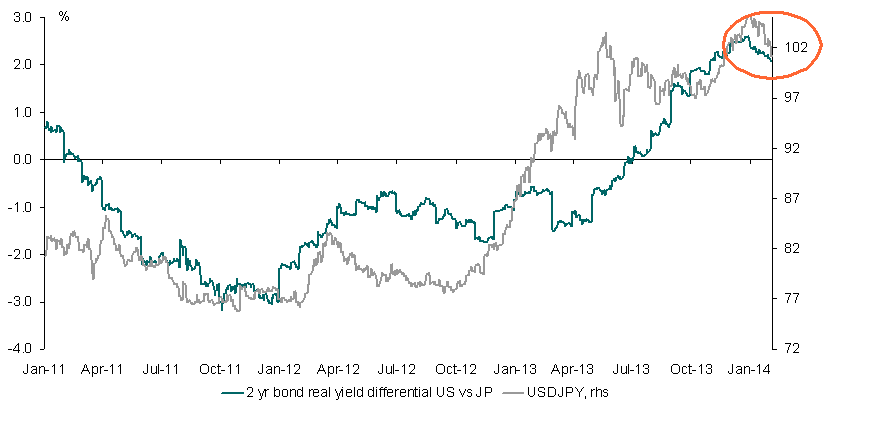
Japanese yen firms as US yields drop

USDJPYyielddiff

Safe haven currencies in particular the JPY and CHF remain well supported, with the former resting on its 100 day moving average around 101.10 versus USD. USD/JPY is set to remain under downward pressure but will face some difficulty in sustaining a move below 101.10 unless US bond yields slip further narrowing the US yield differential with Japan; the yield differential between 10 year US Treasuries and 10 year Japanese JGB yields has already dropped by around 89 basis points since the start of the year.

The drop in Japanese equities has also corresponded to upward pressure on the JPY, with the Nikkei among the worst performing stock markets so far this year. The prospect of further equity weakness suggests that JPY will not resume a weaker trend anytime soon.

Posted in Japan. Tags: , . Leave a Comment »

USD/JPY biased higher within a tight range

After hitting a low around 101.77 yesterday USD/JPY rebounded. USD/JPY short term range is seen at 101.62-103.58. Bias for more short term USD/JPY upside. The bounce in US 10 year Treasury yields overnight will give the USD some support versus JPY.

A combination of a sharp decline in US Treasury yields (narrowing the yield differential with Japan) and elevated risk aversion (my risk barometer has breached its upper band) had pushed the JPY higher.

The close to 30 bps drop in US 10 year yields since the start of the year looks excessive however, and assuming the Fed continues to taper at tomorrow’s FOMC meeting I see little reason for US bond yields to drop much further, suggesting more limited scope for JPY upside versus USD from current levels.

The only caveat is risk aversion. Given that emerging market tensions are unlikely to ease quickly there will be scope for sharp bouts of safe haven JPY buying as risk aversion intensifies.

JPY and EUR find support

Rising risk aversion is supporting the JPY but the currency may also be finding some support from the misplaced view that the Bank of Japan may not need to be any more aggressive in its policy stance to reach its 2% inflation target, with Japan’s finance minister noting that deflationary conditions have almost ended. Such talk looks premature.

Japan still has a long way to go to reach and sustain inflation at its target. The risk is that without any structural reforms (jobs market, manufacturing sector, immigration) deflation and slower growth could quite easily take hold again. In any case, the Bank of Japan is likely to embark on more aggressive policy in the months ahead in order to achieve the 2% target. In the near term USD/JPY looks supported around 102.50.

The EUR found some additional support from a strengthening in manufacturing confidence in the region, which highlighted that economic recovery continues to take shape. Fitch’s affirmation of Germany’s credit ratings at AAA has also helped sentiment towards the currency.

In the near term much of the same tone is likely although the relatively stronger US economic performance and tapering expectations will mean the USD will not fall too far. EUR/USD will face technical resistance around its 2014 high at 1.3776.

Lower US yields undermine the US dollar

A drop in US yields has undermined the USD over recent days against major currencies although emerging market currencies remain under varying degrees of pressure. US 10 year Treasury yields have fallen by around a quarter of a percent since the end of last year, acting as a real drag on the USD.

A rise in risk aversion over recent days (the VIX fear gauge has risen by over 13% since its low on 10 January) appears to have resulted in increased demand for Treasuries and weaker equities, with markets ignoring generally firmer than anticipated US economic data this week including weekly jobless claims and existing home sales.

Emerging market currencies have come under strong pressure while the usual safe havens have strengthened most against the USD in particular CHF and JPY. The EUR has also made up some ground. Fortunately for the USD expectations of Fed tapering continue to fuel some buying of the currency, constraining any downside. Nonetheless, until US Treasury yields resume their upward movement the USD’s upside momentum will be limited.

USD firm versus EUR but not against JPY

Finally back in the office after two weeks of traveling and it appear that the upside momentum for equity markets has definitely waned. Concerns about the pace of growth, earnings and valuations finally appear to have caught up with stocks. Meanwhile US Treasury yields have remained under downward pressure since the release of the disappointing US December jobs report despite some encouraging data since. In Asia China’s GDP release for Q4 reveaked some loss of momentum, with growth decelerating to 1.8% QoQ. Nonetheless, the annual pace of growth looked reasonably healthy at 7.7%, suggesting a limited reaction in markets today.

A US holiday today will likely keep a cap on market activity today but there will be plenty of Q4 earnings reports over coming days to give further direction. In terms of policy decisions the Bank of Japan and Bank of Canada will likely keep policy unchanged following their policy decisions this week. The BoC is faced with inflation well below target while the BoJ continues to battle to push inflation towards its 2% target. Both central banks will maintain easy policy.

On the data front there is very little of note in the US to focus on, with the main release the December existing home sales report on Thursday where a rebound of 1% is expected. European data releases may prove to be more interesting, with the release of flash purchasing managers indices on tap. Further gradual gains are likely to be registered in January although there will be attention on France which has lagged other countries.

Ratings decisions by Moody’s and Fitch on Germany and France, respectively, will also garner some attention. Rumours of a German downgrade are likely to prove unfounded. In the UK the Bank of England MPC minutes will be is likely to reveal an unchanged outcome of voting to keep policy unchanged although the BoE is likely to adjust its guidance soon reflecting the quicker than anticipated fall in the unemployment rate.

The USD looks well placed to extend last week’s gains, especially against the EUR, with a drop below 1.3500 on the cards. Disinflation pressures and relatively soft growth highlight the potential for easier monetary policy. A variety of options for the ECB are on the cards but the EUR will struggle to make headway given expectations of more ECB action. Additionally the EUR appears to be benefiting less from reserves recycling flows, especially given that Asian central bank reserves accumulation has likely to have slowed. The deterioration in speculative positioning reflects the deterioration in sentiment for the currency.

In contrast USD/JPY will struggle too push higher given the drop in US Treasury yields. Additionally weaker Japanese stocks will not help given the correlation between the Nikkei and JPY. The Bank of Japan meeting this week will not give much support for a further move higher in USD/JPY given expectations of an unchanged outcome. Some consolidation around 104.00 is likely over the short term, with upside limited to technical resistance around 104.92.

I fly off to Mumbai tonight for the last leg of our Asia roadshow presentation series. Hopefully my next post can shed some light on the recent stability of the Indian rupee.