Euro on the front foot

The G20 meeting of leaders in Mexico over the weekend did not make much progress in terms of increasing the size of the International Monetary Fund (IMF) or increasing support for the Eurozone. A decision on this has been delayed until the next meeting on 19-20 April. Instead attention has turned to the various bailout votes across Eurozone countries and discussions over increasing the firewall (by boosting the size of the bailout fund) around the Eurozone periphery. Germany continues to oppose any increase in the firewall. Sentiment will hinge this week on the outcome of these events rather than data releases.

The USD has come under growing pressure but this is as reflection of a stronger EUR rather than inherent USD weakness. Data releases in the US have continued on a positive track yet the USD has failed to benefit as higher US bond yields have been matched elsewhere. Business and consumer confidence measures over coming days are also likely to reveal some encouraging outcomes while the Beige Book will report improvement in economic activity but the USD will continue to be restrained.

The EUR is looking increasingly stretched from a fundamental perspective yet technical indicators show it to be on a stronger footing. EUR/USD will find strong resistance around the 1.3550 level and the currency could still stumble over coming days depending on the outcome of Wednesday’s ECB Longer term refinancinf operation (LTRO).

Various policy events will also help dictate EUR direction including national parliamentary votes on the Greek bailout and the EU Summit. Theoretically a large uptake by banks at the LTRO could result in more EUR liquidity and a weaker EUR but the reality is quite different. Improved sentiment in peripheral bond markets as LTRO funds are used to buy local debt are helping the EUR to push higher, with its short covering rally gaining more traction.

GPB has come under pressure in the wake of a stronger EUR, but we still expect EUR/GBP’s charge to falter. My quantitative models show that the currency pair is overbought and we will likely struggle to break above 0.85. If it does, EUR/GBP 0.8562 will prove to be a strong resistance level. UK data this week will likely give some support to GBP, with the manufacturing purchasing managers index (PMI) set to strengthen further. However, the release of a relatively dovish set of Bank of England (BoE) Monetary Policy Committee (MPC) minutes has helped to undermine GBP for the time being, meaning that any recovery will be limited in the near term.
Agreement at last!

Greek politicians finally agreed on further austerity cuts totalling EUR 3.3 billion in order to secure a second bailout package. European official discussions now centre on the details of the bail out package, targeting a cut in Greece’s debt to GDP ratio to 120%.

However, the fact European Finance Ministers have withheld more funds for Greece until the austerity measures begin to be implemented suggests further uncertainty on the horizon. A Greek parliamentary vote set to begin this weekend may see some progress but markets will trade cautiously ahead of the vote.

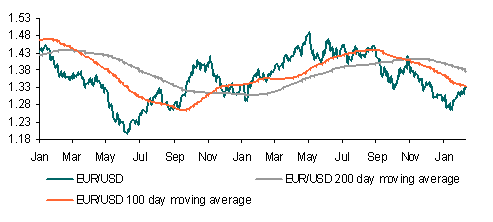
EUR/USD rallied to a high of around 1.3322 but failed to break above its 100 day moving average at 1.3332 following the agreement. As expected the ECB offered no help to the EUR, with market attention continuing to centre on the second 3-year LTRO on 29 February.

The fact that there are still various issues to be resolved means that upside for EUR will be limited in the short term. In any case the currency was already pricing in a lot of good news. EUR/USD will face major resistance around 1.3388.

Notably risk measures are edging higher once again, implying some pressure on risk assets in the near term. Markets today will digest the status Quo from the European Central Bank and an additional but expected injection of GBP 50 billion in quantitative easing from the Bank of England. December US trade data and February Michigan confidence are the only data of note suggesting limited price action ahead of the Greek parliamentary vote.

Euro pricing in a lot of good news

Markets remain in limbo ahead of a potential Greek debt deal although US equities managed to eek out small gains overnight. Stocks in the US have entered a bull market helped by the dovish stance of major central banks.

The Federal Reserve’s commitment to maintain accommodative policy until the end of 2014 and the European Central Bank’s (ECB)3 year LTRO have been drivers of the rally in risk assets. The BoE will contribute to the easy stance of central banks, with an increase in UK quantitative easing set to be announced today. The ECB in contrast is set to remain in status quo.

Will it be a buy on rumour, sell on fact reaction for the EUR to a Greek debt deal? Over recent days anticipation has grown that a deal on debt writedowns and in turn a second bailout package will emerge soon. This has helped to propel EUR/USD higher, with the currency hitting a high of 1.3289 overnight.

So far a deal has been lacking but leaders are expected to approve a draft agreement on fresh austerity measures between the main Greek political parties today. This should pave the way a deal on debt restructuring and a new loan package for the country due to be discussed today between Eurozone finance officials.

However, the EUR has already priced in a lot of good news on this front and even agreements on the issues above may not see the currency push much higher, with strong resistance around EUR/USD 1.3388. Separately today’s ECB meeting is unlikely to provide much direction for the EUR, with the Bank set to maintain current policy settings.

USD/JPY has managed a recovery of sorts but still remains in the middle of multi month 75.5-78.5 range. Nonetheless, the momentum over the short term will continue to be for USD/JPY upside, with resistance around 77.49 targeted. News that the Japanese authorities conducted ‘stealth intervention’ to weaken the JPY in late October/early November will have emboldened JPY bears.

However, at the same time they should also be worried as it is clear that even after all the intervention the JPY remains overly strong. Reflecting this is the fact that speculative and margin trading JPY positioning is at a very high level.

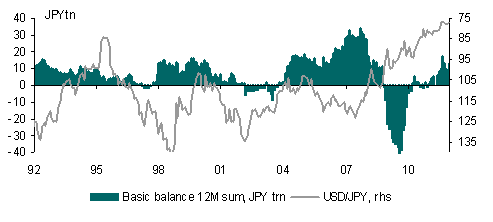
Moreover, while much has been made of the deterioration in Japan’s current account balance over recent months and the potentially negative impact on the JPY it should be noted that Japan’s basic balance (sum of direct investment + current account + portfolio flows) position remains healthy (for now) and is acting as an obstacle to JPY weakness.