Double-dip fears pressure USD

Markets have found it hard to decide whether to sell the USD due to weaker economic data or buy it on higher risk aversion, but the moves overnight were clear; the USD sold off sharply in the wake of a run of soft data releases. Four separate US releases came in below consensus yesterday, with the June ISM, jobless claims, pending home sales and domestic vehicle sales, all disappointed to varying degrees, especially pending home sales, which dropped an astonishing 30% in June.

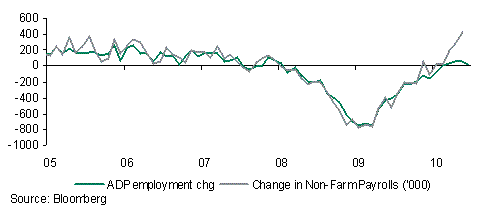
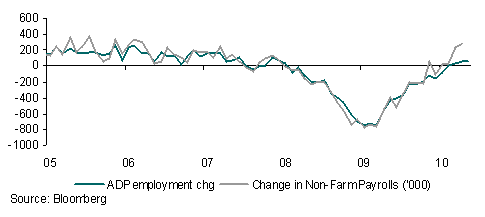
The news could have been much worse today, with the release of the US June jobs report. Following the 13k increase in the June ADP employment count the consensus forecast for nonfarm payrolls looked way too optimistic; consensus expectations were for a 130k drop in payrolls according to Bloomberg, with estimates ranging from 0 to -250k. In the event payrolls dropped by 125k and the unemployment dropped to 9.5%, an outcome that was not as bad as feared.
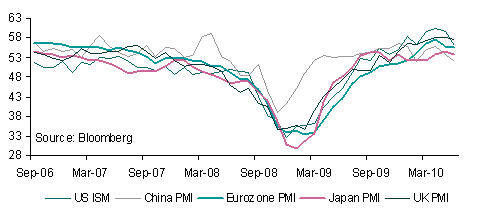
It was not just the US ISM that slipped, but a host of global purchasing managers indices (PMIs) weakened in June including China and India, supporting the view that economic activity will lose momentum in H2 2010. Before we all get too carried away it is worth noting that most manufacturing surveys are coming off a high level.
Nonetheless, for once it wasn’t European concerns that sparked an increase in risk aversion as eurozone banks borrowed less than feared from the ECB, and the Spanish bond tender passed off relatively well, factors that helped EUR/USD jump above 1.25000. Although I remain bearish on the prospects for the EUR over coming months, there may be some further near term upside, with EUR/USD 1.2675, the next resistance level in focus.

As a consequence of US double-dip fears, risk aversion remains at a high level, with US bond yields and commodity prices dropping sharply, leaving commodity currencies sharply lower. In the current environment the USD is likely to be sold on rallies.

On the commodity currency front, AUD/USD may find some relief from the news of a compromise on a proposed mining tax, but the weight of risk aversion will limit any rebound, with my preference to play AUD upside versus NZD. The main concession from Australian Prime Minister Gillard reduce was to reduce the tax to 30% for iron and coal, whilst retaining the 40% tax for oil and gas projects. The agreement likely increases the chance of an election in Australia in the next couple of months as Gillard capitalises on a popularity bounce. Fresh elections could be another factor that limits AUD upside over coming weeks.
Euro Has That Sinking Feeling

The reaction to the US May jobs report shows that markets are particularly susceptible to negative US news at a time when growth fragilities in Europe are becoming increasingly apparent. Coupled with worries about Hungary, risk aversion has jumped.

Unsurprisingly the EUR took the brunt of pressure. Rhetoric over the weekend may help to assuage some fears but I suspect it is too late now that the cat is out of the bag. Hungary’s government maintained that it will meet this year’s budget deficit target of 3.8% of GDP. European Union officials also attempted to calm market concerns, downplaying any comparison of Hungary to Greece.

The overall EUR/USD downtrend remains intact. Renewed doubts about German participation in the EU/IMF rescue package, with the German constitutional court potentially blocking its contribution, will add to pressure as well as a UK press report titled EUR ‘will be dead in five years’ . The January 1999 EUR/USD introduction level around 1.1830 has now moved squarely into sight.

It is unlikely that data and events this week will do much to reverse the market’s bearish tone. Highlights include the ECB, BoE and RBNZ meetings in Europe, UK and New Zealand, respectively. The ECB (Thursday) is highly unlikely to shift its monetary policy stance. Given some opposition to bond purchases from within the ECB council the comments in the accompanying statement will be closely monitored. The BoE will also leave policy unchanged on the same day but the RBNZ is set to begin its hiking cycle with a 25bps move.

On the data front the US slate includes the Fed’s Beige Book, April trade data, May retail sales and June Michigan confidence. The Beige Book is likely to reveal some improvement in activity with little sign of inflation, whilst the trade deficit is set to widen further due to a higher oil import bill. Retail sales will reveal an autos led increase in the headline reading but more subdued core sales, whilst consumer confidence is set to rise for a second straight month.

There will be more attention on rhetoric from EU officials rather than eurozone data, with the Eurogroup of Finance Minister’s and Ecofin meetings garnering more interest. In Japan, politics will take centre stage, with the new cabinet line up in focus following the confirmation of Naoto Kan as Prime Minister. Comments by the new PM himself will be of interest, especially with regard to combating deflation and in particular any elaboration on his penchant for a weaker JPY.

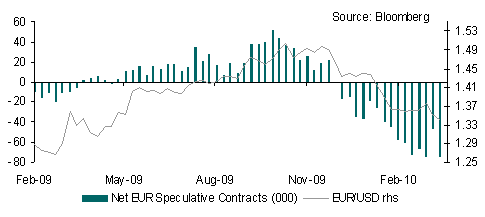
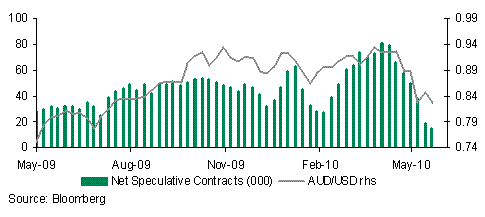
All-in-all, the week is unlikely to see a let up in pressure on risk trades and will start much as the last week ended. Although the market’s attention is on the EUR, it should be noted that the AUD has lost even more ground so far this month although the EUR remains the biggest loser in terms of major currencies so far this year (vs USD). In the case of the AUD the move reflects a massive unwinding of long positioning (as reflected in the latest CFTC IMM data which shows that speculative AUD positioning has dropped to its lowest since March 2009).

In contrast in the case of the EUR where positioning is already very negative, the move simply reflects deteriorating fundamentals. The fact that European officials are showing little concern about the decline in the EUR (why should they given that the currency is now trading around fair value) and in some cases encouraging it, suggests that there is little to stop EUR/USD from dropping much further and parity is looming a lot closer.

What A Disappointment!

Ok so after talking up US data releases over recent weeks the big one namely the May jobs report, came as a disappointment. To recap, payrolls rose 431k, which was less than market consensus. Hiring due to the census which by its nature will be transitory was however, in line with expectations, at 411k, leaving ex-census hiring at a measly +20k.

Believe it or not, the trend in payrolls is one of improvement but the May outcome came as a blow to a market with bullish expectations, especially following earlier comments from the US administration hinting at a robust outcome. The disappointment was compounded by talk of a +700k payrolls outcome, which proved widely off the mark. The unemployment rate did drop more than expected, by two ticks to 9.7%, but this was due to disaffected workers dropping out of the labor force rather than an inherent pick up in job conditions.

Combined with worries about a new target in the sovereign debt crisis in Europe, this time Hungary, markets quickly tanked and risk aversion jumped. So much for relative stability! The concerns were sparked by Hungarian officials themselves, with a spokesman for the Prime Minister warning about the fiscal mess inherited from the previous government. The real blow came when the spokesman compared Hungary to Greece and reportedly said that talk of a default was “not an exaggeration”.

Suffice to say, markets are set up for tense and nervous week in which risk trades are set to suffer further. EUR/USD once again proved to be the weak link dropping below the psychologically important level of 1.20 and the EUR introduction rate around 1.1830 has moved sharply into focus.

Wait And See

It’s difficult to be too conclusive in my blog post today given that markets are in waiting mode for a number of events to pass. First and foremost is the US May jobs report. The consensus forecast is for a gain of 536k in nonfarm payrolls and a slight drop in the unemployment rate to 9.8%. Payrolls estimates range from a high of 750k to a low of 220k, the wide margin likely reflecting the uncertainty of the amount of census hiring.

On the face of it a 500k+ gain in payrolls looks strong, but the bulk of this, probably about three-quarters, will made up of census hiring which by its nature is transitory. Therefore, only about 100k in payrolls will be due to private sector jobs growth, which is still not bad. Most of the clues leading up to the jobs data are consistent with the consensus, including the 55k increase in the May ADP.

The second event is the change in Prime Minister in Japan. Naoto Kan, the previous Finance Minister is set to take over the helm. His job is going to tough, with all eyes on how and when the government begins to get to grips with Japan’s burgeoning debt burden which is approaching 200% of GDP. Most of this, around 96% is held by domestic investors, so Japan is less exposed to foreign investor sentiment.

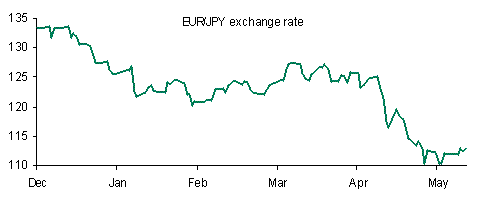
Nonetheless, even domestic investors including many large life insurance companies are increasing their overseas investments at the expense of Japanese debt. Kan is also a supporter of weaker JPY so at the least the rhetoric from Japanese officials to weaken the JPY will step up, especially given the very painful move in EUR/JPY over recent months.

Finally, the G20 meeting beginning today in South Korea will garner attention. Topics will include bank regulation and capital requirements, the European debt crisis, and policy tools such as the recent suggestion by South Korea to make permanent the currency swap agreements between central banks. Aside from a commitment to keep policy supportive, and likely talking up the efforts to combat the crisis in Europe, it is difficult to see anything particularly market moving emerge from the meeting.

FX / Economic Preview

The European Union (EU) aid package for Greece and extension of collateral requirements by the European Central Bank (ECB) helped return a semblance of confidence to markets. Although the probability of a Greek default now looks extremely small, further austerity measures, fiscal issues in other EU countries and the negative impact on growth that all of this implies, suggest that Europe will be plagued by various problems for some time yet.

As a result of more favourable market conditions Greece is set to launch a syndicated bond issues today or tomorrow of up EUR 5 billion according to press reports. Attention will also turn to Greek debt rollovers, beginning with EUR 8.2 billion on April 20.

Improving sentiment following the Greece deal has extended to the EUR, with the currency bouncing off its lows around 1.3267. EUR/USD will now look to break through resistance around 1.3446, which would set up a test of 1.3516. There is plenty of scope for short-covering to help the EUR as reflected in the latest IMM Commitment of Traders’ report (a gauge of speculative market positioning) which revealed net EUR positions reaching yet another record low in the week to 23rd March. Whilst sovereign/official buying interest may keep EUR/USD supported this week the currency pair is best played as a sell on rallies.

A similar assessment applies for GBP. Speculative sentiment for the currency also hit a record low in the latest week but unlike the Greek deal helping the EUR, last week’s UK budget has done little to boost GBP’s prospects. Moreover, a report in the Financial Times highlighting hedge funds bets against GBP, suggests that there are still plenty of headwinds against the currency.

Volumes are set to thin out this week ahead of upcoming holidays, whilst the US March jobs report at the end of the week will likely prevent moves out of current ranges ahead of its release. The consensus forecast is for a 190k increase in non-farm payrolls though much of this is likely to reflect hiring for the 2010 US consensus and a rebound from adverse weather effects in February.

In Europe March economic confidence surveys will be watched closely to determine how much damage Greece and general fiscal woes are having on sentiment. Some improvement, in line with the Eurozone Purchasing Managers Index (PMI) and the German IFO business confidence survey, is expected, which will help to give further, albeit limited relief to the EUR.

The Japanese data slate kicked off the week in good form, with the release of February retail sales data, revealing its biggest annual increase in 12-years. It is difficult to see the recovery in sales taking much greater hold given persistent deflation pressures however, and part of the gain probably reflects the government’s shopping incentive program.

Aside from industrial production and jobs data in Japan the key release will be the results of the Q1 Tankan survey on Wednesday. The survey of manufacturers’ confidence is set to show further improvement. USD/JPY is likely to remain supported around 91.67 but will need a further widening in US/Japan 10-year bond yield spreads to push higher.