US dollar on a firm footing

The stronger than expected US February jobs report (227k versus 210k consensus) and the Greek debt swap should by rights have set a positive tone to markets this week. Unfortunately this is not the case and cautious is set to prevail, with sentiment dampened in part by China’s wider than expected $31.5 billion trade deficit posted in February.

Officials in Europe are set to finalise Greece’s second bailout today but sentiment is unlikely to be boosted as various concerns creep into the market. Growing scepticism about the fact that the Greek bailout fails to correct the country’s underlying problems, worries about whether Portugal will follow in Greece’s wake, fiscal slippage in Spain and the Irish referendum, all point to ongoing tensions in the weeks ahead.

The Federal Reserve FOMC meeting takes centre stage over coming days while data releases including retail sales, industrial production and manufacturing surveys will also prove important for USD direction. The USD reacted positively to the lack of quantitative easing (QE) hints by Fed Chairman Bernanke recently and the stronger than expected February jobs report has reinforced this view.

The USD starts the week on a firm footing but could face renewed pressure if the FOMC statement proves to be more ambiguous on the issue of QE. US data releases will reinforce signs of economic recovery and if they play into a ‘risk on’ tone the USD could suffer. We believe this is unlikely however, with risk assets set to correct lower over coming weeks, playing positively for the USD.

Having rallied following the growing optimism over the Greek PSI debt swap the EUR will find limited support in the days ahead. News of 85.8% participation will have come as relief but the use of collection action clauses (CAC) is not so positive. At least finalisation of the second Greek bailout will now move ahead, with officials set to rubber stamp the deal today.

Data releases such as the March German ZEW survey tomorrow will highlight the sharp turnaround in investor confidence following the ECB’s LTRO and progress on Greece. This would usually bode well for the EUR. However, it is already proving to be a case of buy on rumour, sell on fact outcome for the currency. Potential for a drop below support around EUR/USD 1.3055 is growing as the USD builds momentum.

Following February’s surprise decision by the Bank of Japan to expand its asset purchases and set an inflation goal, the outcome of the policy meeting on Tuesday will deliver few punches. Having weakened in the wake of the last BoJ meeting, partly as a result of higher US bond yields relative to Japan, the JPY threatens to pull back against the USD to support around 80.50.

Improved risk appetite has helped to maintain some pressure on the JPY but this impact ought to prove limited unless yield differentials continue to widen. While the BoJ’s actions will likely keep Japanese government yields supressed, JPY direction will continue to be dictated by the gyrations in US bond yields.
Euro pricing in a lot of good news

Markets remain in limbo ahead of a potential Greek debt deal although US equities managed to eek out small gains overnight. Stocks in the US have entered a bull market helped by the dovish stance of major central banks.

The Federal Reserve’s commitment to maintain accommodative policy until the end of 2014 and the European Central Bank’s (ECB)3 year LTRO have been drivers of the rally in risk assets. The BoE will contribute to the easy stance of central banks, with an increase in UK quantitative easing set to be announced today. The ECB in contrast is set to remain in status quo.

Will it be a buy on rumour, sell on fact reaction for the EUR to a Greek debt deal? Over recent days anticipation has grown that a deal on debt writedowns and in turn a second bailout package will emerge soon. This has helped to propel EUR/USD higher, with the currency hitting a high of 1.3289 overnight.

So far a deal has been lacking but leaders are expected to approve a draft agreement on fresh austerity measures between the main Greek political parties today. This should pave the way a deal on debt restructuring and a new loan package for the country due to be discussed today between Eurozone finance officials.

However, the EUR has already priced in a lot of good news on this front and even agreements on the issues above may not see the currency push much higher, with strong resistance around EUR/USD 1.3388. Separately today’s ECB meeting is unlikely to provide much direction for the EUR, with the Bank set to maintain current policy settings.

USD/JPY has managed a recovery of sorts but still remains in the middle of multi month 75.5-78.5 range. Nonetheless, the momentum over the short term will continue to be for USD/JPY upside, with resistance around 77.49 targeted. News that the Japanese authorities conducted ‘stealth intervention’ to weaken the JPY in late October/early November will have emboldened JPY bears.

However, at the same time they should also be worried as it is clear that even after all the intervention the JPY remains overly strong. Reflecting this is the fact that speculative and margin trading JPY positioning is at a very high level.

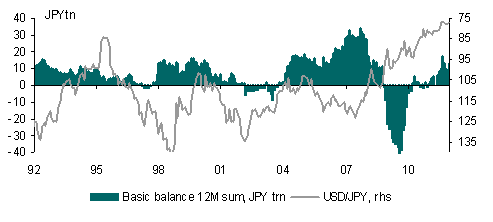
Moreover, while much has been made of the deterioration in Japan’s current account balance over recent months and the potentially negative impact on the JPY it should be noted that Japan’s basic balance (sum of direct investment + current account + portfolio flows) position remains healthy (for now) and is acting as an obstacle to JPY weakness.

Still waiting for Greece

The USD has taken a steady path of recent days, with little move in either direction, reflecting the general malaise in currency markets waiting for an outcome to the Greek debt talks. However, hopes that an agreement will be announced shortly saw the USD lurch lower overnight. The conflicting forces of firming US economic data on the one hand and uncertainties in Greece on the other have left market participants in a bind.

The USD has at least purchased some solace from reduced expectations of quantitative easing but as we noted earlier in the week the Fed may still carry out QE despite of better data. The USD could also suffer from the fact that US bond yields remain relatively low compared to some other major countries.

Indeed, the Fed’s commitment to maintain accommodative monetary policy until the end of 2014 suggests that the USD’s use as a funding currency could continue for a while longer. We look for the USD index to consolidate around the 78.50-79.00 level over the short term.

GBP’s recovery from its lows around 1.5233 on 13 January has been impressive. GBP’s gains are not as strong as that of commodity and Scandinavian currencies but it has outperformed the EUR. We expect this to continue.

Like other currencies GBP has benefited from a widening yield gap between the UK and the US. This has little to do with UK policy expectations given that the Bank of England is expected to initiate more quantitative easing this week. The move in relative US–UK yield differentials has more to do with the rally in US interest rate futures since the start of the year, supported by the recent dovish FOMC statement, which has put the USD under a degree of pressure.

GBP gains will be limited ahead of the BoE meeting tomorrow, with technical resistance seen around 1.5931 vs USD. Against the EUR much will depend on Greek debt talks but eventually we look for a retest of the EUR/GBP January lows around 0.82213.

US dollar remains under pressure

Hopes of progress on the Eurozone debt crisis and encouraging data in the US have helped boost market confidence. However, the slightly disappointing US Q4 GDP report (2.8% Qoq annualised growth) revealed the markets continued vulnerability while Fitch’s downgrade of six Eurozone countries’ sovereign ratings brought a dose of reality back to the region.

Nonetheless, the Eurozone Central Bank (ECB) unlimited 3-year loans to banks and Fed hints at quantitative easing (QE3) have provided markets with a fillip and will help underpin risk assets over coming weeks. If Greek debt talks are wrapped up this week markets will take further solace but the European Union (EU) Summit beginning today will need to deliver on rubber stamping recent agreements for positive sentiment to be maintained.

This is a big week for US data releases and in turn the USD. Heavy weight data including January non-farm payrolls, ISM manufacturing confidence and consumer confidence readings are on tap over coming days. Although payrolls will not be as strong as in December the trend of data releases will continue to be one of improvement as likely to be revealed in the forward looking confidence surveys this week.

The USD may not benefit as much as it would otherwise have done given that the Fed has committed to easy monetary policy for a long while to come to end 2014. It is becoming increasingly clear that firmer activity data may still not prevent a further round of quantitative easing and attendant USD downside risks. Against this background a cautious stance on the USD over coming days is warranted, with the USD index likely to remain under near term pressure.

Dollar, Euro and Yen Outlook 2012

The USD index is set for another positive year over 2012 but it will not be a star performer. The USD has been a clear beneficiary of the crisis in the eurozone and will continue to find sustenance unless there are signs of a concrete resolution on the horizon. My forecasts still see the USD index rising to 82.5 by the end of 2012. This would be well below the highs reached during the height of the financial crisis in March 2009 around 89.

While economic recovery is expected to continue over 2012 it will be a tepid one, with prominent downside risks. Therefore, one of the factors likely to hold the USD back is the likelihood that the Fed embarks on a fresh round of quantitative easing which I believe will take place sometime in H1 2012, specifically aimed at mortgage backed securities.

I am not bullish on the EUR but it is clear in my view that there is an underlying degree of support for the currency. In 2012 I expect more downward pressure on the currency. News on the economic front will become more negative and the region is set to slip into recession, albeit a mild one (with downside risks). In contrast, the outlook for the US looks somewhat better even if the recovery will look tame compared to past growth.

Relatively weak growth will maintain the pressure on the ECB to ease monetary policy and further interest rate cuts are likely in the months ahead. Easier policy will be another factor that undermines the EUR. Even if the there was some progress on a resolution to the eurozone debt crisis I doubt that the stress on markets would be relieved overnight. While the crisis has and will not deliver a death blow to the EUR it will mean that investors, even official ones, take a much more cautious view on the currency going forward. I look for EUR/USD to fall to around 1.26 by end 2012.

The JPY has been one of the most well behaved currencies over past months, remaining within a relatively tight range. Unfortunately for the Japanese authorities and for the economy the JPY has failed to build on any negative momentum caused by intervention. I expect USD/JPY and EUR/JPY to edge higher over coming months but the upside for both currency pairs is likely to be gradual over 2012.

Much will depend on whether risk appetite improves and more importantly on yield differentials between Japan and other countries. My end 2012 forecast for USD/JPY and EUR/JPY remain at 85 and 107, respectively but its worth noting that I now expect a firmer JPY in March 2012 against both USD and EUR than previously forecast due to the likelihood of prolonged uncertainty and elevated risk aversion over Q1 2012