Risk Aversion Back With A Vengeance

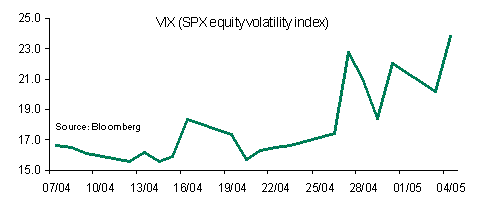
Risk aversion is back with a vengeance as reflected in the rise in equity volatility (VIX), drop in equity markets and rally in US Treasuries.  European peripheral debt markets sold off despite the EU/IMF aid package for Greece, whilst EUR/USD slid below 1.3000.  Various rumours dealt a blow to markets including talk of a sovereign ratings downgrade and a EUR 280 billion bailout for Spain.   The message is clear.  This situation is becoming increasingly dire by the day.  Europe is in big trouble and the whole euro project is under threat of unravelling.  
Concerns about parliamentary approvals, implementation/execution risk, prospects for relatively weaker growth in Europe, as well as contagion to Spain and Portugal, has tempered any enthusiasm towards the EU/IMF bailout package.  In addition, despite the large size of the EUR 110 billion loan package there are growing worries that it will be insufficient to cover Greece’s funding requirements over the next three years.  All of this implies that the EUR will remain under pressure for some time yet.  I have previously spoken about a drop to around EUR/USD 1.25 but the risk is for a much sharper decline is growing.

The USD is the clear winner, spiking to its highest level since May 2009 and is looking well set to consolidate its gains over the short-term despite the fact that net aggregate USD speculative positioning has already reached its highest level since September 2008 (according to the CFTC Commitment of Traders IMM data) in contrast to EUR positioning, which is at a record low.  This is unlikely to stand in the way of further downside for EUR/USD, with the next technical support level seen at 1.2885, which would match the previous lows see in April 2009.

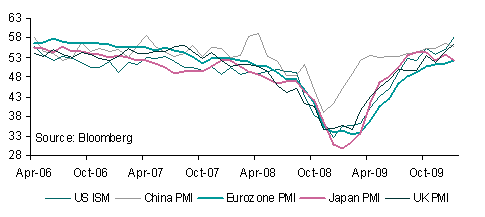
A combination of worries including contagion to Spain and Portugal, policy tightening in China, debt concerns in the UK and Japan, all threaten to undo the positive message from recent positive economic data including further strengthening in Purchasing Managers Indices globally.   The immediate attention remains on Greece and growing scepticism about the ability of Greece to carry out austerity measures in the face of rising domestic opposition, including a nationwide strike today. 
The rout in US and European markets will spill over to Asia, putting equity markets and Asian currencies under pressure.  Another risk currency to suffer is the AUD, which has dropped sharply following the Reserve Bank of Australia (RBA) meeting, in which the Bank indicated that rates were close to peaking.  Speculative positioning has dropped for the past two weeks as longs are taken off but AUD/USD weakness is set to be temporary, with buyers likely to emerge around near term support seen around 0.9001.
The Good, The Bad And The Ugly

GOOD: Positive earnings. The biggest earnings news of the day was from Goldman Sachs reporting that profits almost doubled in Q1. Apple also beat estimates and its shares surged. 82% of US earnings have beaten expectation so far. There is still a long way to go in the earnings season but the growth/earnings story is helping to maintain the positive bias to risk trades. There will be plenty of attention on earnings, including AT&T, eBay, Morgan Stanley, Starbucks, Boeing and Wells Fargo.

Data releases remain upbeat, with the April German ZEW investor confidence survey beating consensus, whilst central banks delivered hawkish messages across the board including the Reserve Bank of Australia policy meeting minutes, which pointed to another interest rate hike in May. However, the biggest impact came from the Bank of Canada which unsurprisingly left rates at 0.25%, but removed the conditional commitment to keep policy on hold until the end of Q2, leaving a rate hike on June 1 very likely.

The CAD jumped on the back of the outcome, with USD/CAD dropping below parity. I continue to like CAD alongside the AUD and NZD and believe they will be the star performers over the coming months despite lofty valuations.    Near term targets for CAD, AUD and NZD vs USD are 0.9953, 0.9407, and 0.7195, respectively. 

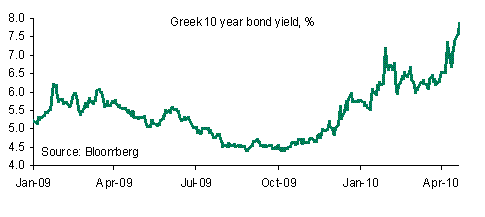
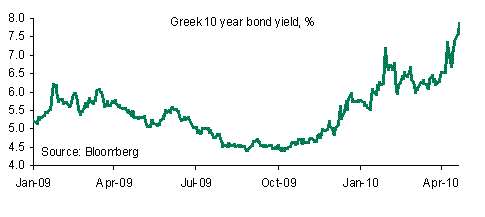
BAD: Talks between Greek officials and the IMF, ECB and EU on the conditions for a EUR 45 billion bailout loan will also be of interest although completion of talks could take weeks and in the meantime the situation is unlikely to improve, with Greece needing around EUR 10 billion to cover obligations by end May. Greek bond yields jumped to fresh record highs around 7.84% yesterday whilst the spread over German bunds also widened. Moreover, although Greece’s sale of EUR 1.95 billion in 13-week paper yesterday was heavily oversubscribed the, the yield was high at 3.65% which was far higher than the 1.67% yield at a similar sale in January.

In contrast to the likes of the CAD, AUD and NZD, the EUR is set to continue to suffer and as reflected in the widening in Greek bond spreads and high funding costs, Greek woes will keep plenty of pressure on the currency, with EUR/USD set to fall to support around 1.3300 in the short-term.

UGLY: UK regulator FSA will conduct a formal investigation of Goldman Sachs. The FSA will work closely with the US Securities and Exchange Commission SEC, which has accused the bank of Fraud though this has vehemently denied by Goldman Sachs. Although the negative market impact of the fraud case has been outweighed by good earnings and data the fallout is spreading. Some European politicians have even called for governments to stop working with the bank.

Central banks in the spotlight

The market mood continues to be weighed down by a combination of worries including monetary tightening in China and Greece’s debt woes. Consequently, risk aversion has taken a turn for the worse over the last couple of weeks. Measures of currency and equity market volatility have also spiked. Meanwhile, risk currencies have remained under pressure, especially those that are most sensitive to risk aversion including AUD, NZD, CAD, and a long list of emerging market currencies.

Greece’s problems remain a major drag on the EUR, with speculative sentiment for the currency dropping close to the all time low recorded in September 2008, according to the CFTC IMM data. Further developments including news that the European Commission will officially recommend that Greece should implement more severe cuts on public sector spending are unlikely to help to reverse negative sentiment for the currency. A lack of confidence and scepticism over Greece’s ability to cut its budget deficit suggest little respite for the EUR in the weeks ahead.

Markets will have plenty of other things to focus on this week, with various manufacturing and service sector PMIs, four major central bank decisions, and the January US non-farm payrolls report, due for release. The PMIs are likely to confirm that output in both manufacturing and service industries remains expansionary but only consistent with limited growth rather than the rapid rebound in activity seen following past recessions.

The most interesting central bank decision this week is likely to be that of the Reserve Bank of Australia. Recent data has if anything given more reason for the central bank to raise interest rates, including the latest release which was the TD Securities inflation gauge, which jumped 0.8% in January, the biggest increase in 6-months. Although a hike is now largely discounted, some hawkish rhetoric from the RBA could be sufficient to give the AUD some support.

Although the UK Bank of England is unlikely to shift policy at its meeting on Thursday the statement will be scrutinized for clues as to whether quantitative easing is over. Any indication that there will be no further QE measures will play positively for GBP given that it has been restrained by speculation that the BoE will increase asset purchases. No change is also expected by the ECB but once again Greece will likely dominate the press conference. Meanwhile Norway’s Norges Bank is likely to pause in its policy of gradual tightening.

Clearly the funding currency of choice, the USD, has been one of the main beneficiaries of higher risk aversion and this has been reflected in the latest CFTC Commitment of Traders report, which shows that net short aggregate USD speculative positions have dropped sharply, with USD positioning close to flat again. Similarly, the other beneficiary, namely the JPY, has also seen a significant shift in positioning as shorts have been covered. Expect more to come.

Appetite for carry trades was not be helped by the news that the UK’s Lord Turner has signalled a regulatory crackdown on FX carry trades. The report in the UK press fuelled a sell of in JPY crosses but is unlikely to have more than a short term market impact given the practical difficulties in regulating carry trades. Nonetheless, the fact that speculative positioning is still quite long in the AUD, NZD and CAD suggest scope for more downside in such currencies in the current risk averse environment.

Where will interest rates go up next?

Following the decision by the Reserve Bank of Australia to raise interest rates attention has swiftly turned to which central bank will move next. Indeed, there has been a reassessment of global interest rate decisions following Australia’s move. The hike in Australia is unlikely, however, to be quickly followed by the US, Japan, Europe or UK where policy is set to remain highly accommodative for long while.

Attention will however, turn to the Bank of Korea as well as the RBNZ and Norges Bank. In particular, the Norges Bank may be the next to hike when it meets on October 28. Norway has already appears to be priming markets for a rate hike. The RBNZ is likely to be slower to hike given the still slow pace of recovery in New Zealand and comfortable inflation backdrop.

The impact on currencies is not straightforward as the bigger influence on currency markets throughout the crisis has been risk appetite rather than interest rates. However, the influence of risk on currencies is beginning to wane and although interest rates have not been a major driver of currencies over recent months the move by the RBA likely accelerates the process of yield re-emerging as a key currency driver.

This is a big problem for the US dollar given that the Fed is unlikely to be quick to raise interest rates even if quantitative easing is withdrawn sooner. This means that the dollar will suffer from a growing yield disadvantage as interest rate hikes are priced in elsewhere. Taken together with improving risk appetite as reflected in the resilience of global equity markets, the main casualty will be the dollar, hit both from a yield and risk appetite perspective.

Risk currencies and those currencies with the greater prospect of higher rates will do well meaning further upside for the Australian dollar and New Zealand dollar as well as the Norwegian krone. Asian currencies look to continue to strengthen with the Korean won remaining an outperformer despite intervention threats by the Korean central bank. The euro will benefit from dollar weakness but is unlikely to benefit from anything euro specific given the likely slower pace of recovery in the eurozone. Meanwhile sterling is likely to remain under pressure, not helped by yield or risk appetite, and sentiment hit afresh by weak data.