Asian currencies – What’s correlated with what?

Asian currencies as reflected in the performance of the ADXY index have been on bit of a rollercoaster ride over recent weeks, dropping sharply in the face of a resurgent USD (note most Asian currencies have had a high correlation with the movements in the USD index over the past three-months) only to strengthen briefly before resuming weakness. Since the end of last month almost all Asian currencies are weaker, with the biggest falls led by MYR, KRW, SGD and INR.

Correlation analysis shows that Asian currencies are not particularly being influenced by yield differentials at present, with only USD/IDR and USD/PHP possessing a significant correlation with 2-year bond differentials. In the case of the IDR there has been a narrowing in the yield differential with the US over recent weeks as Indonesian yields have dropped, a factor that could be undermining the IDR at present.

Similarly risk aversion does not appear to be playing a major role in influencing Asian currencies, with a low correlation registered between my Risk Aversion Barometer and all Asian currencies over the past three-months. However, equity performance is more important for some currencies, with the SGD, THB, PHP, IDR and TWD all having a high sensitivity to the performance of their local equity market. Interestingly the INR is less sensitive to equity performance even though India has recorded heavy outflows of equity capital over recent weeks.

Asian currencies are likely to continue to track the gyrations of the USD in general over the short-term as has been the case over recent weeks but it will not be a one way bet for the USD. Whilst I remain bullish on the USD’s prospects over the medium term I am cautious about the ability of the USD to sustain its currency bounce given that there has not been any back up in US bond yields or any clarification on what the Fed will do after QE2 has been completed.

Against this background I do not expect Asian currency weakness to extend much further. Top picks for the year are KRW and PHP as well as the CNY. In any case given the strong influence of general USD direction on Asian currencies, I suggest playing long Asian FX positions versus EUR over coming months, especially given that the EUR is likely to slide much further against the USD by year end, with 1.30 remaining my target.
Equity Flow Reversal Supports Asian FX

Asian currencies have rebounded smartly from their post Japan earthquake lows on March 16. The ADXY (Bloomberg-JP Morgan Asia Currency index) is now at its highest level since September 1997 reflecting a sharp rebound in capital inflows to the region. The performance of Asian currencies continues to correspond closely with the movement in capital flows.

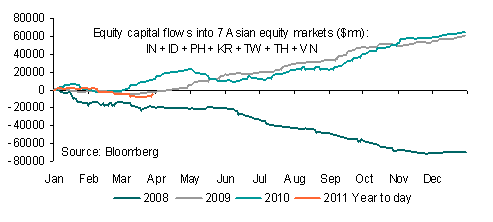
Although almost all Asian equity markets have registered outflows so far this year (total equity outflows -$6.2bn), the trend is reversing. Over the past month there has been a major slowing in capital outflows for most countries in Asia whilst India, Thailand and the Philippines have actually registered sizeable inflows. South Korea is notable in that there has been a sharp increase in equity capital inflows over the past week.

Although there has been much focus on a rotation of capital flows out of Asia and into developed economies this year, it is worth noting that the pattern of equity flows in Q1 2011 has not been too different from that witnessed in the past couple of years. In both 2009 and 2010 equity outflows were recorded over the two (2010) or three (2009) months of the year before a reversal took place. This pattern looks like it is repeating itself.

Clearly the environment for Asian equity markets is not as supportive as it was last year given the belated tightening in monetary policies being undertaken by many central banks and prospects of an end to QE2 in the US. Whilst this will result in some reduction in capital flows to the region compared to last year, the overall outlook is positive. Easing risk aversion (our risk aversion barometer has already reversed all of its post Japan earthquake spike and is trending lower), positive growth outlook and maintenance of low US rates point to more inflows.

One currency in particular that will benefit is KRW, with a further drop in USD/KRW likely over coming weeks. KRW has already strengthened by around by around 2.7% since its post Japan earthquake low making it the best performing currency since then. Further gains are likely; a test of USD/KRW 1100 is on the cards in the short-term, with the year end target standing at 1050.

Why buy KRW? 1) Korea has registered the biggest improvement in equity capital flows recently, 2) KRW has been the most sensitive Asian currency to risk over the past month and therefore benefits the most as risk appetite improves, 3) Estimated Price/Earnings ratio for Korean equities looks cheap compared to its historical z-score according to our estimates. As a result our quantitative model on USD/KRW based on commodity prices, risk aversion and equity performance highlights the potential for significantly more KRW strength.