Q4 earnings and Chinese data

Since the start of the year the market has gyrated from “risk on” to “risk off” and back again. On balance the overall tone has been just about positive, with firmer economic data, most notably in China outweighing sovereign debt concerns in Greece and elsewhere. Although debt concerns are unlikely to dissipate quickly, especially given Greece’s inability to convince markets of its plans to cut its burgeoning budget deficit, the “risk on” tone is likely to win.

“Risk off” may be the tone at the start of the week however, as US equities ended the week on a negative note ahead of the Martin Luther King holidays. The holidays will likely keep trading slow. Data wise the main US events housing starts on Wednesday and the Philly Fed on Thursday. Q4 US earnings are likely to take a bigger share of market attention as the earnings season rolls on. Bank earnings will be a key focus, with Citigroup, Morgan Stanley, BoA, Wells Fargo and Goldman Sachs set to report this week.

Given the growing influence of Chinese data on markets the monthly data pack from China will capture more attention than usual on Thursday. In particular, GDP and inflation data will be of most interest. GDP data is likely to reveal an acceleration in growth in Q4 YoY to above 10% but given worries about over heating and following last week’s tightening in China’s monetary policy CPI data will be closely scrutinized. Inflation is likely to pick up further maintaining the pressure for further monetary tightening as well as a stronger CNY.

Elsewhere, in the eurozone the main event is the German ZEW survey tomorrow, which is likely to show further signs of flagging, due to Greek concerns. There is also an interest rate decision to contend with; the Bank of Canada is unlikely to surprise markets as it keeps policy unchanged tomorrow. The UK has a relatively heavier data slate, with CPI tomorrow, Bank of England minutes on Wednesday and retail sales at the end of the week.

The UK data kicked off on a positive note this week, with house prices rising 0.4% MoM in January and 4.1% YoY according to UK property website Rightmove, the biggest annual gain in over a year. Moreover, activity on Rightmove’s website reached a record high in the first full week of the year. The data as well as expectations that Kraft will raise its bid for Cadbury will likely help GBP in addition to other GBP positive M&A news. GBP/USD will look to test resistance around 1.6365 this week.

After a slightly firmer start helped by the weak close to US equity markets on Friday the USD is likely to generally trade on the back foot over the week. Speculative sentiment for the USD has definitely soured into the new-year as reflected in the CFTC IMM data which revealed a big jump in net short positions in the week ending 12 January 2010. Net aggregate USD positions shifted from +1.6k to -51.9k over the week, with the main beneficiaries being the EUR, and risk trades including AUD, NZD and CAD.
Ratings Concerns Hit Euro

Post payrolls euphoria has faded quickly this week. Fed Chairman Bernanke’s cautious comments about growth had weighed on US markets earlier but it is now eurozone concerns that have come to the forefront. Markets were faced with a further reality check following a sharp drop in German industrial production and news that S&P put Greece on watch for a downgrade, with Fitch going a step further and downgrading Greece’s ratings to BBB+ with a negative outlook.

Greece with a budget deficit of 12.7% of GDP was picked on by the ratings agencies but sovereign debt / fiscal concerns apply to several countries across the eurozone. Indeed, since the recent Dubai shock, which continues to weigh on markets following a report today about an accelerated payment clause on $2 billion debt issued by the Emirates utilities provider, concerns have moved quickly to the health of government balance sheets. The potential for more European ratings cuts will keep sentiment towards eurozone markets cautious.

The UK should not be ignored in this respect and attention will turn to the UK pre-budget report though it’s difficult to see what Chancellor Darling can say that will help GBP. Other economic news has been disappointing with Australia registering a bigger than expected trade deficit in October and Japan recording a sharp downward revision to Q3 GDP, all of which will act to contribute to the “risk off” tone to markets today.

Although the direct brunt of the ratings downgrade was felt on Greek bonds the EUR has come under strong selling pressure registering a further sharp move lower from the 1.5141 high printed last week. Capitulation at the failure to break above recent highs led to some selling and this was exacerbated by the negative data and ratings news. EUR/USD is likely to have further to go on the downside but sovereign interest and bargain hunting will likely prevent a more severe decline. EUR/USD technical support is seen around 1.4623.

Gold / FX correlations

There is no shortage of cash rich investors in Asia even amidst the current troubles in Dubai. Indeed, sentiment in the gemstones market is particularly upbeat, with a rare five-carat pink diamond selling for a record HK$84.24 million in Hong Kong. Perhaps this is a good reflection of abundant liquidity and of course wealth in Asia and in particular China, with talk that mainland Chinese investors were strong participants in the diamond auction.

It’s not just diamonds that are selling for record prices; gold hit a fresh high above $1,200 and once again at least part of this is attributable to the appetite of Asian central banks as well as demand from China as the country tries to increase its gold reserves. The rise in gold prices has coincided with a bullish announcement from the world’s top gold producer that it has completely eliminated its market hedges earlier than forecast due to the positive outlook on prices and waning supply.

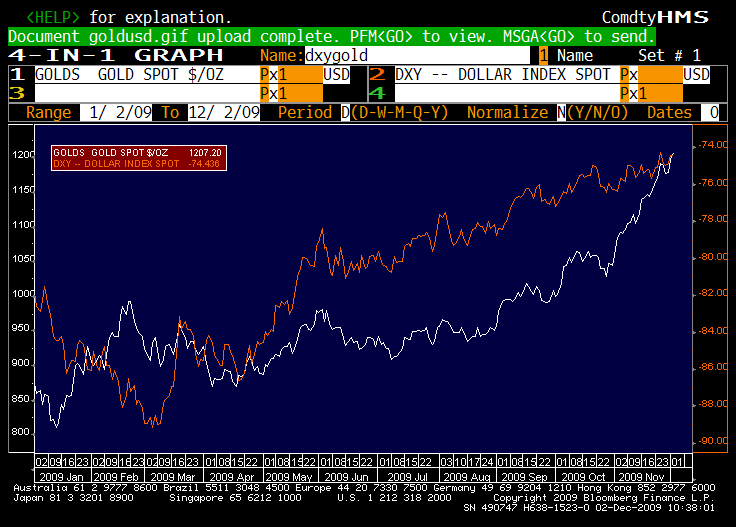
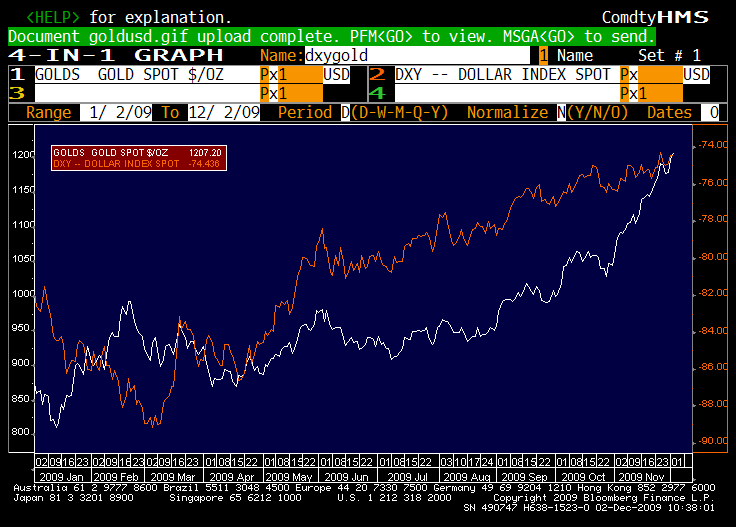
The correlation between gold prices and the USD remains very strong at -0.88 over the last 3-months, with firmer gold prices, implying further USD weakness. In fact, the gold / USD correlation has been consistently strong over the past few months and is showing little sign of diminishing.

Over the past 6-months the correlation has been -0.91 and over the past 1-month it was -0.75.  Assuming that anything above 0.70 can be considered statistically significant, the relationship shows that USD weakness has been well correlated with gold strength and that despite talk of a breakdown in the relationship it appears to remain solid. 

As long as the bullish trend in gold continues, the pressure on the USD will remain in place.  Adding to this pressure is the fact that risk is back on for now. Markets took the news of a fall in the ISM manufacturing index and in particular the drop in the employment component in its stride even though it supports the view of a weaker than consensus drop in payrolls in November when it is published on Friday.

There are still plenty of reasons to be cautious in the weeks ahead and although we appear to be back in a “risk on” environment markets are likely to gyrate between “risk on” and “risk off” over coming weeks. At least for now, the USD looks to remain under pressure but if risk aversion creeps back up as I suspect it may then the USD will see a bit more resilience into year end. 

Moreover, central banks globally are reaching the limits of their tolerance of USD weakness and will be tested once again, with EUR/USD back above 1.5000, EUR/CHF moving back below 1.5100 and the USD/JPY set to re-test 85.00 following the relatively benign measures announced by the BoJ in which the Bank did little to stem deflationary pressure or weaken the JPY.