China’s gradual renminbi move

China’s decision to “proceed further with reform” of the CNY exchange rate regime will dictate market activity at the turn of the week. The decision to act now reflects the fact that China is no longer in crisis mode policy. Although the eurozone sovereign crisis may have delayed China’s move, the authorities in China clearly felt that conditions had improved sufficiently enough to act. The decision will pre-empt some of the criticism that China would have faced at the G20 meeting next weekend, leaving attention firmly on Europe.

Before we all get too excited it should be noted that it is unlikely that China’s announcement presages aggressive action on the CNY. Stability appears to be the name of the game, a fact that has already drawn criticism from some in the US Senate who may still push for legislation over China’s exchange rate.

China will likely allow some, albeit gradual appreciation of the CNY. In this respect, it’s worth noting that the CNY appreciated by around 6.6% against the USD during 2007 and around the same amount in 2008 prior to the formal peg with the USD. Appreciation at a similar pace of coming months is unlikely.

The initial impact on the USD was an echo of the July 2005 move but to a far smaller degree. The USD was sold off across the board as market players reacted to the likelihood of the USD playing a less important role in China’s exchange rate mechanism. The USD rallied when China maintained its CNY fixing but lost ground as the CNY appreciated against the fixing.

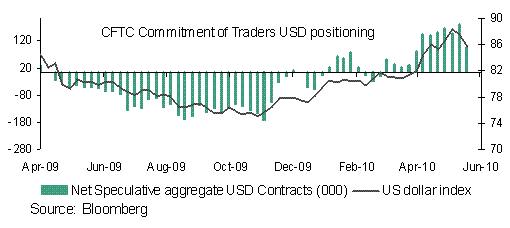
The fact that net USD speculative positions halved over the past week according to the CFTC IMM data, suggest that the USD is far less vulnerable this week to selling pressure from a positioning perspective. In other words there will be no repeat of the sharp FX moves that were seen post the July 2005 CNY revaluation. Whilst the major currency impact is likely to prove muted, Asian currencies are set to benefit more significantly, with further strengthening likely this week.
China’s announcement will play into the tone of firmer risk appetite at the beginning of the week but the move in some risk currencies, especially the EUR is looking increasingly stretched. The EUR and risk appetite may have benefited from recent positive news flow including the announcement of European bank stress tests and the relatively positive reception to Spain’s bond auction, but speculative positioning (IMM) data reveals that there was already a strong short-covering rally over the past week, which saw net EUR short positions almost halve.
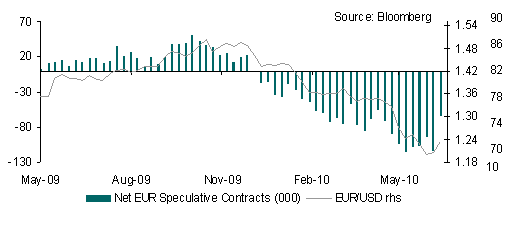
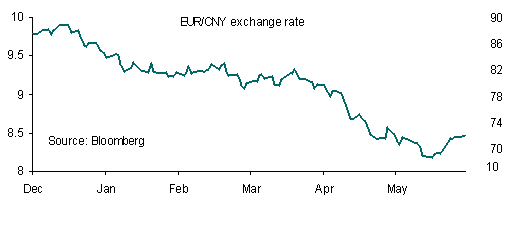
Further EUR/USD gains will be harder to come by, with an immediate obstacle around 1.2500. Perhaps another reason for China to be cautious about the pace of CNY appreciation is the likelihood of further EUR weakness and the impact that this would have on China’s trade with Europe. As it is EUR/CNY has already dropped by over 13% so far this year and China will not want to enact measures that will accelerate the pace of the move in the currency pair.
Calming the Tiger

As markets enter the year of the Tiger a somewhat calmer tone appears to be ensuing, with risk appetite edging higher helping equities and the beleaguered EUR to recover some lost ground.  US stocks were helped by a firmer than expected reading for the Empire manufacturing survey (to 24.91 in Feb) and a slight uptick in the US NAHB (National Association of Home Builders) index (to 17 in Feb) but consumer confidence remained weak as indicated by the decline in the weekly reading of ABC Consumer Confidence (-49).  

On the other side of the pond the better than expected February ZEW survey (a survey of investor confidence) in Germany (45.1) helped sentiment although it still recorded a decline from the previous month as Greek fiscal/debt concerns weighed on financial market participants’ confidence.  The bigger impetus came from comments by Greek Finance Minister Papaconstantinou who said there would be no need to for a bailout of the country.

Tensions over Greece eased further following news that tax collectors in the country called off a planned strike, helping to allay some concerns that unions will block planned spending cuts.   On the policy front, the EU Council ratified Greece’s plans but with strings attached, giving the country one month to present a report on the timetable for implementing budget cuts for 2010 and three months to outline policy measures required to cut the deficit below 3% by 2012.

Meanwhile, commodity prices have pushed higher helping currencies such as the AUD and NZD to strengthen.  Moreover, the AUD was boosted by more hawkish interest rate expectations following the release of the minutes of the latest RBA policy meeting which indicated that the Reserve Bank was merely pausing in its rate cycle.  Expectations of a rate hike in March increased as a result.

Overall, the recent rally in the USD is looking increasingly overdone and some reversal is likely over coming weeks.  The fact that market positioning has reached extreme levels in particular in the case of the EUR highlights scope for some recovery in the currency, especially now that the worst case scenario of a Greek default has passed.  The outlook for commodity currencies is even more bullish as risk appetite improves further.     

If anything, data today is likely to give further support to the recovery story, with US industrial production and housing starts expected to post healthy gains.  The Fed FOMC minutes may offer some additional insight into the debate over the implementation of exit strategies but there is unlikely to be much elaboration from the recent comments by Fed Chairman Bernanke in his speech to the US Senate in which he hinted that a rise in the discount rate is not far off.  

Risk currencies including many Asian currencies are likely to benefit from the improvement in risk appetite over the short term.  EUR/USD will likely strengthen as more short positions are covered but will face strong technical resistance around 1.3839.   Asian currencies have been resilient to the recent rise in risk aversion and this is likely to continue over the coming weeks.  As risk appetite recovers currency plays including long AUD/JPY , and even some further upside in EUR/USD look favourable.