Euro’s Teflon Coating Wearing Thin

EUR has suffered a setback in the wake some disappointment from the European Union summit at the end of last week and the major defeat of German Chancellor Merkel and her ruling Christian Democratic Union party in yesterday’s election in Baden-Wuerttemberg. The EUR had been fairly resistant to negative news over recent weeks but its Teflon like coating may be starting to wear thin.

The setbacks noted above + others (see previous post) follow credit rating downgrades for Portugal by both S&P and Fitch ratings and growing speculation that the country is an imminent candidate for an EU bailout following the failure of the Portuguese government to pass its austerity measures last week and subsequent resignation of Portugal’s Prime Minister Socrates.
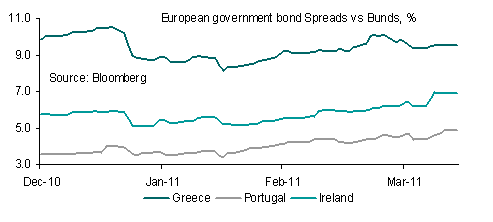
For its part Portugal has stated that it does not need a bailout but looming bond redemptions of around EUR 9 billion on April 15 and June 15 against the background of record high funding costs mean that the pressure for a rescue is intense. Complicating matters is the fact that fresh elections cannot be held earlier than 55 days after being announced, meaning that policy will effectively be in limbo until then. A June vote now appears likely.

After what was perceived to be a positive result of the informal EU leaders summit a couple of weeks ago, the outcome of the final summit last week failed to deliver much anticipated further details whilst more negatively the EU bailout fund’s paid-in capital was scaled back to EUR 16 billion (versus EUR 40 billion agreed on March 21) due to concerns expressed by Germany.

Ireland is also in focus ahead of European bank stress tests results on March 31. Ireland is pushing for increased sharing of bank losses with senior bondholders as part of a “final solution” for financial sector. Meanwhile the new government remains unwilling to increase the country’s relatively low corporation tax in exchange for a renegotiation of terms for the country’s bailout. This point of friction also threatens to undermine the EUR.

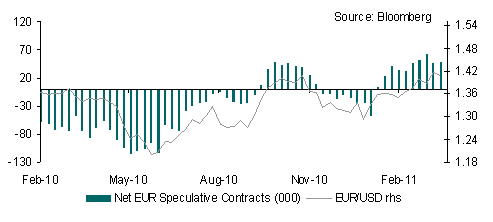
The bottom line is that the bad news is building up and the ability of the EUR to shake it off is lessening. Considering the fact that the market long EUR, with positioning well above the three-month average the EUR is vulnerable to position adjustment. After slipping over recent days EUR/USD looks supported above 1.3980 but its upside is looking increasingly restricted against the background of various pieces of bad news.
Drastic Action Needed

There has been no let up in pressure on eurozone markets and consequently risk aversion continues to increase. The failure of Ireland’s bailout package to stem the haemorrhaging in eurozone bond markets highlights the difficulties in finding in a lasting solution and worsening liquidity conditions in several eurozone bond markets highlights the urgency to act.

Indeed, if spreads continue to widen as they have since late October, by early to mid 2011, Portuguese, Spanish and Italian Euribor spreads would be higher than the EFSF loan spread. In the (admittedly extreme) case that sovereigns could not raise money in the market, peripherals would run out of money early in 2011. Policy makers will try to not let the situation get so out of hand but what can be done to stem the damage?

The European Central Bank (ECB) may be forced to delay its exit strategy by maintaining unlimited liquidity allotments to banks into next year and/or implement further liquidity support measures. The ECB meeting will be closely scrutinized for details, with ECB President Trichet having to adjust policy accordingly. A further option could be for the ECB to step up its bond buying programme which may provide some relief to peripheral eurozone bond markets and the EUR.

Whether this offers a lasting solution however, is debatable. The risk of action by the ECB tomorrow may fuel some caution in the market towards selling the EUR further in the short term and could even prompt some short EUR covering around the meeting which could see EUR/USD regain a sustainable hold above 1.3000 again but this may be temporary, offering better levels to sell.

Meanwhile, speculation of a break up of the eurozone into a core euro and a peripheral euro has intensified given the growing divergence in growth and competitiveness across the region. Such speculation looks far fetched. The eurozone project has been politically driven from the start and over the last 60 years or so internal economic strains have been papered over by politicians. The political will is likely to remain in place even if the divergence in fundamentals across Europe has continued to widen.

Bond market sentiment was not helped by the fact that S&P put Portugal’s ratings on creditwatch negative citing downward economic pressure and concerns over the government’s credit worthiness. Importantly S&P still expects Portugal to remain at investment grade if downgraded. Note that Portugal’s central bank highlighted that the country’s banking sector faced “intolerable” risk unless the government implements planned austerity measures.

In contrast the US story is looking increasingly positive, highlighting that the USD’s strength is not merely a reaction to EUR weakness but more likely inherent and broad improvement in USD sentiment. US consumer confidence, Chicago PMI and the Milwaukee PMI beat forecasts in November, continuing the trend of consensus beating data releases over recent weeks.
Although this does not change the outlook for quantitative easing (QE) as the Fed remains focused on core CPI and the unemployment rate, the data paints an encouraging picture of the economy.

Risk trade rally fizzles out

The risk trade rally spurred by China’s decision to de-peg the CNY fizzled out. The realization that China will only move very gradually on the CNY brought a dose of reality back to markets after the initial euphoria. The fact that unlike in July 2005 China ruled out a one off revaluation adds support to the view that China will move cautiously ahead with CNY reform. In addition, renewed economic worries have crept back in, with particular attention on a potential double dip in the US housing market following a surprise 2% drop in existing home sales in May.

European banking sector woes have not disappeared either with S&P raising the estimate of writedowns on Spanish bank losses, whilst Fitch ratings agency noted that there is an increased chance of the eurozone suffering a double-dip recession. The net impact of all of these factors is to dampen risk appetite and the EUR in particular.

The UK’s announcement of strong belt tightening measures in its emergency budget did not fall far outside of market expectations. The budget outlined a 5-year plan of deficit reduction, from 11% of GDP in 2009-10 to 2.1% of GDP in 2014-15. The main imponderable was the response of ratings agency and so far it appears to have been sufficient not to warrant a downgrade of the UK’s credit ratings. Fitch noted that the “ambitious” plan ensured that the UK would keep its AAA credit rating. The emergency budget and reaction to it has been mildly positive for GBP, which has shown some resilience despite the pull back in risk currencies.

The recent rally in Asian currencies is looking somewhat overdone but direction will come from gyrations in risk appetite and the CNY rather than domestic data or events. Encouragingly equity capital flows into Asia have picked up again over recent weeks, with most countries with the exception of the Philippines registering capital inflows so far this month, led by India and South Korea.

China’s CNY move may attract more capital inflows into the region, suggesting that equity capital flows will continue to strengthen unless there is a relapse in terms of sovereign debt/fiscal concerns in Europe. Nonetheless, central banks in the region will continue to resist strong FX gains via FX interventions, preventing a rapid strengthening in local currencies.

Although India and Korea have registered the most equity inflows this month, both the INR and KRW have had a low correlation with local equity market performance over recent weeks. In fact the most highly sensitive currencies to their respective equity market performance have been the MYR and IDR both of which have reversed some of their gains from yesterday. USD/MYR will likely struggle to break below its 26th April low around 3.1825 whilst USD/IDR will find a break below 9000 a tough nut to crack.

Greek bailout edges closer

A semblance of calm appears to have returned into the weekend following a fit of nervousness about all things Greece.  For currency markets this means that the EUR has recovered some composure after hitting 2010 lows around 1.3115 but direction next week will largely depend on the much anticipated announcement from European officials over coming days on the size and conditionality of a loan package to the country.   In return Greece is reported to be planning a EUR 24 billion package of additional measures to cut its burgeoning fiscal deficit.

Over recent days the consensus on how much funding Greece will need has increased to EUR 120 billion from the initial EUR 45 billion announced just over a couple of weeks ago.   Presumably the jump in size of assistance will be sufficient to convince markets that Greece’s default risk will be minimal, not just in the coming year but over the next few years.   It may also help to prevent further credit ratings downgrades following the decision by S&P ratings agency to downgrade Greece to junk status.  Moody’s left Greece on review for a downgrade but may also cut its ratings to junk if the situation does not improve. 

There are still many obstacles to an improvement in confidence towards Greece, however including the willingness of Germany to contribute to any aid package ahead of regional elections on May 9th and the ability of the Greek government to push through austerity measures in the face of growing social unrest in the country.   Moreover, the task ahead for Greece which aims at cutting the budget deficit down to 2% by 2013 is enormous having never been achieved in modern history.  Given the outlook for much weaker growth in the months and years ahead as well as growing domestic resistance in Greece, it will be all the more difficult. 

The likely announcement of an aid package over coming days will keep market sentiment relatively well supported and as reflected in the narrowing in Greek debt spreads, which seem to be trading more like equities, it is already having a positive impact.  Nonetheless, the bounce to markets will be limited and whilst a EUR 100-120 billion package will help to shore up confidence, there is just too much uncertainty remaining.  This points to continued volatility in the weeks ahead and very limited upside for EUR/USD and more likely a test of technical support around 1.3091 in the short-term then down to 1.2885.

Shaking Off The Bad News

Markets managed to shake off the initial shock of the SEC’s fraud case against Goldman Sachs following news that the charge was not approved unanimously, but with a 3-2 vote. This was interpreted by some to imply that there was more of a political rather than economic bias behind the charge, with two Democrats voting for and two Republicans voting against and SEC Chairman Schapiro siding with the Democrats.

Stronger than forecast earnings from Citigroup and a bigger than expected 1.4% jump in US March leading indicators also helped to calm market nerves, with US equities closing higher and the VIX volatility index reversing some of its spike higher. Attention is still firmly fixed on earnings and with 121 S&P 500 companies due to release earnings this week including Apple, Goldman Sachs, Johnson & Johnson and Yahoo today.

Nonetheless, it is difficult to see sentiment improve too much against the background of ongoing worries about Greece as reflected in the renewed widening in Greek debt spreads yesterday. Moreover, the negative economic impact of the spread of volcanic ash from Iceland, and potential for more lawsuits related to CDOs from regulators as well as investors, against banks, will continue to act as a drag on market risk appetite.

Earnings have been positive so far into the season and as seen overnight, this is helping to counter market negatives, giving risk appetite some support. In turn, this will give risk currencies some relief but given the gyrations between positive and negative news it is difficult to see most currencies breaking out of recent ranges.

My overall bias is for positive earnings and data to overcome the negatives this week, leaving the likes of the AUD, NZD and CAD as well Asian currencies firmer. The EUR and GBP are likely to remain the weakest links, with both currencies set to retrace lower and EUR/USD finding plenty of sellers above 1.3500.