Reality Check

Markets face a reality check going into this week. The euphoria emanating from recent Fed, ECB and BoJ actions is fading quickly. The reality of weak growth and underlying structural tensions is coming back to haunt markets, suggesting much more limited upside for risk assets over coming weeks.

While there are some positive indications that the growth outlook may not have much further to deteriorate, such as the bounce in the Baltic Dry Index, scepticism about the ability of central banks to reflate economies is growing. In this respect, its worth highlighting that the rally in gold prices failed to extent much further last week although in part this may be due to an options expiry tomorrow.

Renewed tensions are creeping back into the market psyche, especially with regard to Europe. Procrastination from Spain about a formal bailout threatens to weigh on markets in the days ahead as some officials suggest that the EUR 100 billion received for Spanish banks will be sufficient for the country to avoid needing further aid. Bank stress test results, a Moody’s review on Spanish ratings and the country’s 2013 budget will all be scrutinised over coming days.

Meanwhile, disagreement between Germany and France over the timing of introducing banking union and supervision is accentuating tensions in the region. Greece remains in the limelight too, as the government continued to find further budget cuts in order to receive the next tranche of loans. The only good news appeared to come from a German press report that the ESM permanent bailout fund’s firepower will be leveraged up to EUR 2 trillion.

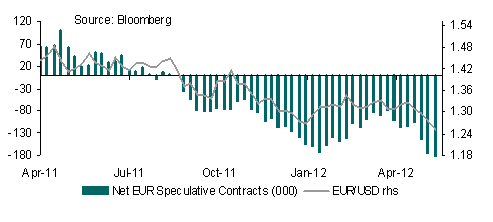
The EUR has lost momentum following its initial surge higher and looks constrained on any move above 1.3000. While EUR short positions have continued to be pared back according to IMM data the scope for short covering is becoming more limited. Developments in Spain and Greece will provide further guidance for the currency, but any upside in EUR/USD will be limited to resistance around 1.3180. It seems more likely that having failed to sustain gains, the EUR will continue to drift lower.
EUR jumps on Spanish news, but Greek risks ahead

Spain’s request for a EUR 100 billion bailout for its banks has significantly shifted the bias for markets this week, with risk assets buoyed and safe haven assets pressured. The fact that Spain will receive a bailout ‘light’ in terms of the conditions of the loan, will also have come as good news as the stringent measures associated with bailouts of Greece, Portugal and Ireland, will be avoided. Taken together with mixed (but less bad than feared) Chinese data over the weekend, the scene is set for markets to rally early in the week.

However, plenty of event risk remains, not least of which is the outcome of Greek elections at the weekend and results of French parliamentary elections today, which could easily reverse the positive mood of markets.

The USD has continued to head lower a trend that has been established since the end of May, with its drop set to accelerate at the start of the week following news of Spain’s banking bailout and the subsequent bounce in risk assets.

Although Fed Chairman Bernanke provided some relief for the USD last week by not indicating a desire to embark on fresh quantitative easing, the reality is that US data has been disappointing of late, keeping the door open to such action, restaining the USD.

More damaging to the USD is the bounce in risk appetite even before the Spanish news. Softer US data this expected week including likely sluggish May retail sales, a small increase in industrial production and lower manufacturing and consumer confidence surveys, will keep the debate on QE firmly open, leaving the USD struggling in the days ahead.

EUR/USD lurched higher following Spain banking bailout request. However, the sum of EUR 100 billion is far higher than the EUR 40 billion anticipated and could add around 20% to Spain’s sovereign debt. While the size of the package is significant it is also worrying, a fact that could come back and haunt the EUR.

Undoubtedly the upside in EUR is being helped by the fact that speculative positioning reached a fresh record low last week (according to the CFTC IMM data) leaving plenty of scope for short covering. In the near term EUR/USD will remain buoyed but any gains will be restricted to technical resistance around the EUR/USD 1.2690 level where sellers will emerge, especially given uncertainty surrounding the outcome of Greek elections.

Sell Euro into rallies

There was limited respite for markets in yesterday’s thin market trading, with any bounce in risk appetite sold into quickly. This is exactly the pattern of trading that is likely to take place over coming weeks as Greece remains in the spotlight while Spanish banking woes garner more attention.

Taken together with rising global growth worries (note the Baltic Dry Index is turning over again) suggests that it will be very difficult for markets to drag themselves out the quagmire. The lack of major data releases today, with only German inflation and US consumer confidence of note, suggests that there will be little for markets to take their minds off the Eurozone debt crisis.

EUR/USD hit a high around 1.2625 helped no doubt by the fact that positioning was at record short levels. However, the bounce was quickly sold into leaving the EUR vulnerable to a drop below 1.2500 today. A renewed sell off in Spanish debt as banking sector concerns intensify dented any positive impact from weekend polls in Greece showing more support for pro bailout parties.

There is little on the data front today aside from German CPI leaving markets to continue to ponder on peripheral country woes. “Grexit’ fears have by no means been quelled as the reduction in bank deposits continues to show. EUR/USD will struggle to make any headway against this background, with further probing below 1.2500 likely in coming days.

The job of the Swiss National Bank has become increasingly tougher. Speculation of a ‘Grexit’ and continued flight of capital from Greece as well as other peripheral countries means that there is more prospect of upside for the CHF than downside versus EUR. The EUR/CHF 1.2000 floor has not deterred investors from parking such capital in CHF much to the chagrin of the SNB which has even warned about implementing capital restrictions.

Elevated risk aversion means that inflows of capital to Switzerland from the Eurozone periphery will persist. As a result EUR/CHF looks set to trade around the 1.2000 floor for some time to come, with the risk that the SNB has to increasingly buy EUR to protect the floor.