
When investors’ concerns shift from how low will the EUR go to whether the currency will even exist in its current form, it is blatantly evident that there is a very long way to go to solve the eurozone’s many and varied problems. As many analysts scramble to revise forecasts to catch up with the declining EUR, the question of the long term future of the single currency has become the bigger issue. Although the EUR 750 billion support package was hailed by EU leaders as the means to prevent further damage to the credibility of the EUR, it has failed to prevent a further decline, but instead revealed even deeper splits amongst eurozone countries.
Although the European Central Bank (ECB) confirmed that it bought EUR 16.5 billion in eurozone government bonds in just over a week, with the buying providing major prop to the market, private buyers remain reluctant to renter the market. As a result of the ECB’s sterilised interventions bond markets have stabilised but the EUR is now taking the brunt of the pressure, a reversal of the situation at the beginning of the Greek crisis, when the EUR proved to be far more resilient. Reports that some large institutional investors have exited from Greek and Portuguese debt markets whilst others are positioning for a eurozone without Greece, Portugal and Spain, suggest that the ECB may have taken on more than it has bargained for in its attempts to prop up peripheral eurozone bond markets.
As was evident in the US March Treasury TICS report it appears that a lot of the outflows from Europe are finding their way into US markets. The data revealed that net long-term TIC flows (net US securities purchases by foreign investors) surged to $140.5 billion in March. The bulk of this flow consisted of safe haven buying of US Treasuries ($108.5 billion), although it was notable that securities flows into other asset classes were also strong especially agencies and corporate bonds, which recorded their biggest capital inflow since May 2008. Asian central banks also reversed their net selling of US Treasuries, with China investing the most into Treasuries since September 2009. Anecdotal evidence corroborates this, with central banks in Asia diversifying far less than they were just a few months ago.
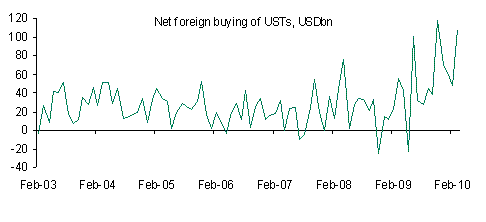
This reversal of flows is unlikely to stop anytime soon. It is clear that enhanced austerity measures in the eurozone will result in weaker growth and earnings potential. This will play negatively on the EUR especially given expectations of a superior growth and earnings profile in the US. Evidence of implementation, action and a measure of success on the fiscal front will be necessary to begin the likely long process of turning confidence in the EUR around. This will likely take a long time to be forthcoming. EUR/USD has managed to recover after hitting a low of around 1.2235 but remains vulnerable to further weakness. The big psychological barrier of 1.20 looms followed by the EUR launch rate of around 1.1830.

 ECONOMETER