Q1 Economic Review: Elections, Recovery and Underemployment

I was recently interview by Sital Ruparelia for his website dedicated to “Career & Talent Management Solutions“, on my views on Q1 Economic Review: Elections, Recovery and Underemployment.

Sital is a regular guest on BBC Radio offering career advice and job search tips to listeners. Being a regular contributor and specialist for several leading on line resources including eFinancial Careers and Career Hub (voted number 1 blog by ‘HR World’), Sital’s career advice has also been featured in BusinessWeek online.

As you’ll see from the transcript of the interview below, I’m still cautiously optimistic about the prospects for 2010 and predicts a slow drawn out recovery with plenty of hiccups along the way.

Sital: Mitul, when we spoke in December to look at your predictions for 2010, you were cautiously optimistic about economic recovery in 2010. What’s your take on things after the first quarter?

Click here to read the rest…

Why Buy Asian FX (Part 2)

The strength of portfolio capital inflows into Asia reflects the outperformance of Asian economies relative to Western economies. Whilst the US, Europe, Japan and UK have struggled to recover from recession and are likely to register only sub-par recovery over the coming months, Asian economies led by China are recovering quickly and strongly. This pattern is set to continue, leading to a widening divergence between Asian and G7 economic growth.

As growth strengthens inflationary pressures are set to build up and Asian central banks will likely raise interest rates more quickly than their G7 counterparts. Already some central banks have moved in this direction, with India, Malaysia, Philippines and Vietnam, having tightened policy. This will be followed by many other central banks in Asia over Q2 2010 including China. Even countries with close trade links to Asia, in particular Australia will rate hikes further over coming months, with Australian interest rates likely to rise to a peak of 5% by year-end.

Given that the US is unlikely to raise interest rates in 2010 higher interest rates across Asia will result in a widening in the interest rate differential with the US leading to more upside potential for Asian currencies as their ‘carry’ attraction increases relative to the USD. The most sensitive Asian currencies to interest rate differentials at present are the Malaysian ringgit (MYR), Thai baht (THB) and Philippines peso (PHP) but I believe that as rates rise in Asia, the sensitivity will increase further for many more Asian currencies.

Most Asian currencies have registered positive performances versus the USD in 2010 led by the MYR and Indonesian rupiah (IDR) and closely followed by the Indian rupee (INR), THB and South Korean won (KRW). The notable exception is China which has been unyielding to pressure to allow the CNY to strengthen. Even China is set to allow some FX appreciation although if the US labels China as a “currency manipulator” it could prove counterproductive and even result in a delay in CNY appreciation.

Looking ahead, the trend of strengthening Asian FX will continue likely led by the likes of the KRW and INR but with the MYR, TWD and IDR not far behind. Stronger growth, higher interest rates, strengthening capital inflows and higher equity markets will contribute to appreciation in Asian currencies over the remainder of the year.

FX / Economic Preview

The European Union (EU) aid package for Greece and extension of collateral requirements by the European Central Bank (ECB) helped return a semblance of confidence to markets. Although the probability of a Greek default now looks extremely small, further austerity measures, fiscal issues in other EU countries and the negative impact on growth that all of this implies, suggest that Europe will be plagued by various problems for some time yet.

As a result of more favourable market conditions Greece is set to launch a syndicated bond issues today or tomorrow of up EUR 5 billion according to press reports. Attention will also turn to Greek debt rollovers, beginning with EUR 8.2 billion on April 20.

Improving sentiment following the Greece deal has extended to the EUR, with the currency bouncing off its lows around 1.3267. EUR/USD will now look to break through resistance around 1.3446, which would set up a test of 1.3516. There is plenty of scope for short-covering to help the EUR as reflected in the latest IMM Commitment of Traders’ report (a gauge of speculative market positioning) which revealed net EUR positions reaching yet another record low in the week to 23rd March. Whilst sovereign/official buying interest may keep EUR/USD supported this week the currency pair is best played as a sell on rallies.
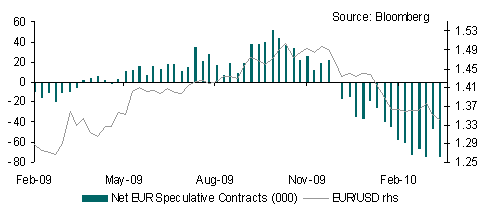
A similar assessment applies for GBP. Speculative sentiment for the currency also hit a record low in the latest week but unlike the Greek deal helping the EUR, last week’s UK budget has done little to boost GBP’s prospects. Moreover, a report in the Financial Times highlighting hedge funds bets against GBP, suggests that there are still plenty of headwinds against the currency.

Volumes are set to thin out this week ahead of upcoming holidays, whilst the US March jobs report at the end of the week will likely prevent moves out of current ranges ahead of its release. The consensus forecast is for a 190k increase in non-farm payrolls though much of this is likely to reflect hiring for the 2010 US consensus and a rebound from adverse weather effects in February.

In Europe March economic confidence surveys will be watched closely to determine how much damage Greece and general fiscal woes are having on sentiment. Some improvement, in line with the Eurozone Purchasing Managers Index (PMI) and the German IFO business confidence survey, is expected, which will help to give further, albeit limited relief to the EUR.

The Japanese data slate kicked off the week in good form, with the release of February retail sales data, revealing its biggest annual increase in 12-years. It is difficult to see the recovery in sales taking much greater hold given persistent deflation pressures however, and part of the gain probably reflects the government’s shopping incentive program.

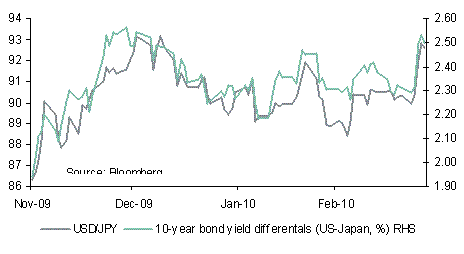
Aside from industrial production and jobs data in Japan the key release will be the results of the Q1 Tankan survey on Wednesday. The survey of manufacturers’ confidence is set to show further improvement. USD/JPY is likely to remain supported around 91.67 but will need a further widening in US/Japan 10-year bond yield spreads to push higher.

US Dollar Back On Top As Yields Rise

Two issues are driving markets and both are playing negatively for sentiment; the rise in G7 bond yields and the outcome of the EU summit. At a time when G7 bond yields have been pushing higher the poor response to the US $32 billion 7-year note sale contributed to a further increase in yield. The sale resulted in a yield of 3.374%, which was higher than expected, and a bid/cover ratio of 2.61. A combination of large US Treasury supply, medium term funding issues and signs of improving growth suggest no let up for US Treasuries.

The most reactive currency to yield differentials is currently USD/JPY. The 1-month correlation between USD/JPY and US/Japan bond yield differentials is a high 0.85. The spike in US 10-year Treasury yields especially relative to JGB yields (by around 21 basis points this week) is the main contributor to the jump in USD/JPY over recent days. Given the bearish outlook for US bonds in the near term, it suggests more upside for USD/JPY but also increasingly for other currencies against the USD as the importance of yield increases. Immediate USD/JPY technical resistance is seen around 93.21, with support at 91.87.

The other event of note yesterday was developments surrounding Greece in the European Union summit though in truth it was probably the strong comments by ECB President Trichet that had the bigger impact on EUR sentiment. The final EU communiqué noted the readiness for bilateral loans to Greece and substantial International Monetary Fund (IMF) financing in a Greek aid mechanism. Importantly and a likely sop to Germany, any aid will not contain a subsidy for Greece. Aid by the EU and IMF will only be provided in the event of “very serious difficulties”.

The EU agreement means that no money will be forthcoming immediately, but at least there will be a back stop should Greece have financing difficulties over coming weeks, which will act as an important safety net ahead of substantial Greek debt rollovers. This news was supplemented by the fact that ECB will not raise its minimum collateral requirements at the end of the year, which means that Greek debt will not be excluded in the event of a ratings downgrade. This is good news for Greece.

The combination of the fact that Greece will have to borrow money only at market rates, ongoing worries about other EU countries fiscal problems and European Central Bank (ECB) President Trichet putting somewhat of a dampener on sentiment by criticizing IMF involvement in the deal, will keep the EUR under pressure. Although Trichet later reversed his comments, the damage was already done and any relief to EUR/USD will be short-lived. The currency pair is increasingly poised for a further downside move, with the next target at 1.3213 on the path towards an eventual test of 1.3000.

Greek Confusion, India Tightening

It is highly interesting that markets could take fright from a rate hike in India but this appears to be what has happened. India’s surprise 25bps rate hike has provoked another bout of risk aversion whilst the lack of any concrete agreement on a framework for a Greek bail out dealt a further blow to confidence. FX tensions between the US and China have not helped, with China threatening retaliation to any US move to name the country as a currency manipulator in the mid April US Treasury report.

Should we really be worried by a rate hike in India or China? Whilst the India rate move reflects the fact that emerging market central banks are moving far more aggressively to raise rates than their G7 counterparts, global fears that India’s move will dampen recovery prospects are unfounded. Monetary tightening in India and China and other economies is taking place against the backdrop of economic strength not weakness.

As such the global impact on growth should be limited. Rising inflation pressure in Asia is reflection of the much quicker economic recovery, relatively low rates and undervalued currencies in the region. Not only will central banks in Asia have to raise interest rates but will also have to allow further currency appreciation.

There is still plenty of confusion about a bail out for Greece ahead of the 25-26th March EU summit. German Chancellor Merkel dampened expectations of a bailout by stating that it was not even on the agenda for the summit. In contrast, EU President Barroso has pushed EU members to agree on an explicit stand-by aid agreement for Greece as soon as possible.

There is also disagreement about whether there should be any IMF involvement, with Germany favouring some help from the Fund whilst France opposes it. Meanwhile, the Greek Prime Minister has reportedly given an ultimatum that should no aid plan be forthcoming at the EU summit, Greece will turn to the IMF for assistance.

All of this suggests more downside for EUR/USD, with a test of support around 1.3422 looming. In the event that the EU summit offers good news for Greece, EUR/USD sentiment could turn quickly so a degree of caution is warranted. Speculative sentiment for the EUR has improved according to the latest CFTC Commitment of Traders (IMM) data for the week to 16th March, with net short EUR positions at their lowest since the beginning of February. Nonetheless, the short covering seen over the past week could come to an abrupt end should there be no aid package for Greece.

The most volatile currency over the past week was GBP/USD and after hitting a high of around 1.5382 it has slid all the way back to around the 1.5000 level. Much of this was related to the gyrations in EUR/USD but GBP took on a life of its own towards the end of the week and has not been helped by comments by BoE MPC member Sentence who highlighted the risk of a “double-dip” recession in the UK.

GBP is highly undervalued and market positioning is close to a record low but a sustainable recovery looks unachievable at present. Attention this week will centre on the 2010 UK Budget announcement and markets will scrutinise the details of how the government plans to cut the burgeoning budget deficit. Failure to restore some credibility to the government’s plans will dent GBP sentiment further and lead to a sharper decline against both the EUR and USD.