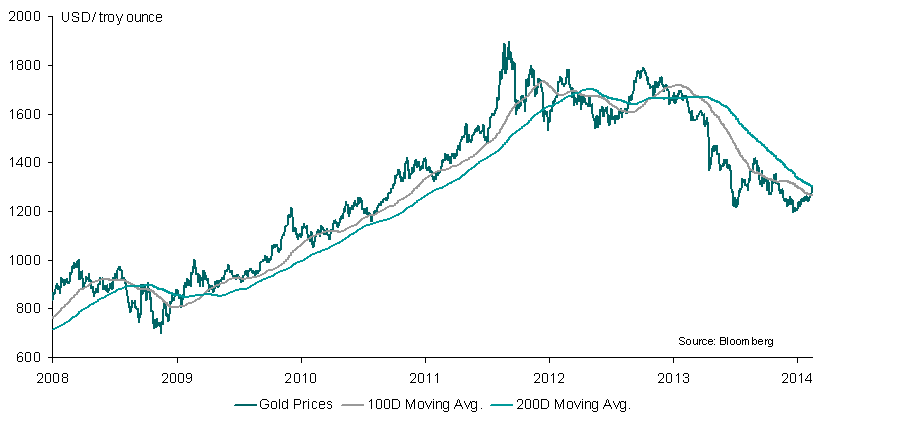
Gold breaches its 200 day moving average

AUDjobsGold prices have risen sharply since the beginning of the year, up over 8% year to date. Higher risk aversion, lower US yields and a weaker USD have boosted gold. Consequently gold prices are trading around their 200 day moving average level around 1303.70. This could prove significant, with a close above the 200 day moving average important to sustain any short term uptrend,

Encouraging signs for gold bulls
ETF investor demand appears to have stabilised over recent weeks while CTFC IMM demand appears to be picking up. This data suggests that Investors are tentatively moving back into gold. The poor performance of equity markets since the start of the year has indeed made gold look more attractive as an investment while lower yields mean that the opportunity cost of holding gold has lessened.

Chinese demand for gold increases sharply
Additionally gold demand from China has picked up strongly. China Gold Association data showed that Chinese demand for gold jumped 41% to 1,176 tonnes last year. Chinese demand likely overtook India’s last year. Oddly Chinese import and production data were even stronger, making it possible that China bolstered its reserves with gold last year.

Indian restrictions hit demand
India restricts demand for gold via import restrictions. However, there is a lot of pressure domestically to remove these restrictions and a review is scheduled to take place at the end of the fiscal year at end March 2014. If these restrictions are removed or at the least weakened, Indian gold imports could increase sharply but it seems unlikely that imports will rise as strongly as previous years.

Moreover, the Indian government will want to avoid an adverse impact on India’s current account deficit, suggesting that a complete removal of gold import restrictions is unlikely. However, in the meantime the restrictions are having a major impact on Indian gold demand which dropped sharply last year.

Gold rally to fade
Risk appetite has already improved sharply over February and while I continue to expect bouts of volatility in the weeks and months ahead I do not expect to see sustained periods of elevated risk aversion. Therefore any boost to gold from rising risk aversion is set to prove temporary in the months ahead.

Secondly global inflation pressures remain well contained. Inflation for the major economies is likely to remain benign. Only in Japan is inflation expected to pick up but this is an aim of policy and is not expected to result in a bout of gold buying to hedge against such inflation risks. Therefore, gold demand as an inflation hedge will not take place.

Two major drivers of the gold price are US bond yields and the US dollar. Both are highly correlated with gold price gyrations, with gold falling as US yields and the USD rise and vice-versa. Both yields and the USD are set to rise over the coming months. Consequently any short term gold price gains are unlikely to hold, with the metal set to resume its decline.

US dollar soft ahead of retail sales

The USD has lost a fair bit of ground in February failing to benefit from a renewed rise in US Treasury yields. A more positive risk environment recently has undermined some of the demand for USDs while some negative data surprises such as the ISM manufacturing survey and non farm payrolls have also weighed on demand for the USD.

The release of January retail sales data today will give another opportunity to gauge the path of consumption at the turn of the year but unfortunately for the USD a relatively flat outcome for sales will provide little rationale to buy the currency. The consensus expectation is for headline retail sales to post a 0% monthly reading, while sales ex autis is likely to rise by a measly 0.1%.

In the near term this implies little potential for a USD rebound but over but over coming weeks I expect the USD to rally in line with higher US yields. USD index (DXY) is likely to flatline around the 80 level in the coming sessions before rallying over coming weeks.

A more constructive start to the week

Following a period of heightened volatility markets ended last week on a more positive note. Despite another soft reading for US non farm payrolls in January which revealed jobs growth of 142k following a gain of 74k in the previous month, markets took some comfort from a drop in the unemployment rate to 6.6% which for a change was not related to a drop in the participation rate. The participation rate rose to 63.0% in January.

Against this backdrop Fed Chairman Yellen will be giving her first testimony to Congress this week and while there is likely to be little change to the Fed’s policy outlook there will need to be some reassessment of the Fed’s forward guidance, especially given the surprisingly quick drop in the unemployment rate. The USD index slipped last week but we expect a slightly firmer tone to ensue over coming days in line with higher US yields.

Markets will kick off the week much as they left off last week, with a calmer and more constructive tone likely. Aside from Yellen’s speeches, US data will be soft on the whole, with January retail sales likely to post a small decline, while industrial production will record a gain and Michigan sentiment will fall, with consumer confidence weighed down by weaker equity markets.

My Interview on Reuters / ET Now

Watch my interview on Reuters / ETNOW. Click on the link below

videoId=276730253&videoChannel=104″>http://in.reuters.com/video/2014/02/06/need-reform-oriented-government-in-india?videoId=276730253&videoChannel=104

“Mitul Kotecha, head of global markets research Asia & FX strategy at Credit Agricole CIB, is more optimistic on emerging markets than before but sees risk aversion among investors in EM equities. He tells ET NOW, investors are awaiting the election outcome and says it’s essential a reform-oriented government comes to power.”

Attention turns to ECB and BoE

Ahead of two key central bank policy decisions by the European Central Bank and Bank of England where no change is expected as well as tomorrow’s release of the US jobs report, range trading is likely to dominate. Risk aversion measures remain elevated however, and further slippage by US stocks was recorded overnight.

The USD remained supported within ranges, helped by firmer US Treasury yields. Fed officials overnight showed little inclination to alter the pace of tapering despite the recent turmoil in emerging markets suggesting that emerging markets can expect little relief from the Fed.

Meanwhile, US data releases provided mixed signals, with the ADP private sector employment report (a key indicator for tomorrow’s non farm payrolls data) coming in below consensus at 175k in January (consensus 185k) while the US ISM non manufacturing survey (a survey of service sector participants) was slightly higher than consensus at 54.0 in the same month.

Aside from the policy rate decisions December US trade data and Q4 non farm productivity are on tap today although neither are likely to be big market movers.