Calm ahead of US payrolls and ECB meeting

It’s non-farm payrolls week in the US, with currencies treading water until Friday when the report is released. Ahead of the data there are several other releases on tap which will give clues to the outcome of the April jobs report, including the ISM manufacturing survey and ADP jobs report. The USD has taken a softer tone as risk appetite improved and US bond yields dropped further.

Given the Fed kept open the door to more easing it will act as a restraint on the USD unless markets become convinced that there will no further Fed balance sheet expansion over coming months. In the meantime unless risk aversion spikes again the USD is set to find it difficult to sustain any gains.

It’s always the same story with the EUR, a tale of ongoing resistance to bad news. Weaker Eurozone confidence surveys as well as a downgrade to Spain’s credit ratings did little to weaken the EUR. The key event is the European Central Bank (ECB) meeting on Thursday but despite growing growth worries, a policy rate cut is unlikely as the ECB remains in wait-and-see mode.

Data releases will not be too damaging for the EUR, with monetary and credit aggregate set to rise and German retail sales set to rebound in March. The EUR looks poised to edge higher against this background in the short term, but will be constrained by uncertainty ahead of the US jobs report. Technical resistance to the upside will be found around the 1.3265 area.

The JPY barely flinched when the Bank of Japan announced an expansion of its asset purchase fund by JPY 10 trillion in its aim to reach a 1% inflation goal. Unfortunately for the BoJ the ongoing narrowing in the US Treasury yield premium over Japan JGB yields overwhelmed the negative impact of its action on the JPY.

Overall, my quantitative models continue to show USD/JPY lower over the short term, with a move below 80.00 on the cards. If as I expect, risk aversion also creeps higher, it will imply more short term upside JPY pressure. Trading will be relatively quiet, with no major data on the calendar due to Golden Week holidays in Japan.
FX volatility declining, AUD still vulnerable

FX options appear to be increasingly comfortable with the current lack of movement in currencies. For example, 3-month EUR/USD implied volatility has dropped to multi-year lows while my measure of G3 implied volatility has been at very low levels over recent months.

This has corresponded with the drop in risk aversion as market fears over US growth and Eurozone debt issues recede. Over the short term there appears to be little to jolt markets out of their stupor and if anything EUR/USD is likely to continue to drift higher according to our short term quantitative models.

Indeed, firmer risk appetite, despite the odd hiccup, plays positively for the EUR while the pull back in US bond yields has restrained the USD. The Ecofin meeting beginning tomorrow will likely give further support to the EUR, if as expected, ministers bolster the Eurozone ‘firewall’.

It has been a one step forwards, two steps back motion for AUD/USD over recent weeks as it continues to edge lower. Although US bond yields have pulled back Australian yields have pulled back relatively more, reducing Australia’s yield advantage and weighing on the AUD in the process.

Over recent weeks speculative AUD positioning has also fallen, reflecting deteriorating sentiment for the currency, but the fact that the market is still long suggests scope for further short term downside.

Aside from yield differentials most of the usual correlations with AUD have broken down suggesting that the AUD is getting a dose of independent weakness. However, China news remains a key focal point for AUD and the decline in the Shanghai composite stock index has become an interesting lead indicator for AUD performance. Over the near term AUD will likely continue to weaken in jagged steps.

Dear readers please note that there will be very limited updates of econometer.org over the next couple of weeks due to my Easter vacation.

JPY retracement, CHF pressure

Risk assets rallied overnight, the USD weakened and US Treasury yields rose. There was little new in terms of economic news, with only NAHB March homebuilders confidence of note, which came in slightly weaker than expected. The bigger driver for markets was the news that Apple Inc. will pay around USD 45 billion in dividends and share buybacks over the next 3-years.

Today sees a crop of second tier releases including housing starts and building permits in the US and inflation data in the UK while there will also be attention on a speech by Fed Chairman Bernanke. Risk assets will remain supported but I continue to see consolidation for markets in the near term.

USD/JPY has retraced lower as warned last week. My quantitative models suggest scope for even more of a correction lower, with a drop below 83.00 on the cards in the short term. While the upward move in the currency pair was built on a widening in the US yield advantage over Japan, the move looks overdone. Nonetheless, any pullback will offer better levels to initiate long USD/JPY medium term positions.

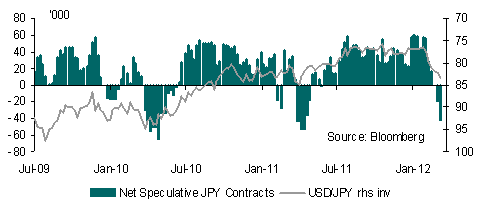
Clearly the market believes that the JPY will weaken further given the build up in JPY short positions over recent weeks, with shorts at their highest since April 2011. February trade data to be released on Thursday will provide further fuel for JPY bears given the persistence of a trade deficit and weakness in exports.

Following the bounce in EUR/CHF last week the currency pair has dropped back into its recent tight range around the 1.2050-1.2070 area. Strong warnings by the Swiss National Bank at its policy meeting did not lead to any follow through on the CHF. I expect a gradual drift higher in EUR/CHF over coming weeks in line with the incremental change in sentiment for the Eurozone as Greece slips from the radar.

Official pressure for CHF weakness will remain intense given the deterioration in economic data as likely to be revealed in today’s release of Q4 industrial production. Nonetheless, the SNB will be wary of confronting the market in terms of FX intervention to weaken the CHF despite its verbal warnings. Meanwhile USD/CHF remains highly sensitive to gyrations in the USD index given its strong correlation, suggesting some consolidation in the short term as the USD pulls back.

Consolidation

The overall tone to markets remains a positive one. Core bonds (Treasuries, bunds) have taken on a bearish tone in the wake of strengthening economic data and have established the usual bullish equities / bearish bonds relationship. Meanwhile volatility measures both in equity and currency markets have dropped to historically low levels.

The USD has been propelled by higher US bond yields but looks vulnerable as US Treasuries consolidate in the short term. Data this week is fairly light, suggesting that direction will be limited as only housing data in the US and purchasing managers’ indices in Europe will be of interest. Overall, the start to the week will see markets in consolidation mood.

The USD index had made up plenty of ground since hitting its lows around 78.095 at the end of February. Higher US bond yields in the wake of strengthening economic data and receding expectations of more Fed money printing have boosted the USD. Nonetheless, US Treasuries appear to be consolidating their losses (ie yields have failed to push higher recently), limiting the ability of the USD to strengthen further.

Data releases in the US this week will be mainly centred on the housing market and are unlikely to be strong enough to warrant a further strengthening in the currency. Much will also depend on gyrations in risk. My Risk Barometer has moved into ‘risk loving’ territory, which plays negatively for the USD versus many high beta currencies. The USD will struggle to make further gains in the short term.

The agreement to furnish Greece with a second bailout gave the EUR no help whatsoever. Instead, higher US Treasury yields relative to bunds dealt the EUR a strong blow and the currency came dangerously close to dropping below the 1.3000 psychologically important level versus USD. Even a narrowing in peripheral bond spreads against the core has failed to give the EUR a lift. Further EUR losses will be limited over coming days but only because US yields have not pushed higher.

Nonetheless, the technical picture has turned bearish and any relief could prove temporary. A mixed batch of data releases including ‘flash’ purchasing managers’ indices which overall will reveal the composite PMI below the 50 boom/bust level for a second month in a row, will not be particularly helpful for the EUR. EUR/USD is likely to be stuck in a 1.2974 – 1.3291 range over coming sessions.

USD finding support, AUD slipping

US bond yields look relatively well supported and in turn this is providing a degree of support for the USD. In this respect the firmer than consensus reading in a gauge of service sector activity, the February US ISM non-manufacturing survey (57.3 versus 56.8 in January) which contrasted with relatively weak service sector purchasing managers’ indices (PMI) in Europe, helped to maintain the healthy yield differential between the US and German bunds.

Combined with the generally ‘risk off’ sentiment pervading markets, in part due to the weaker PMI data, the USD looks to be in good form early in the week. The next market mover will be Wednesday’s ADP jobs report (a measure of jobs growth in the services sector), which will provide clues to Friday’s February non-farm payrolls outcome. In the meantime the fact that the speculative market (IMM) is positioned short USD (for the first time since September 2011) suggests that the room for further USD selling looks limited, with the USD index looking well supported above 79.00.

AUD and other high beta currencies lost more ground in the wake of the drop in the Chinese non-manufacturing PMI in February. AUD remains highly reactive to Chinese data releases given the high and growing exposure of Australia’s economy to China. Given the likelihood of a soft landing in China this year, the medium term damage to the AUD will be limited and I stil look for AUD/USD to reach 1.10 by year-end.

Over the near term however, there is scope for more AUD downside but much will depend on the outcome of the Reserve Bank of Australia (RBA) policy meeting. Expectations of rate cuts have diminished following recently better data and a less dovish statement at the last RBA meeting. A relatively benign statement will offer the AUD little support, leaving AUD exposed to a drop to technical support to just under 1.06 versus the USD.

Posted in Australia, FX, US. Tags: , , , , , . Leave a Comment »