Euro and Yen capitalise on weaker Dollar

Equities continued their bounce back overnight helped by a reiteration from Fed officials that US monetary policy will remain highly accommodative through late 2014. Risk assets overcame a weaker than expected report on US jobless claims, with a smaller than expected trade deficit in February ($46 billion) helping sentiment. The launch of a North Korean missile which apparently failed did little to dent sentiment. Nonetheless, Spanish concerns continue to weigh on its markets, bucking the trend of improvement elsewhere.

Today’s data slate has little in terms of first tier data on tap, with inflation releases in Europe and the US in focus. The bigger influence will be a slate of Chinese data including Q1 GDP. The market has already priced in a good number (around 9% YOY) and therefore there is a risk of disappointment, which could hit risk assets. Also watch out for earnings from US financials including JP Morgan and Wells Fargo. So far US earnings have been positive, although admittedly its early days yet.

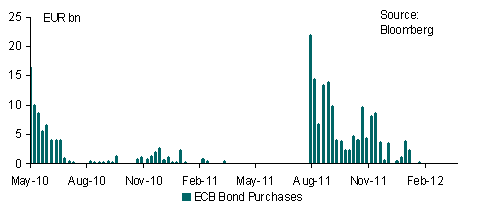
Downward pressure on EUR/USD has lessened for the time being and any further decline will be limited in the short term. While it is evident that the boost to markets provided by the European Central Bank’s Long Term Refinancing Operation (LTRO) has faded, EUR bears have been dealt a blow from renewed prospects of securities market purchases.
Italy’s debt auction yesterday provided little help to the EUR but at least it was not cause of further selling pressure. Concerns about Spain continue but any further downside pressure on EUR/USD will be restricted to technical support around the 1.3004 level (March 15 low), with EUR/USD set to remain in a 1.30-1.32 range.

JPY has pulled back sharply against the USD over the past month as I repeatedly warned. But before I blow my own trumpet any further I would note that further downside risks to USD/JPY remain in place although the room is now more limited than in previous weeks. According to my quantitative model a drop to around 79.00 is likely to mark a low in USD/JPY.

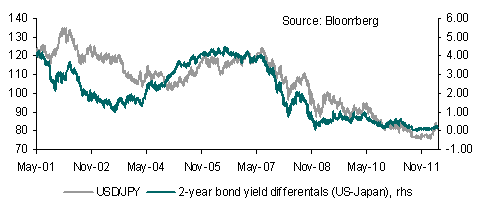
Warnings by the Bank of Japan of more “powerful” monetary easing have helped to prevent further JPY strengthening over recent sessions. However, a renewed narrowing in the US 2-year bond yield advantage over Japan will likely limit any upside for USD/JPY as reflected in the extremely strong correlation between USD/JPY and yield differentials over the past 3-months.
JPY pullback risks, GBP to slip versus USD

A combination of market friendly comments by Fed Chairman Bernanke, a better than expected outcome for the German IFO business confidence survey in March and hopes of a bolstering of the Eurozone bailout fund, have managed to lift risk assets while pressuring the USD. Markets appear to have shaken off, at least for now, growth worries emanating from weaker manufacturing confidence surveys in China and Europe last week.

Nonetheless, while Bernanke maintained that accommodative monetary policy is still required especially given concerns about the jobs market, he did not hint at more quantitative easing, suggesting that market optimism may be tempered in the days ahead. Data and events today include US and French consumer confidence as well as bill auctions in Spain and Italy. US consumer confidence is likely to slip slightly while the bill auctions are likely to be well received.

While I remain bearish on the JPY in the medium term (beyond 1 month), over the near term I believe there is scope for a pull back. The move in USD/JPY has gone beyond what would be expected by the shift in relative yields. This is corroborated by my short term quantitative model which shows that USD/JPY should be trading around 80.

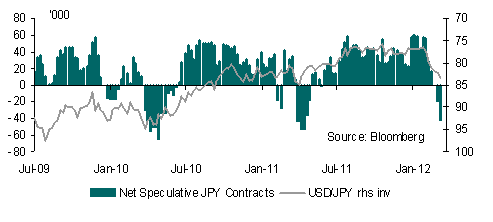
The speculative market is positioned for JPY weakness but also points to some scope for short covering; both CFTC IMM data and Japanese TFX data (a gauge of local margin trading positioning) reveal significant short JPY positions. If as I expect, USD/JPY does pull back it will offer better levels for investors to initiate medium term JPY bearish trades.

Ultimately the JPY will regain its attraction as a funding currency for carry trades and the bigger the shift in relative yield with the US, the more the potential for capital outflows from Japan into higher yielding assets.

GBP has failed to sustain gains above 1.59 against the USD over recent weeks let alone manage to test the psychologically important 1.60 level. The current bounce above 1.59 is unlikely to last. It will require a renewed downtrend in the USD in general provoked by a sharp improvement in risk appetite and/or a drop in US bond yields for GBP to move much higher. Neither seems likely.

Indeed, GBP will be vulnerable to a general firmer USD over the remainder of the year. While I would not suggest playing a bullish call on GBP versus the USD I think there is much more juice in holding GBP versus EUR, with downside risks to this currency pair likely to open up. Indeed, my quantitative models reveal that GBP is mispriced against both EUR and AUD.

JPY retracement, CHF pressure

Risk assets rallied overnight, the USD weakened and US Treasury yields rose. There was little new in terms of economic news, with only NAHB March homebuilders confidence of note, which came in slightly weaker than expected. The bigger driver for markets was the news that Apple Inc. will pay around USD 45 billion in dividends and share buybacks over the next 3-years.

Today sees a crop of second tier releases including housing starts and building permits in the US and inflation data in the UK while there will also be attention on a speech by Fed Chairman Bernanke. Risk assets will remain supported but I continue to see consolidation for markets in the near term.

USD/JPY has retraced lower as warned last week. My quantitative models suggest scope for even more of a correction lower, with a drop below 83.00 on the cards in the short term. While the upward move in the currency pair was built on a widening in the US yield advantage over Japan, the move looks overdone. Nonetheless, any pullback will offer better levels to initiate long USD/JPY medium term positions.

Clearly the market believes that the JPY will weaken further given the build up in JPY short positions over recent weeks, with shorts at their highest since April 2011. February trade data to be released on Thursday will provide further fuel for JPY bears given the persistence of a trade deficit and weakness in exports.

Following the bounce in EUR/CHF last week the currency pair has dropped back into its recent tight range around the 1.2050-1.2070 area. Strong warnings by the Swiss National Bank at its policy meeting did not lead to any follow through on the CHF. I expect a gradual drift higher in EUR/CHF over coming weeks in line with the incremental change in sentiment for the Eurozone as Greece slips from the radar.

Official pressure for CHF weakness will remain intense given the deterioration in economic data as likely to be revealed in today’s release of Q4 industrial production. Nonetheless, the SNB will be wary of confronting the market in terms of FX intervention to weaken the CHF despite its verbal warnings. Meanwhile USD/CHF remains highly sensitive to gyrations in the USD index given its strong correlation, suggesting some consolidation in the short term as the USD pulls back.

Euro pricing in a lot of good news

Markets remain in limbo ahead of a potential Greek debt deal although US equities managed to eek out small gains overnight. Stocks in the US have entered a bull market helped by the dovish stance of major central banks.

The Federal Reserve’s commitment to maintain accommodative policy until the end of 2014 and the European Central Bank’s (ECB)3 year LTRO have been drivers of the rally in risk assets. The BoE will contribute to the easy stance of central banks, with an increase in UK quantitative easing set to be announced today. The ECB in contrast is set to remain in status quo.

Will it be a buy on rumour, sell on fact reaction for the EUR to a Greek debt deal? Over recent days anticipation has grown that a deal on debt writedowns and in turn a second bailout package will emerge soon. This has helped to propel EUR/USD higher, with the currency hitting a high of 1.3289 overnight.

So far a deal has been lacking but leaders are expected to approve a draft agreement on fresh austerity measures between the main Greek political parties today. This should pave the way a deal on debt restructuring and a new loan package for the country due to be discussed today between Eurozone finance officials.

However, the EUR has already priced in a lot of good news on this front and even agreements on the issues above may not see the currency push much higher, with strong resistance around EUR/USD 1.3388. Separately today’s ECB meeting is unlikely to provide much direction for the EUR, with the Bank set to maintain current policy settings.

USD/JPY has managed a recovery of sorts but still remains in the middle of multi month 75.5-78.5 range. Nonetheless, the momentum over the short term will continue to be for USD/JPY upside, with resistance around 77.49 targeted. News that the Japanese authorities conducted ‘stealth intervention’ to weaken the JPY in late October/early November will have emboldened JPY bears.

However, at the same time they should also be worried as it is clear that even after all the intervention the JPY remains overly strong. Reflecting this is the fact that speculative and margin trading JPY positioning is at a very high level.

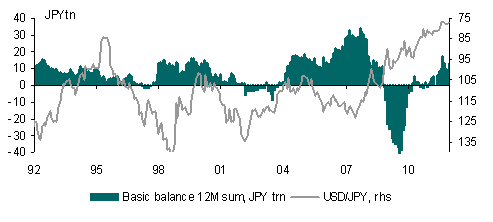
Moreover, while much has been made of the deterioration in Japan’s current account balance over recent months and the potentially negative impact on the JPY it should be noted that Japan’s basic balance (sum of direct investment + current account + portfolio flows) position remains healthy (for now) and is acting as an obstacle to JPY weakness.

Contagion spreading like wildfire

EUR continues to head lower and is is destined to test support around 1.3484 versus USD where it came close overnight. Contagion in eurozone debt markets is spreading quickly, with various countries’ sovereign spreads widening to record levels against German bunds including Italy, Spain, France, Belgium and Austria. Poor T-bill auctions in Spain and Belgium, speculation of downgrades to French, Italian and Austrian debt, and a weak reading for the November German ZEW investor confidence index added to the pressure.

A bill auction in Portugal today will provide further direction but the precedent so far this week is not good. The fact that markets have settled back into the now usual scepticism over the ability of authorities in Europe to get their act together highlights the continued downside risks to EUR/USD. Although there is likely to be significant buying around the 1.3500 level, one has to question how long the EUR will continue to skate on thin ice.

The Bank of Japan is widely expected to leave policy unchanged today but the bigger focus is on the Japanese authorities’ stance on the JPY. Finance Minister Azumi noted yesterday that there was no change in his stance on fighting JPY speculators. To some extent the fight against speculators is being won given that IMM speculative positions and TFX margin positioning in JPY has dropped back sharply since the last FX intervention to weaken the JPY.

However, this has done little to prevent further JPY appreciation, with USD/JPY continuing to drift lower over recent days having already covered around half the ground lost in the wake of the October 31 intervention. Markets are likely therefore to take Azumi’s threats with a pinch of salt and will only balk at driving the JPY higher if further intervention takes place. Meanwhile, USD/JPY looks set to grind lower.

GBP will take its direction from the Bank of England Quarterly Inflation Report and October jobs data today. There will be particular attention on the willingness of the BoE to implement further quantitative easing. A likely dovish report should by rights play negatively for GBP but the reaction is not so obvious. Since the announcement of GBP 75 billion in asset purchases a month ago GBP has fared well especially against the EUR, with the currency perhaps being rewarded for the proactive stance of the BoE.

Moreover, the simple fact that GBP is not the EUR has given it a quasi safe haven quality, which has helped it to remain relatively resilient. Nonetheless, GBP will find it difficult to avoid detaching from the coat tails of a weaker EUR and in this respect looks set to test strong support around GBP/USD 1.5630 over the short term.