Yuan band widening, Euro still under pressure, Yen firm

The big news over the weekend was the widening in China’s CNY trading band to 1% from 0.5% previously. It is unlikely to have much of an impact on global markets, with the move not particularly surprising.

China clearly wants to add more two-way risk to the market and in this way the it allows the CNY to better reflect daily market conditions. Nonetheless, CNY is currently seen around equilibrium and appreciation pressure is limited , suggesting that intra day volatility will remain limited.

The USD index is trading around the middle of its range for the year and FX volatility has declined. Recent data disappointments have taken the shine off the USD and revitalized the debate on more Fed quantitative easing. Bouts of risk aversion have given some support to the USD but this has to be balanced against weaker US data.

It will require a renewed rise in US bond yields and an increase in risk aversion before the USD can strengthen anew. Data over coming days may offer some support but whether releases including retail sales, manufacturing surveys and industrial production prove sufficiently strong to boost US bond yields is debatable, suggesting another week of benign USD action.

EUR/USD remains close to its recent lows and is showing little inclination to move back up towards the top of its 1.30-1.35 range. Renewed worries about Spain’s fiscal/debt position as well as opposition to reforms in Italy threaten to keep the EUR restrained.

Data releases may actually regain some attention over coming days however, with the key April German ZEW and IFO surveys scheduled for release. The former is expected to fall slightly while the latter is expected to remain close to the March level.

Given that both surveys have been rising over recent months the outcomes will not prove particularly worrying. However, little change expected in both surveys suggests that the EUR will find little support either. EUR/USD technical support is seen around 1.2974.

Another trade deficit expected in March in Japan will support a JPY bearish view but in reality much of the reason for the deficit is not related to the strength of the JPY but rather external demand weakness and strong energy imports.

Nonetheless, the rise in the JPY over recent days will have fuelled renewed concerns among Japanese policy makers while piling on the pressure on the Bank of Japan to be more aggressive on its policy stance.

I suspect USD/JPY may have further to fall in the short term as its move corresponds with the narrowing in the US yield advantage over Japan. A drop below USD/JPY 80 looks increasingly on the cards.
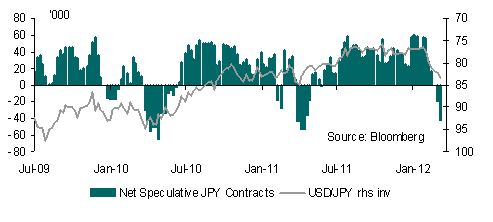
JPY retracement, CHF pressure

Risk assets rallied overnight, the USD weakened and US Treasury yields rose. There was little new in terms of economic news, with only NAHB March homebuilders confidence of note, which came in slightly weaker than expected. The bigger driver for markets was the news that Apple Inc. will pay around USD 45 billion in dividends and share buybacks over the next 3-years.

Today sees a crop of second tier releases including housing starts and building permits in the US and inflation data in the UK while there will also be attention on a speech by Fed Chairman Bernanke. Risk assets will remain supported but I continue to see consolidation for markets in the near term.

USD/JPY has retraced lower as warned last week. My quantitative models suggest scope for even more of a correction lower, with a drop below 83.00 on the cards in the short term. While the upward move in the currency pair was built on a widening in the US yield advantage over Japan, the move looks overdone. Nonetheless, any pullback will offer better levels to initiate long USD/JPY medium term positions.

Clearly the market believes that the JPY will weaken further given the build up in JPY short positions over recent weeks, with shorts at their highest since April 2011. February trade data to be released on Thursday will provide further fuel for JPY bears given the persistence of a trade deficit and weakness in exports.

Following the bounce in EUR/CHF last week the currency pair has dropped back into its recent tight range around the 1.2050-1.2070 area. Strong warnings by the Swiss National Bank at its policy meeting did not lead to any follow through on the CHF. I expect a gradual drift higher in EUR/CHF over coming weeks in line with the incremental change in sentiment for the Eurozone as Greece slips from the radar.

Official pressure for CHF weakness will remain intense given the deterioration in economic data as likely to be revealed in today’s release of Q4 industrial production. Nonetheless, the SNB will be wary of confronting the market in terms of FX intervention to weaken the CHF despite its verbal warnings. Meanwhile USD/CHF remains highly sensitive to gyrations in the USD index given its strong correlation, suggesting some consolidation in the short term as the USD pulls back.

Limbo ahead of Fed FOMC meeting

A mixed session overnight leaves markets with little direction ahead of the Bank of Japan and Federal Reserve FOMC meetings today. There was no stimulus for markets from the meeting of European officials yesterday while Greece’s debt swap has failed to boost confidence.

Overall there is a real hesitancy for investors to take positions, with both volumes and volatility remaining very low. For instance the VIX volatility gauge has dropped to its lowest level since May 2011 while my measure of composite FX volatility continues to languish at relatively low levels compared to last year.

The USD has little to fear from the Fed FOMC meeting tonight. If anything it may even benefit from a less downbeat statement from Fed Chairman Bernanke following the meeting. Growing speculation that the Fed will embark on some form of sterilised quantitative easing, i.e. not printing any more money, bodes well for the USD too.

Ahead of the FOMC decision a firm February retail sales report will help add to the plethora of evidence revealing stronger signs of US recovery. A key indicator to watch in this respect is the (National Federation of Independent Business (NFIB) report of small business confidence which should also strengthen. Importantly for the USD the data should also help to maintain pressure on US bonds, keeping yields elevated and in turn the USD supported.

The BoJ meeting today will not deliver any surprises, an outcome that will likely leave the JPY largely unmoved. Speculative sentiment for the JPY has shifted negatively as reflected in the latest CFTC IMM report which reveals the biggest short position in the currency since April last year.

Crucial in pushing the JPY weaker has been the widening in bond yield differentials with the US, thanks largely to a rise in US bond yields. The 2-year yield gap is now around 20 basis points, the highest gap since August 2011. This will help to keep USD/JPY supported but my quantitative models suggest that the upmove may be overdone in the short term, with a correction lower in prospect to technical support around 81.44.

Anxious wait for Greek PSI

An anxious wait for the outcome of the Greek private sector involvement in a debt swap taken together with a bout of risk aversion and confirmation of weak growth in the Eurozone (Q4 GDP dropped by 0.3%) have set the scene for nervous trading in EUR/USD. Confirmation of the Greek debt swap deadline on Thursday has done little to stead nerves.

The EUR has lost plenty of ground over recent days but will likely consolidate ahead of the outcome of the PSI. Direction will then depend on whether there has been sufficient voluntary participation by bond holders to avoid forcing private sector involvement. In the event of strong participation the EUR will rally but I suggest selling into any such rally.

Another factor that is playing a role in dampening EUR demand is the fact that the European Central Bank (ECB) balance sheet continues to expand at a rapid rate, to a record EUR 3.02 trillion last week following the second ECB long term refinancing operation (LTRO). Overall, expect little respite for the EUR. Effectively the ECB is undertaking quantitative easing via the back door, which is weighing on the EUR in the process.

USD/JPY has pulled back from its highs in the wake of an increase in risk aversion. As I have been noting over recent days the move in USD/JPY had overshot its short term ‘fair value’ estimate according to my quantitative models. The drop in USD/JPY fits into line with this view. The fact that US bond yields have pulled back from recent highs has also played into the drop in USD/JPY.

While I remain bearish on the JPY over the medium term, there is scope for a further move to technical support the 80.00 level in the short term. Further out, much will depend on the ability of Japanese officials to follow through on more aggressive policy to reflate the economy.

The Bank of Japan’s inflation goal will need a determined effort in terms of more aggressive monetary policy to enable it to succeed. This will ensure that Japanese government bond yields remain suppressed at a time when I expect US bond yields to move higher. Consequently USD/JPY will likely move higher too, with my year end target remaining at 85.00.

Risk currencies buoyed

Positive developments helped to buoy markets. Although US durable goods orders were weaker than forecast a jump in US consumer confidence to its highest since February 2011 gave equity markets and risk assets in general a lift. Even in Europe the news was encouraging as Italy managed to auction 10-year debt at a cheaper rate than previously while Portugal passed a third review of its bailout programme and noted that unlike Greece it would need a second bailout.

There was some negative news however, with the European Central Bank (ECB) temporarily suspending the eligibility of Greek bonds as collateral for its funding operations and Ireland calling a referendum on the European fiscal compact. Nonetheless, hopes of a healthy take up at today’s ECB second 3-year Long term refinancing operation (LTRO) will keep markets in positive mood in the short term.

The USD index continues to look restrained when risk assets are rallying. Given the positive equity market mood overnight it is no surprise that the USD came under further pressure while the EUR looks firm ahead of today’s 3-year LTRO by the ECB. Fed Chairman Bernanke’s testimony will give the USD some direction but we do not expect him to deliver any big surprises. EUR/USD will continue to rally if we are correct about a strong EUR 600-700 billion take up at the LTRO but the currency pair will meet resistance around 1.3550.

JPY has lost ground against various cross including USD, EUR and AUD. Much of its weakness is related to widening yield differentials but our models reveal that USD/JPY in particular has overshot its implied value. Unless US yields widen further versus Japan, JPY could even rebound over coming days. EUR/JPY has breached its 200 day moving however, which is a bullish signal for the currency pair. A generally firm EUR tone likely to be maintained in the short term will also be exhibited versus JPY.

Warnings by Swiss National Bank head Jordan reiterating his stance of defending the EUR/CHF floor of 1.20 has done little to push the currency pair higher. EUR/CHF has enjoyed a strong relationship with movements in interest rate differentials. This implies that it will take a relative rise in German yields versus Swiss yields for EUR/CHF to move higher. This is certainly viable given the deterioration in Swiss economic data over recent months. Eventually EUR/CHF will move higher but over the short term it is unlikely to move far from the 1.20 level.