Euro and yen downside risks

The lack of progress on a second bailout for Greece will keep markets nervous, leaving risk assets vulnerable to further slippage. The USD will be a beneficiary in this environment. Weak Eurozone GDP data for Q4 2011 released today will contrast with relatively firm data including industrial production and the Empire manufacturing survey in the US, leaving the story of US economic outperformance intact.

EUR has lost steam and looks vulnerable to a further correction lower. The fact that EU finance ministers have cancelled a meeting due to be held today means that markets will have to prolong their wait for an agreement on a second bailout package for Greece.

News that Greece’s political leaders will send a commitment to European officials today that they will implement further austerity measures will give some reassurance that things are moving in the right direction but a looming deadline for debt redemption in March will mean heightened nervousness.

Admittedly the market is still short EUR but positioning has moved close to its 3-month average suggesting a less potential for aggressive short covering. Following the downgrade of ratings of several Eurozone countries yesterday and a likely drop in Q4 2011 Eurozone GDP today, caution will be the prevalent theme today, leaving EUR/USD on the back foot and opening the door for a test of technical support around 1.3026.

The Bank of Japan’s decision to increase its asset purchase program and set an inflation goal had an immediate negative impact on the JPY. A sharp drop in GDP growth in Q4 last year, persistent deflation pressures and more aggressive action from other central banks pushed the BoJ into action.

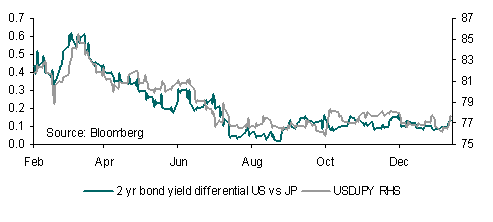
Will there be any follow through on the JPY? USD/JPY had already been under some upward pressure in the wake of the widening in US bond yields versus Japan. The move by the BoJ will result in even more of a widening in yield differentials especially given that the BoJ actions means there will be an increase in official purchases of Japanese government bonds, helping to suppress JGB yields.

In the near term USD/JPY has broken above its 200 day moving average level, paving the way for a test of the 31 October 2011 high around 79.55. Further out, our bond forecasts show that both US and Eurozone 2-year bond yields will increase relative to Japanese yields over the coming months, supporting our forecasts of USD and EUR appreciation versus JPY.
Dollar, euro and yen view

Pressure on the US dollar was maintained last week but there were definite signs that selling momentum is slowing. The lack of major US data releases meant that the key focus for the USD was events in Europe. This week there will be some return of attention back to the domestic front, with heavyweight releases such January retail sales, manufacturing surveys, industrial production and inflation data.

On balance the data will provide more evidence of US recovery but as we have noted previously this is not necessarily positive for the USD. Firmer US data helps to boost risk appetite, which in turn plays negatively for the USD. This could be counterbalanced if US interest rate expectations turn more hawkish but the Fed has effectively ruled out such a prospect, with its commitment to maintain easy policy.

Europe has some important data releases over coming days including the German February ZEW survey and GDP data across the Eurozone. The data will be less encouraging, especially the Eurozone GDP data, compared to the US and is unlikely to give any support to the EUR. Instead events surrounding Greece will be crucial for EUR sentiment. EUR/USD appeared to lose some traction at the end of the week but the EUR remained firm against other currencies.

Greece’s approval of austerity measures overnight will bode well for markets but the tough stance of EU officials towards Greek austerity implementation means that focus will turn to yet another extraordinary meeting of European officials on Wednesday. Even assuming that some form debt deal and second bailout package is ironed out it is questionable how much the EUR will rally as so much good news is already in the price.

The JPY for a change managed to register relatively big moves, with USD/JPY pushing higher over the past week. The revelation that ‘stealth’ FX intervention was carried out by the authorities in Japan taken together with verbal warnings threatening more intervention helped to exacerbate JPY moves.

Speculation that the Bank of Japan is pondering further easing steps at its policy meeting on Tuesday may also be contributing to the softer tone in the JPY. Such hopes may be disappointed however, as we expect the BoJ to retain its current policy settings. The biggest factor explaining the move in USD/JPY is the fact that US bond yields moved higher relative to Japan, with the yield differential ending the week at its highest so far this year.

Australian and NZ Dollar Outperform

The boost to EUR following the dovish tone of the Fed FOMC statement on Wednesday has faded although the EUR looks well supported against the USD, JPY and GBP. Further gains against the USD will however, be limited to around 1.3201 (21 December 2011 high and 61.8% retracement from its 1.3553 high).

Reports overnight that Greek private lenders were willing to accept a coupon rate below 4% helped to boost confidence of an imminent deal with regard to Greek debt restructruing. Ahead of next week’s EU Summit the EUR will consolidate its gains, with attention focussing on a meeting between German Chancellor Merkel, Italian Prime Minister Monti, and French President Sarkozy on Monday.

USD/JPY has become insensitive to moves in most of its usual drivers. Bond yield differentials have lost influence over recent months despite a very strong relationship in the past. Similarly USD/JPY is also not particularly sensitive to moves in the USD index or risk aversion, with these relationships also breaking down lately according to my correlation calculations. Net foreign portfolio flows should in theory be playing negative for the JPY with outflows from bond and equity flows recorded in 8 of the last 10 weeks.

However, the reality is that USD/JPY remains stubbornly entrenched in a narrow 77-78 range. While a base appears to have been formed around the 77.00 level the upside momentum for the currency pair is weak. I stand by my view of USD/JPY ending the quarter around current levels given the loss of influence of its usual drivers but still look for an eventual move higher.

AUD and NZD have performed extremely well over recent weeks recording the biggest gains among major currencies so far this year. Both currencies have been boosted by improving risk appetite and receding growth worries in China. AUD in particular looks attractive in the wake of the dovish Fed and relative high AUD yield. I continue to believe markets are too dovish on Australian policy rate expectations, with markets pricing in more rate cuts this year beginning in February. Any reversal in easing expectations will support AUD.

AUD is also benefiting from diversification flows, with Russia’s central bank noting that it may begin to buy AUD in February. Nonetheless, AUD/USD gains look overly aggressive in a short space of time, with positioning turning increasingly long. AUD/USD will face strong resistance around 1.0753 over coming days.

EUR/JPY set to slip further

The EUR looks set to plumb lower over coming weeks but how quickly will it fall given that market positioning is already at record low levels? The absence of official investors such as central banks who are normally strong buyers of EUR on dips, helped to pull the rug from under the EUR, resulting in a fairly sharp lunge lower. While it is easy to jump on the bandwagon expecting a further sharp fall this week, it may be worth taking some caution given the extent of short market positioning.

Admittedly officials in Europe are not too worried, and quite rightly so, given that the currency remains overvalued and still far too strong. Moreover, FX options market have also not reacted too much to the move, suggesting that for most, the decline in the EUR is not something to be too excited about. The underperformance of European data releases relative to the US over recent weeks adds further ammunition to those calling for a weaker EUR and assuming this divergence in data performance continues, the EUR will find it difficult to sustain much of a recovery.

Meanwhile the JPY continues to remain firm despite the generally firm USD tone this year. The JPY did give up some ground at the end of last week but shows little inclination to head back above the 78.0 level. Japanese official worries about JPY strength were evident in comments from Finance Minister Azumi who rolled out the usual mantra that they were watching FX market closely. He also expressed growing concerns about the drop in the EUR, highlighting concerns about the impact on Japanese exports as EUR/JPY drops to multi year lows.

Unfortunately for Japanese officials it appears that the EUR will get weaker and at least over the short term, the JPY stronger. EUR/JPY looks set to drop to its October 2000 low around 89.00 over coming weeks against the background of continued pressure in the Eurozone and elevated risk aversion.

Dollar, Euro and Yen Outlook 2012

The USD index is set for another positive year over 2012 but it will not be a star performer. The USD has been a clear beneficiary of the crisis in the eurozone and will continue to find sustenance unless there are signs of a concrete resolution on the horizon. My forecasts still see the USD index rising to 82.5 by the end of 2012. This would be well below the highs reached during the height of the financial crisis in March 2009 around 89.

While economic recovery is expected to continue over 2012 it will be a tepid one, with prominent downside risks. Therefore, one of the factors likely to hold the USD back is the likelihood that the Fed embarks on a fresh round of quantitative easing which I believe will take place sometime in H1 2012, specifically aimed at mortgage backed securities.

I am not bullish on the EUR but it is clear in my view that there is an underlying degree of support for the currency. In 2012 I expect more downward pressure on the currency. News on the economic front will become more negative and the region is set to slip into recession, albeit a mild one (with downside risks). In contrast, the outlook for the US looks somewhat better even if the recovery will look tame compared to past growth.

Relatively weak growth will maintain the pressure on the ECB to ease monetary policy and further interest rate cuts are likely in the months ahead. Easier policy will be another factor that undermines the EUR. Even if the there was some progress on a resolution to the eurozone debt crisis I doubt that the stress on markets would be relieved overnight. While the crisis has and will not deliver a death blow to the EUR it will mean that investors, even official ones, take a much more cautious view on the currency going forward. I look for EUR/USD to fall to around 1.26 by end 2012.

The JPY has been one of the most well behaved currencies over past months, remaining within a relatively tight range. Unfortunately for the Japanese authorities and for the economy the JPY has failed to build on any negative momentum caused by intervention. I expect USD/JPY and EUR/JPY to edge higher over coming months but the upside for both currency pairs is likely to be gradual over 2012.

Much will depend on whether risk appetite improves and more importantly on yield differentials between Japan and other countries. My end 2012 forecast for USD/JPY and EUR/JPY remain at 85 and 107, respectively but its worth noting that I now expect a firmer JPY in March 2012 against both USD and EUR than previously forecast due to the likelihood of prolonged uncertainty and elevated risk aversion over Q1 2012