Post US Jobs Data FX Outlook

The massive upside surprise to US payrolls could prove to be a significant indicator for the USDs fortunes in the months ahead.  To summarize, payrolls dropped by 11k, much less than expected. Net revisions totaled +148k, the workweek rose and the unemployment rate fell to 10%, also better than forecast and likely a surprise to the US administration who hinted at a rise in the unemployment rate.

Equity and bond market reaction was as would be expected; equities rallied and bonds sold off.  Gold prices dropped sharply too.  However, and this is what was most interesting, the dollar strengthened. Why is this odd? Well, over the past 9 months any news that would have been perceived as positive for risk appetite was associated with dollar weakness.  This reaction clearly did not take place following the jobs data. 

It’s worth noting that going into the payrolls data markets were very short USDs as reflected in the CFTC Commitment of Traders IMM data which revealed the biggest aggregate net short USD position since 25 March 2008. The bounce in the USD could have reflected a strong degree of short covering especially against the JPY where net long JPY positions had jumped to close to its all time high.  Going into year end expect to see more position adjustment, perhaps indicating a return of the JPY funded carry trade is back on the cards.

The dollar’s reaction to the payrolls data was reminiscent of its pre-crisis relationship of buying dollars in anticipation of a more aggressive path for US interest rates and indeed markets brought forward expectations of higher rates following the data.  It is probably too early to believe that the dollar’s movements are once again a function of interest rate differentials but it is a taste of things to come. In any case, markets will be able to garner further clues from a speech by Fed Chairman Bernanke today.

The post payrolls dollar reaction could have also reflected the fact that EUR/USD failed to break above the 1.5145 high over the week resulting in a capitulation of stale long positions, especially as the move towards reducing liquidity provision by the ECB also failed to push the EUR higher. If the S&P 500 stays above 1100 EUR/USD could retrace higher for the most part a broad 1.48-1.51 range is likely to dominate over the week.  Nonetheless, a break below 1.4820 could provoke an accelerated stop loss fuelled drop in EUR/USD.  ECB President Trichet speaks today and may reiterate that the ECB’s measures to begin scaling back its liquidity provision should not be taken as a step towards monetary tightening.

USD/JPY proved interesting last week pushing higher in the wake of strong rhetoric by the Japanese authorities threatening intervention to prevent JPY strength. The BoJ’s attempt to provide more liquidity to banks also helped on the margin to weaker the JPY but the impact of the move is likely to prove limited. Nonetheless, exporters and Japanese officials may be more relaxed this week, if USD/JPY can hold above 90.00.  However, a likely sharp revision lower to Japanese Q3 GDP tomorrow will help maintain calls for a weaker JPY.
Caution ahead of US payrolls

The weaker than forecast November US ISM non-manufacturing, a negative UK press report about the problems in Dubai and caution ahead of the US jobs report have dampened risk appetite overnight though there is expected to be little action until the release of the US jobs report today, with some USD short covering likely ahead of the release.  The jobs data could add to disappoint, with data this week including the ADP jobs report, and the employment components of the ISM surveys consistent with a worse than consensus (-125k) reading.  

It was encouraging however, that jobless claims revealed a further decline (457k) to its lowest since November 2008 indicating further improvement in the jobs market, though the data will have little bearing on today’s payrolls data which as noted above will likely disappoint expectations.  A below consensus may fuel some increase in risk aversion and a slightly firmer USD though markets are most likely to settle into ranges in the near term. 

The JPY may make up some lost ground against the background of weaker equity performance.  Amidst the confusing messages on the JPY over recent weeks officials appear to be giving stronger hints at intervention, leaving the currency on the back foot over recent days.  The drop in the JPY may prove temporary however, if official rhetoric is not followed up by action; USD/JPY is likely to struggle to break through resistance around 88.60.  

Following the BoJ’s disappointing JPY P10 trillion operation announced this week attention turns to the announcement of new government stimulus measures which were reportedly expected today.  This may also prove disappointing however, as there appears to be disagreement between coalition partners on the size and composition of stimulus.  Finance Minister Hatoyama was expected to announce additional spending of up to JPY 4 trillion.  

There was no surprise that the ECB left the refi rate unchanged at 1% yesterday but some surprise in the steps to withdraw provision.  The ECB announced that the interest rate on the December 12-month tender will be indexed to the refi rate and that the full allotment at most of the ECB’s refinancing operations is extended until 13 April 2010 only. As much as ECB President Trichet tried to play down the perception that the steps were a signal of a tighter policy markets are unlikely to interpret it this way. 

Despite the shift in the ECB’s stance EUR/USD pared gains after reaching a high around 1.5141 but failed to test resistance at 1.5150 which is likely to provide strong resistance in the days ahead, reflecting the fact that markets had priced in a hawkish shift by the ECB already.   Going forward, if the market perceives the ECB as prematurely shifting towards a more hawkish stance against the EUR could suffer rather than find any support from such actions

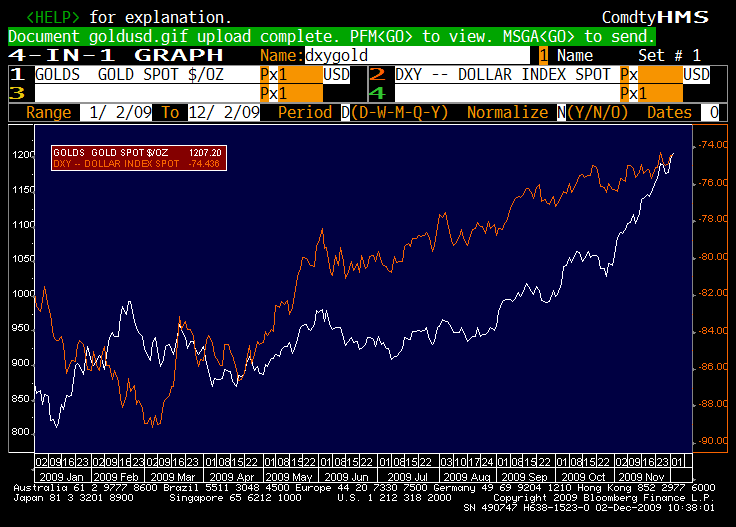
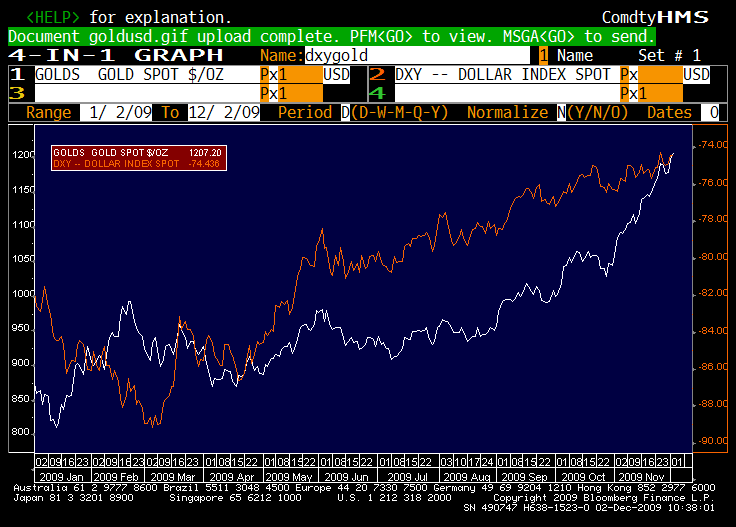
Gold / FX correlations

There is no shortage of cash rich investors in Asia even amidst the current troubles in Dubai. Indeed, sentiment in the gemstones market is particularly upbeat, with a rare five-carat pink diamond selling for a record HK$84.24 million in Hong Kong. Perhaps this is a good reflection of abundant liquidity and of course wealth in Asia and in particular China, with talk that mainland Chinese investors were strong participants in the diamond auction.

It’s not just diamonds that are selling for record prices; gold hit a fresh high above $1,200 and once again at least part of this is attributable to the appetite of Asian central banks as well as demand from China as the country tries to increase its gold reserves. The rise in gold prices has coincided with a bullish announcement from the world’s top gold producer that it has completely eliminated its market hedges earlier than forecast due to the positive outlook on prices and waning supply.

The correlation between gold prices and the USD remains very strong at -0.88 over the last 3-months, with firmer gold prices, implying further USD weakness. In fact, the gold / USD correlation has been consistently strong over the past few months and is showing little sign of diminishing.

Over the past 6-months the correlation has been -0.91 and over the past 1-month it was -0.75.  Assuming that anything above 0.70 can be considered statistically significant, the relationship shows that USD weakness has been well correlated with gold strength and that despite talk of a breakdown in the relationship it appears to remain solid. 

As long as the bullish trend in gold continues, the pressure on the USD will remain in place.  Adding to this pressure is the fact that risk is back on for now. Markets took the news of a fall in the ISM manufacturing index and in particular the drop in the employment component in its stride even though it supports the view of a weaker than consensus drop in payrolls in November when it is published on Friday.

There are still plenty of reasons to be cautious in the weeks ahead and although we appear to be back in a “risk on” environment markets are likely to gyrate between “risk on” and “risk off” over coming weeks. At least for now, the USD looks to remain under pressure but if risk aversion creeps back up as I suspect it may then the USD will see a bit more resilience into year end. 

Moreover, central banks globally are reaching the limits of their tolerance of USD weakness and will be tested once again, with EUR/USD back above 1.5000, EUR/CHF moving back below 1.5100 and the USD/JPY set to re-test 85.00 following the relatively benign measures announced by the BoJ in which the Bank did little to stem deflationary pressure or weaken the JPY.

Dubai, Economic Recovery and Predictions For 2010

I was recently interview by 6 Figure Career Management a website dedicated to financial services careers. In the interview I am asked by Sital Ruparelia on my views on the economy and jobs market in 2010 as well as the impact of the recent problems in Dubai on the global recovery.

As you can see from the transcript below I am cautiously optimistic about the prospects for 2010 – despite the recent concerns about Dubai’s debt problems and the possibility of a ‘double-dip’ recession.

“Cautious Optimism For 2010“

Sital: Mitul, in your guest article at the end of Qtr 1 in April, you correctly predicted ‘the light at the end of the tunnel’ and indeed we’ve seen a 6-month stock market recovery along with the US and some European economies coming out of recession.

As we approach the end of 2009, what’s your view on the global economy? Click here to read the rest…