US dollar under pressure

US stocks have clawed back almost all their losses registered in the wake of the mini emerging markets crisis in January. The S&P 500 closed at 1838.63, up 0.48% on Friday. The rally in stocks is impressive considering the run of weaker than forecast US data releases over recent weeks although investors appear to be placing much of the blame on poor weather conditions. The gains in US stocks echoes the generalized improvement in risk appetite, with sentiment towards emerging markets also having stabilized.

The USD continues to be a casualty of the firmer risk tone, with a lack of upward momentum in US yields also not helping the currency (10 year US Treasury yield around 2.7428%). The USD index is now close to its lows for the year around 80.00, with the JPY and commodity currencies the biggest gainers so far this year among major currencies. In terms of emerging market currencies the Indonesian rupiah and Thai baht have been the best performers versus USD.

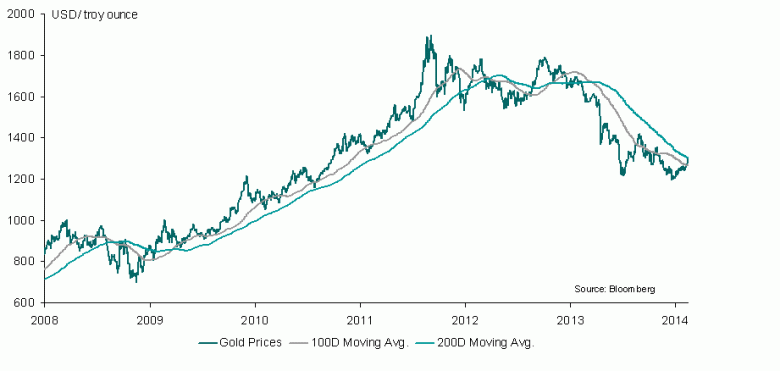
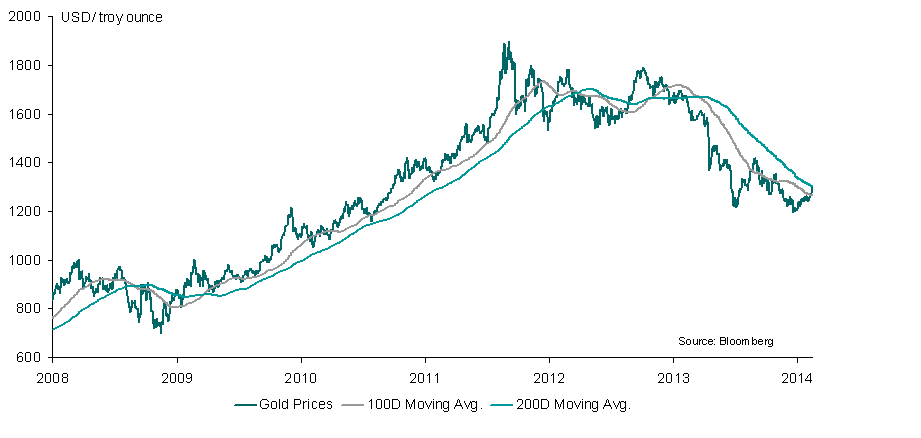
Despite the firmer tone to risk, gold prices have continued their ascent, closing above their 200 day moving average at the end of last week. As I wrote in Gold breaches its 200 day moving average, I don’t expect the rally in gold prices to be sustained. Some market consolidation is likely today with a lack of key data releases and a US holiday (President’s Day) keeping activity subdued.

Posted in US. Tags: , , , . Leave a Comment »

Gold breaches its 200 day moving average

AUDjobsGold prices have risen sharply since the beginning of the year, up over 8% year to date. Higher risk aversion, lower US yields and a weaker USD have boosted gold. Consequently gold prices are trading around their 200 day moving average level around 1303.70. This could prove significant, with a close above the 200 day moving average important to sustain any short term uptrend,

Encouraging signs for gold bulls
ETF investor demand appears to have stabilised over recent weeks while CTFC IMM demand appears to be picking up. This data suggests that Investors are tentatively moving back into gold. The poor performance of equity markets since the start of the year has indeed made gold look more attractive as an investment while lower yields mean that the opportunity cost of holding gold has lessened.

Chinese demand for gold increases sharply
Additionally gold demand from China has picked up strongly. China Gold Association data showed that Chinese demand for gold jumped 41% to 1,176 tonnes last year. Chinese demand likely overtook India’s last year. Oddly Chinese import and production data were even stronger, making it possible that China bolstered its reserves with gold last year.

Indian restrictions hit demand
India restricts demand for gold via import restrictions. However, there is a lot of pressure domestically to remove these restrictions and a review is scheduled to take place at the end of the fiscal year at end March 2014. If these restrictions are removed or at the least weakened, Indian gold imports could increase sharply but it seems unlikely that imports will rise as strongly as previous years.

Moreover, the Indian government will want to avoid an adverse impact on India’s current account deficit, suggesting that a complete removal of gold import restrictions is unlikely. However, in the meantime the restrictions are having a major impact on Indian gold demand which dropped sharply last year.

Gold rally to fade
Risk appetite has already improved sharply over February and while I continue to expect bouts of volatility in the weeks and months ahead I do not expect to see sustained periods of elevated risk aversion. Therefore any boost to gold from rising risk aversion is set to prove temporary in the months ahead.

Secondly global inflation pressures remain well contained. Inflation for the major economies is likely to remain benign. Only in Japan is inflation expected to pick up but this is an aim of policy and is not expected to result in a bout of gold buying to hedge against such inflation risks. Therefore, gold demand as an inflation hedge will not take place.

Two major drivers of the gold price are US bond yields and the US dollar. Both are highly correlated with gold price gyrations, with gold falling as US yields and the USD rise and vice-versa. Both yields and the USD are set to rise over the coming months. Consequently any short term gold price gains are unlikely to hold, with the metal set to resume its decline.

Sweden Riksbank preview

There is almost no disagreement about expectations for today’s Riksbank policy decision. The central bank last lowered the repo rate in December and is unlikely to alter policy settings again so soon, with the policy rate likely to be maintained at 0.75%

The SEK is unlikely to be impacted by today’s rate decision, with the currency benefitting from the recent improvement in risk appetite. However, a relatively dovish statement from the Riksbank may undermine the SEK especially as it approaches EUR/SEK support around 8.75.

Further out, we expect SEK to continue to appreciate gradually but its worth noting that gains in the currency are not comfortable for the Swedish authorities, who have called for stricter capital rules on its banks to help weaken the currency (via keeping policy rates low).

US dollar soft ahead of retail sales

The USD has lost a fair bit of ground in February failing to benefit from a renewed rise in US Treasury yields. A more positive risk environment recently has undermined some of the demand for USDs while some negative data surprises such as the ISM manufacturing survey and non farm payrolls have also weighed on demand for the USD.

The release of January retail sales data today will give another opportunity to gauge the path of consumption at the turn of the year but unfortunately for the USD a relatively flat outcome for sales will provide little rationale to buy the currency. The consensus expectation is for headline retail sales to post a 0% monthly reading, while sales ex autis is likely to rise by a measly 0.1%.

In the near term this implies little potential for a USD rebound but over but over coming weeks I expect the USD to rally in line with higher US yields. USD index (DXY) is likely to flatline around the 80 level in the coming sessions before rallying over coming weeks.

Risk rally losing steam

The rally in risk assets is losing its momentum, with US stock markets failing to extend gains following a four day rally while US Treasury yields continued their ascent in the wake of Fed Chairman Yellen’s testimony highlighting no deviation from tapering. Her testimony to the Senate will be delayed today while US data in the form of retail sales is likely to register a soft outcome. Sentiment was boosted overnight by strong Chinese trade data in January and the approval by the US Congress allowing a suspension of the debt limit, a far cry from the major saga that took place last time the debt ceiling was about to be breached.

Additionally Eurozone markets will find some support from comments by European Central Bank board member Coeure who noted that the central banks is “very seriously” considering negative deposit rates. His view may be supported by the release of the ECB monthly bulletin today and Survey of Professional Forecasters (SPF). Coeure’s comments undermined the EUR however, while in contrast sharp upward revisions to growth forecasts by the Bank of England in its Quarterly Inflation Report boosted GBP. Suffice to say, EUR/GBP dropped like a stone and looks set to remain under downward pressure.