AUD hit by weak jobs data

AUD has been one of the best performing major currencies so far in February. Better than expected Chinese trade data released yesterday was a boon for the AUD given Australia’s strong trade links with China. Moreover, as markets have backed away from RBA policy easing expectations AUD has gained a sound footing.

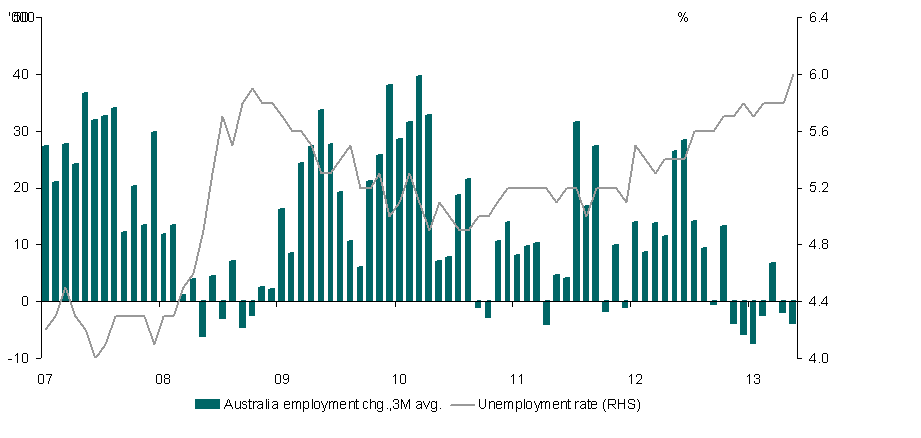
Positive sentiment for the AUD was dashed today however, following the release of January jobs data which came in worse than expected at -3.7k versus +15k consensus. The details were weak too, with the unemployment rate rising to a 10 year high of 6% and participation rate dropping to 64.5%.

The data will clearly restrain AUD in the short term, but is unlikely to spark renewed risks of further policy easing given a rise in inflation pressures. In this respect, AUD is set to continue to show some resilience over coming weeks. Near term AUD/USD support is seen around 0.8915.

AUDjobs

Posted in Australia. Tags: , , . Leave a Comment »

Australian dollar rallies, Korean won bounces back

On the currency front, the best performers so far this year have been an odd combination of JPY, NZD and AUD versus USD. JPY has benefitted from both compressed yield differentials with the US and risk aversion but its gains are likely to reverse over the coming weeks as these factors reverse.

I have been generally more constructive on AUD and NZD than the consensus and remain so. Both AUD and NZD look oversold and will gradually appreciate further, especially as both the RBA and RBNZ have now likely ended their easing cycles, with the latter set to raise policy rates by the end of this quarter. AUD/USD breached 0.90 this morning helped by a strong business confidence reading for January.

Most Asian currencies have rebounded so far this month, with some of the biggest losers over January recording gains. The KRW has been the best performer in February recording gains despite continued outflows of equity capital. Korea has recorded $1.26 billion in equity outflows so far this month, the highest among Asian countries.

In contrast bond inflows into Korea have been relatively solid over January and this continued into February, helping to provide some support to KRW despite equity outflows. Helping the KRW is the fact that is much less sensitive to US bond yields than many other Asian currencies helping it to avoid any fallout from higher US yields in February. USD/KRW is on path for a break below support around 1070.

Awaiting Yellen

There was very little activity of note overnight, with markets taking on the appearance of grounding to a halt ahead of the first semi-annual testimony to Congress by new Fed Chairman Yellen later tonight. A Japanese holiday today will act as another dampener on activity.

Weaker data and/or emerging market tensions are highly unlikely to deter Yellen and the Fed from maintaining a tapering path but of interest to markets will be any indication that the unemployment rate is to be deemphasized given its misleading fall over recent months. With little else of note on tap until the release of US retail sales and Eurozone Q4 2013 GDP later in the week Yellen’s speech will set the tone for markets over coming days.

The biggest market movers over recent days have been the VIX index, natural gas and gold prices. The VIX has fallen sharply reflecting a major turnaround in risk appetite from an elevated level, which has been corroborated by our risk barometer moving back into risk ‘neutral’ territory from risk ‘hating’.

Nonetheless, although emerging market fears have calmed down the path ahead is still likely to be a volatile one. Natural gas prices have also dropped reflecting expectations of milder weather ahead in the US. In contrast gold prices have rallied further extending gains this year to around 6%. Lower US yields and a weaker USD have helped to buoy gold prices over recent days while news of record gold demand and supply from China has also helped.

USD/JPY bracing for a rebound

In the post below I look at the arguments for JPY weakness in the weeks and months ahead.

A combination of elevated risk aversion and a narrowing US / Japan yield differential have been the major contributors to the strengthening in the JPY over January resulting in safe haven JPY demand and repatriation flows. The sensitivity of the JPY to both factors has been especially strong and it will require a reversal of one if not both of these to spur another wave of JPY selling.

Improving risk appetite required
If there is not a metamorphosis of the current bout of pressure into a full blown crisis as seems likely, risk appetite will improve and the upward pressure on the JPY will abate. Any improvement in risk appetite will however, be gradual and prone to volatility, especially in an environment of Fed tapering. It may therefore require more than simply improving risk appetite to weaken the JPY anew.

Japanese equity performance will be eyed
Of course associated with any improvement in risk appetite has to be a reversal of the recent negative performance of Japanese equities. Although Japanese equities will continue to be hostage to the fortunes of global risk sentiment, assuming that “Abenomics” continues to deliver results and growth in Japan continues to pick up (our forecast this year is 2% YoY GDP growth) further fallout in the Japanese equity market may be limited.

Flows will need to reverse
Over the past several weeks Japan has registered net inflows of capital in large part due to repatriation by Japanese investors. JPY has faced upward pressure from such inflows over recent weeks. Looking ahead assuming that risk appetite improves and US yields increase net capital outflows are expected to resume, which will put further downward pressure on the JPY.

Yield differentials will be particularly important
The extra dose of JPY pressure and important determinant of renewed weakness will be a re-widening of the US / Japan real yield differential. Eventually US bond yields will resume their ascent, driving the yield differential with Japan wider, and putting upward pressure on USD/JPY. The same argument will apply for EUR/JPY, albeit to a lesser degree.

Speculation positioning more balanced
The recent short covering rally has likely resulted in a market more evenly balanced in terms of positioning, providing a solid footing for the next leg lower in JPY. Indeed, compared to the three month average, JPY positioning has bounced back and is susceptible to a rebuilding of JPY shorts over coming weeks, driving the JPY lower.

Model points to renewed JPY weakness
Combining the factors above (except positioning) and adding in forecasts for US bond yields, risk aversion and conservative estimates for a recovery in Japanese equity markets over coming months, my quantitative model for USD/JPY highlights the prospects of a major rebound in the currency pair.

Untimely end to the Flappy Bird

Flappy_Bird_logo

I have a confession to make. Over the last few days I have become adicted to Flappy Bird. The idea of the game is to tap the screen and fly a bird through sets of pipes. I am clearly no good at it as my high score is a measly 6 but I continue to perservere in order to better my score. Sadly or perhaps fortunately for would be Flappy Bird addicts the game will no longer be available as an app. According to the FT the Vietnamese creater of the mobile game which topped the app charts has said that it “ruins my simple life” and therefore he removed the app from sale. The good news is that those who have already downloaded it won’t lose it so my Flappy Bird adiction can continue unabated.