AUD the “Teflon” currency

Despite further concerns about Chinese growth, following the release of the much worse than expected trade data over the weekend, AUD continues to hold gains above 0.90. Additionally declines in key commodities such as iron ore have done little to dent the enthusiasm for AUD. In this respect, AUD is fast becoming the new “Teflon” currency, helped by the neutral stance of the Reserve Bank of Australia and recently positive domestic data such as building approvals, Q4 GDP and January trade data.

The next major test for AUD will be Thursday’s release of the February jobs report. Clearly there has been a worsening in jobs conditions but the worst is likely over and after a decline in employment over the last couple of months some rebound is expected (our forecast +20k, consensus +15k).

AUD is set to consolidate over the near term, with technical support seen around 0.8980.
JPY capped

USD/JPY is being buffeted by the conflicting forces of relatively elevated risk aversion and higher US yields, leaving the currency pair in difficult position to sustain gains. Today’s BoJ outcome has the potential to give some direction but its unlikely that the central bank will deliver any surprises after boosting its funding for lending scheme at the last meeting. Nonetheless, additional easing is likely to take place around as early as April. The emergence of US Treasury buyers as 10 year yields approach 2.8% suggests that US yields may be capped for now and it may take the emergence of more positive / less weather impacted data to push yields higher. Consequently USD/JPY will struggle to make much headway over the short term, with resistance seen around 103.77.

Risk aversion edging higher

As the reverberations from China’s poor trade data, weaker loan growth and money supply, as well as continued tensions in the Ukraine ahead of a referendum next Sunday, spread through the market, risk aversion continues to edge higher according to our risk barometer.

Lingering questions over the weather impact on the US economy are also capping risk appetite even after the better than expected US jobs report at the end of last week. Although there is no sign of any panic selling of risk assets at present the tone is decidedly cautious.

Consequently safe haven assets remain in demand, with for example gold prices holding up well and US Treasury yields being capped. Additionally industrial commodity prices have taken a hit, with iron ore prices under major pressure.

There is little on the agenda today that will give a clearer picture for markets, with the Bank of Japan policy meeting and UK industrial production data, the key events for the day. As a result, caution is likely to prevail.

Chinese yuan drops further

China lowered the CNY’s fixing by 0.18% to 6.1312 per USD today, the biggest cut in the fixing since July 2012 to the weakest level since December 3. The move comes quickly in the wake of the poor trade data over the weekend and in particular the sharp 18.1% drop in exports compared to a year earlier.

Although lunar new year timing may have impacted the data, the drop in exports is still significant and may explain why China has been forcing a weaker currency over recent weeks.

Additionally February inflation data in China was soft, with price pressures recording a broad based decline, with CPI inflation falling to a 13 month low of 2% YoY. The soft inflation data adds further reason for the authorities in China to push for a weaker currency.

USD/CNY and USD/CNH both moving higher in reaction to the data and weaker fixing, with the Chinese currency likely to remain under pressure in the short term both onshore and offshore.

Euro / dollar eyeing 1.40

EURIMM

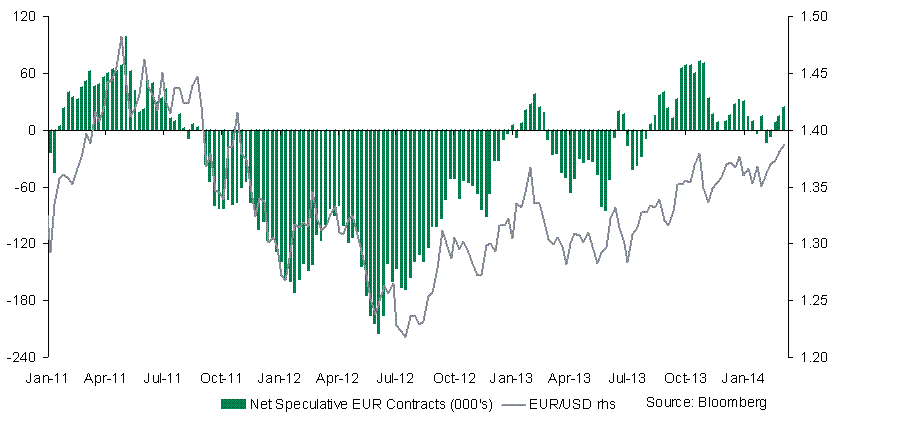
EUR has continued to push higher over recent weeks and looks well supported as inflows into European assets continues unabated. Although speculative EUR positioning continues to move higher above its 3-month average, suggesting that positioning is becoming a little more stretched, sentiment for the EUR remains firm. The ECB’s decision last week to refrain from any policy easing while not hinting at any easing in the pipeline, suggests that EUR/USD will remain a buy on dips on any decline to support around 1.3775. A test of strong psychological resistance around 1.4000 cannot be ruled out over coming sessions.

Posted in eurozone. Tags: , . Leave a Comment »