No FX co-operation

Despite all the jawboning ahead of the IMF / World Bank meetings over the weekend the meeting ended with little agreement on how deal to with the prospects of a “currency war”. US officials continued to sling mud at China for not allowing its currency, the CNY, to appreciate quickly enough whilst China blamed the US for destabilizing emerging economies by flooding them with liquidity due to the Fed’s ultra loose monetary policy stance. Chinese trade data on Wednesday my throw more fuel on to the fire given another strong surplus expected, lending support to those in the US Congress who want to label China as a “currency manipulator”.

Although the IMF communiqué mentioned countries working co-operatively” on currencies there were no details on how such cooperation would take place. The scene is now set for plenty of friction and potential volatility ahead of the November G20 meeting in Seoul. Although many central banks are worrying about USD weakness when was the last time US Treasury Secretary Geithner talked about a strong USD? US officials are probably happy to see the USD falling and are unlikely to support any measure to arrest its decline unless the drop in the USD turns into a rout. In contrast, the strengthening EUR over recent weeks equates to around 50bps of monetary tightening, a fact that could put unwanted strain on Europe’s growth trajectory, especially in the periphery.

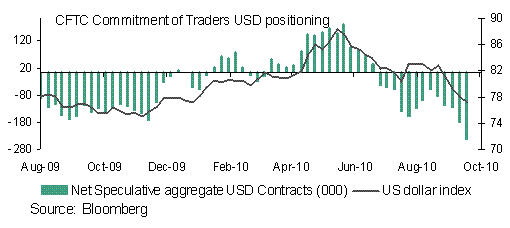
The outcome of the IMF meeting leaves things much as they left off at the end of last week. In other words there is little to stand in the way of further USD weakness apart from the fact that the market is already extremely short USDs. Indeed the latest CFTC IMM data revealed that aggregate net USD positioning came within a whisker of its all time low, with net positions at -241.2k contracts (USD -30 billion), the lowest USD positioning since November 2007. Interestingly and inconsistent with the sharp rise in the EUR, positioning in this currency remains well below its all time highs, supporting the view that rather than speculative investors it is central banks that are pushing the EUR higher.
The US jobs report at the end of last week proved disappointing, with total September payrolls dropping by 95k despite a 64k increase in private payrolls. The data will act to reinforce expectations that the Fed will begin a program of further asset purchases or quantitative easing (QE2) at its November meeting. Data and events this week will give further clues, especially the Fed FOMC minutes tomorrow and speeches from Fed Chairman Bernanke on Thursday and Friday as well as various other Fed speakers on tap.

Recent speeches by Fed officials have highlighted growing support for QE although some have tried to temper expectations. Questions about the timing and size of any new programme, as well as how it will be communicated remain unanswered. Although November seems likely for the Fed to start QE the Fed’s Bullard suggested that the Fed may wait until December. The minutes will be scrutinized for clues on these topics. The Fed is likely to embark on incremental asset purchases with the overall size being data dependent and the USD set to remain under pressure while this happens.
Money Printing

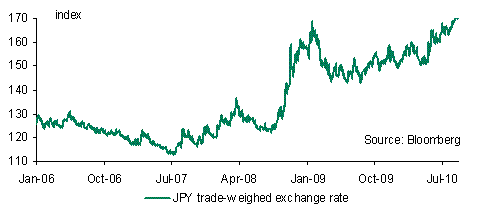
It was a day of surprises on Tuesday as the Bank of Japan (BoJ) not only created a JPY 5 trillion fund to buy domestic assets including JGBs but also cut interest rates to zero. Expect more measures to come in the fight against a stronger JPY and deflation. The Reserve Bank of Australia (RBA) also surprised markets by leaving its policy rate unchanged at 4.5% delaying another rate hike yet again despite expectations by many including ourselves of a 25bps rate hike.

The easier policy stance from the BoJ and RBA taken together with firmer service sector purchasing managers indices – including the September US ISM non-manufacturing survey, which came in at 53.2 from 51.5 – gave risk appetite a solid lift. Even the AUD which dropped sharply following the RBA decision, managed to recoup all of its losses and more overnight.

Japan’s decision could have set the ball rolling for a fresh round of quantitative easing (QE) from central banks as they combat sluggish growth prospects ahead and ongoing deflation risks. The US Fed as has been much speculated on and the Bank of England (BoE) are likely candidates for more QE. Whilst the European Central Bank (ECB) is unlikely to adopt such measures there are reports that board members are split over the timing of exit policy. The BoE decision on Thursday may provoke more interest than usual against this background although the Bank is unlikely to act so quickly. The Fed on the other hand appears to be gearing up for a November move.

Growing prospects of fresh QE looks likely to provide further impetus for risk trades. Notably commodity prices jumped higher, with the CRB commodities index at its highest level since the beginning of the year. Although there is plenty of attention on the gold price which yet a fresh record high above $1340 per troy ounce as well as tin which also hit new highs, the real stars were soft commodities including the likes of sugar, coffee and orange juice up sharply.

The main loser once again is the US dollar and this beleaguered currency appears to be finding no solace, with any rally continuing to be sold into, a pattern that is set to continue. Although arguably a lot is in the price in terms of QE expectations, clearly the fact that the USD continues to drop (alongside US bond yields) highlights that a lot does not mean that all is in the price.

The USD is set to remain under pressure against most currencies ahead of anticipated Fed QE. The fact that the USD has already dropped sharply suggests a less pronounced negative USD reaction once the Fed starts buying assets but the currency is still set to retain a weaker trajectory once the Fed USD printing press kicks into life again as a simple case of growing global USD supply will push the currency weaker.

USD weakness will only spur many central banks including across Asia to intervene more aggressively to prevent their respective currencies from strengthening. A “currency war” looms, a fact that could provoke some strong comments at this weekend’s IMF and World Bank meetings. In the meantime intervention by central banks will imply more reserves recycling, something that will continue to benefit currencies such as EUR and AUD.

Japanese FX Intervention

The Bank of Japan acting on the behest of the Ministry of Finance intervened to weaken the JPY, the first such action since 2004. The intervention came as the USD was under broad based pressure, with the USD index dropping below its 200-day moving average. USD/JPY dropped to a low of around 82.88 before Japan intervened to weaken the JPY. The move follows weeks of verbal intervention by the Japanese authorities and came on the heels of the DPJ leadership election in which Prime Minister Kan retained his leadership.

One thing is for certain that Japanese exporters had become increasingly concerned, pained and vocal about JPY strength at a time when export momentum was waning. However, the move in USD/JPY may simply provide many local corporates with better levels to hedge their exposures.

Time will tell whether the intervention succeeds in engineering a sustainable weakening in the JPY but more likely it will only result in smoothing the drop in USD/JPY over coming months along the lines of what has happened with the SNB interventions in EUR/CHF. As many central banks have seen in the past successful intervention is usually helped if the market is turning and in this case USD/JPY remains on a downward trajectory.

Although the BoJ Governor Shirakawa said that the action should “contribute to a stable foreign exchange-rate formation” it is far from clear that the BoJ favoured FX intervention. Indeed, the view from the BoJ is that the move in USD/JPY is related less to Japanese fundamentals but more to US problems.

Now that the door is open, further intervention is likely over coming days and weeks but for it to be effective it will require 1) doubts about US growth to recede, 2) speculation of Fed QE 2 to dissipate, 3) and consequently interest rate differentials, in particular bond yields between the US and Japan to widen in favour of the USD. This is unlikely to happen quickly, especially given continued speculation of further US quantitative easing. A final prerequisite to a higher USD/JPY which is related to the easing of some of the above concerns is for there to be an improvement in risk appetite as any increase in risk aversion continues to result in JPY buying.

When viewed from the perspective of Asian currencies the Japanese intervention has put Japan in line with other Asian central banks which have been intervening to weaken their currencies. However, Asian central bank intervention has merely slowed the appreciation in regional currencies, and Japan may have to be satisfied with a similar result. Japan’s intervention may however, give impetus to Asian central banks to intervene more aggressively but the result will be the same, i.e. slowing rather then stemming appreciation.

As for the JPY a further strengthening, with a move to around 80.00 is likely by year end despite the more aggressive intervention stance. Over the short term there will at least be much greater two-way risk, which will keep market nervous, especially if as is likely Japan follows up with further interventions. USD/JPY could test resistance around 85.23, and then 85.92 soon but eventually markets may call Japan’s bluff and the intervention may just end up putting a red flag in front of currency markets to challenge.

Resisting Asian FX Appreciation

The upward momentum in Asian currencies has continued unabated over recent weeks the gyrations in risk appetite. Most Asian currencies have registered gains against the USD over 2010 with the notable exception of one of last year’s star performers, KRW which after gaining by close to 9% last year has weakened slightly this year. Last year’s best performer the IDR which raked in close to 20% gains over 2009 versus USD has continued to strengthen this year, albeit to a smaller degree. Another currency that has extended gains this year has been the THB, which is on track to beat last year’s 4% appreciation against the USD.

The strength in Asian currencies has in part reflected robust inflows into Asian equity markets. For example Indonesia has been the recipient of around $1.7 billion in equity inflows so far this year. However, India and Korea have registered even larger inflows into their respective equity markets, at around $13 billion and $7.7, respectively, yet both the INR and KRW have underperformed other Asian currencies. The explanation for this is largely due to deteriorating current account positions in both countries. Further deterioration is likely.

The fact that equity flows have had only a small impact on the INR and KRW is reflected in their low correlations with their respective equity market performance. For most other Asian currencies the correlation with equity performance has been quite high, with the THB and MYR having the strongest correlations with their respective equity market indices over the past 3-months although the SGD, PHP and IDR have also maintained statistically significant correlations.

Clearly, for many but not all Asian currencies equity market gyrations are important drivers but at a time when growth is slowing more than many had expected in the US and governments in the eurozone are implementing austerity measures which will likely result in slowing growth and a worsening trade picture in the region, central banks in Asia will become increasingly wary of allowing their currencies from strengthening too quickly.

Increasingly Asian currency strength is being met with intervention by central banks in the region buying USDs against a host of Asian currencies. Over recent weeks this intervention appears to have become more aggressive. Nonetheless, any FX intervention led weakness in Asian FX is likely to prove short lived, with renewed appreciation likely over the coming months unless risk aversion increases dramatically. In other words a drop in Asian currencies will provide better opportunities to go long.

The CNY will play an important role on the pace and pattern of Asian currency movements. Investors in the region will also have one eye on developments on the visit of US National Economic Council director Larry Summers to Beijing. The CNY has firmed over recent days but this appears to be the usual pattern when a senior US official is in town and ahead of a G20 meeting. The fact is however, that the lack of CNY appreciation since the June CNY de-pegging remains a highly sensitive issue.

China is unlikely to yield to US pressure and is set to continue to act at its own pace and comments from officials in China over the past couple of days suggest no shift in FX stance. Although the CNY has not appreciated by as much as many had hoped for or expected since the June de-pegging the path is likely to be upwards, albeit at a gradual pace. For Asian currencies a slow pace of CNY appreciation implies further reluctance to allow a fast pace of appreciation so expect plenty of FX intervention in the weeks and months ahead.

US Dollar Tensions

There was considerable relief, most acutely in the US administration, that the US August jobs report revealed a better than expected outcome. To recap, private sector payrolls increased by 67k vs. an upwardly revised 107k in July whilst total non farm payrolls dropped 54k. The data sets the market up for a positive start to the week in terms of risk appetite despite Friday’s drop in the August US non-manufacturing ISM index, deflating some of the market’s upbeat mood.

Once again I wonder how long positive sentiment can be sustained with so many doubts about recovery prospects and limited ammunition on the fiscal front as well as some reluctance on the monetary front, to provide further stimulus should a double dip become a reality.

Markets will be treated to several major central bank decisions including from the Bank of Japan, Bank of England, Bank of Canada and Reserve Bank of Australia this week. These meetings are set to prove uneventful, with unchanged decisions across the board expected although the Bank of Canada decision is a tough call.

The main US release this week is the Fed’s Beige Book on Wednesday, a report which will help the Fed to prepare for the FOMC meeting on September 21. The evidence contained within it is unlikely to be positive reading, with consumer spending set to be relatively soft and evidence of recovery likely to remain patchy.

On Thursday the US July trade deficit is set to reveal some narrowing and as usual the deficit with China will be of interest given the renewed tensions over FX policy. FX tension seems to be intensifying once again due to the relatively slow pace of CNY appreciation since the June de-pegging as well as political posturing ahead of November US mid-term elections. A deterioration in US trade data, a factor that largely contributed to the soft Q2 GDP outcome in contrast to a strengthening in China’s trade surplus will have added fuel to the fire.

The firmer risk backdrop has put the USD on the back foot, with the USD index dropping sharply overnight. Nonetheless, speculative USD positioning as reflected in the CFTC IMM data reveals further short covering up to the end of August, implying USD speculative sentiment is actually turning less negative.

Another country which has a different sort of tension regarding the USD is Japan. Improving risk appetite will likely prevent the JPY from visiting previous highs against the USD but will do little to reduce FX intervention speculation. Indeed, there was more jawboning over the weekend on the subject, with Japan’s finance minister Noda reiterating that Japan would take decisive action to stem the JPY’s appreciation but adding that coordinated FX intervention was a difficult option. Clearly Japan us unlikely to succeed with unilateral FX intervention.

Political events have added to the debate on FX policy as focus turns to the election for leader of the ruling DPJ party next week, with a battle looming between current Prime Minister Kan and challenger Ozawa. Although Ozawa is unpopular with the electorate he yields plenty of political power, and appea rs to be more inclined towards FX intervention. Having failed to sustain a move above 85.00 the pull back in USD/JPY suggests little appetite to extend gains, likely leaving USD/JPY in a relatively tight range, with strong support around 83.55 and resistance around 85.23.