US payrolls clues

Most investors will be glad to see the back of August, a month that marked the biggest monthly decline in US stocks in nine years. The main imponderable is whether September will be any better. A series of manufacturing surveys globally today will do little to restore confidence although there was some good news in a slight increase in China’s official August purchasing managers index (PMI) as well a stronger than forecast increase in Australian Q2 GDP, which will likely provide some short-term relief for risk trades.

There was also some slight solace for markets in terms of US data at least from the point of view that the data was not as disappointing as many recent releases. Although the August Chicago PMI slipped (to 56.7) consumer confidence increased (to 53.5) though admittedly confidence remains at a relatively low level. The job market situation detailed within the consumer confidence report was more pessimistic in August than the previous month, however, with those reporting jobs hard to get moving higher. This sends a negative signal for Friday’s payrolls data.

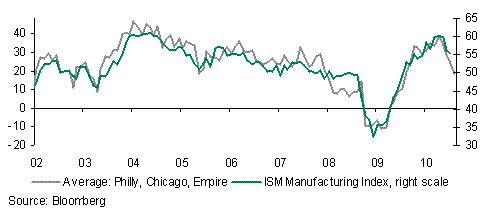
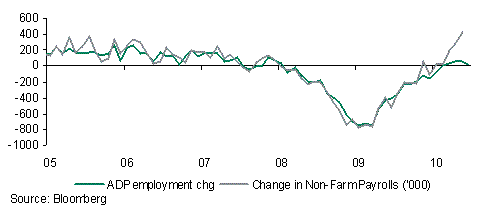
There will be more clues to Friday’s US jobs report today which will enable any fine tuning of forecasts to take place in the wake of the August ADP employment report and ISM manufacturing survey. Consensus forecasts centre on a 15k increase in private jobs. Despite the slight increase in the Empire manufacturing survey in August, the falls in other manufacturing surveys point to some downside risks to the ISM today, with a simple average of the three pointing to the ISM closer to the 50 mark, which will highlight a loss in US manufacturing momentum.
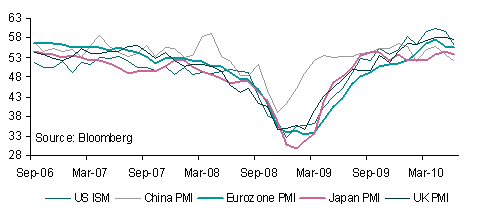
Manufacturing surveys elsewhere will also be in focus, with the final PMI readings scheduled to be released for the eurozone and UK. There is likely to be confirmation of the slight drop in the eurozone PMI to 55.0 in August while the UK PMI is likely to drop to around 57.0 over the month. Both surveys remain at a relatively high level but it is clear that activity is moderating in H2 2010 from a healthy level in H2. The data will give little support to the EUR but the currency has found a degree of stability over the last couple of days. Nonetheless, a further downward move is in prospect.

The Fed FOMC minutes provided little for markets to get excited about. The minutes noted concerns about large scale asset purchases from some Fed officials, indicating resilience to increasing quantitative easing despite acknowledging increased downside risks to the growth and inflation outlook. It is unclear exactly what will be the trigger for further QE as acknowledged by Fed Chairman Bernanke last week.

The minutes will do little to help market confidence given the hesitancy to pursue further QE and provide further stimulus to the economy but the USD is likely to benefit from the fact that the Fed may not be as eager to expand its balance sheet further. Other currencies that remain beneficiaries in the current risk averse environment are the JPY and CHF. The JPY may find further upside more difficult given ongoing intervention fears but the trend remains for a lower USD/JPY in the coming weeks.
Follow The Oracle

Many investors are probably wishing they had the psychic abilities of Paul the octopus. The mollusc once again gave the correct prediction, by picking Spain to beat the Netherlands to become the winner of the World Cup. This ability would have been particularly useful for currency forecasters, many of which have been wrong footed by the move higher in EUR/USD over recent weeks.

Confidence appeared to return to markets over the past week helped by a string of rate hikes in Asia from India, South Korea and Malaysia, and firm data including yet another consensus beating jobs report in Australia. An upward revision to global growth forecasts by the International Monetary Fund (IMF) also helped, with the net result being an easing in double-dip growth concerns.

The good news culminated in a much stronger than forecast June trade surplus in China. However, China’s trade numbers will likely keep the pressure on for further CNY appreciation, and notably US Senators are still pushing ahead with legislation on China’s FX policy despite the US Treasury decision not to name China as a currency manipulator.

Political uncertainty on the rise again in Japan following the loss of control of the upper house of parliament by the ruling DPJ party. The JPY has taken a softer tone following the election and will likely remain under pressure. CFTC IMM speculative JPY positioning has increased but this has been met with significant selling interest by Japanese margin accounts who hold their biggest net long USD/JPY position since October 2009 according to Tokyo Financial Exchange (TFX) data.

In the absence of the prodigious abilities of an “oracle octopus” data and events this week will continue to show slowing momentum in G3 country growth indicators but not enough to warrant renewed double-dip concerns. Direction will be largely driven by US Q2 earnings. S&P 500 company earnings are expected to have increased 27% from a year ago according to Thomson Reuters.

There are several data releases of interest in the US this week but the main release is the retail sales report for June which is likely to record another drop over the month. Data and events in Europe include the Eurogroup finance ministers meeting, with markets looking for further insight into bank stress tests across the region. Early indications are positive but the scope of the tests remains the main concern. The July German ZEW survey will garner some interest and is likely to show a further slight decline in economic sentiment.

EUR/USD gains looked increasingly stretched towards the end of last week, as it slipped back from a high of around 1.2722. Technical resistance around 1.2740 will prove to be tough level to crack over coming days, with a pullback to support around 1.2479 more likely. CFTC IMM data reveals that short covering in EUR has been particularly sharp in the last week, with net short positions cut by over half, highlighting that the scope for further short covering is becoming more limited.

Conversely aggregate net USD long positions have fallen by over half in the last week as USD sentiment has soured, with longs at close to a three-month low. The scope for a further reduction in USD positioning is less significant, suggesting that selling pressure may abate.

Q2 Economic Review: Double-Dip Recession or Prolonged Recovery?

I was recently interviewed by Sital Ruparelia for his website dedicated to “Career & Talent Management Solutions“, on my views on my view on the Q2 Economic Review: Double-Dip Recession or Prolonged Recovery?

Sital is a regular guest on BBC Radio offering career advice and job search tips to listeners. Being a regular contributor and specialist for several leading on line resources including eFinancial Careers and Career Hub (voted number 1 blog by ‘HR World’), Sital’s career advice has also been featured in BusinessWeek online.

Please see below to read my article

Since we last discussed the economic outlook at the end of quarter 1, much has happened and unfortunately there has not been a great deal of positive news. I retained a cautiously optimistic outlook for economic recovery for the Q1 Economic Review: elections, recovery and underemployment discussion article, but highlighted that recovery would be a long and drawn-out process, with western economies underperforming Asian economies.

The obstacles to recovery discussed then continue to apply now, including consumers paying down debt, high unemployment, tight credit conditions and weak confidence.

Click here to read the rest…

Double-dip fears pressure USD

Markets have found it hard to decide whether to sell the USD due to weaker economic data or buy it on higher risk aversion, but the moves overnight were clear; the USD sold off sharply in the wake of a run of soft data releases. Four separate US releases came in below consensus yesterday, with the June ISM, jobless claims, pending home sales and domestic vehicle sales, all disappointed to varying degrees, especially pending home sales, which dropped an astonishing 30% in June.

The news could have been much worse today, with the release of the US June jobs report. Following the 13k increase in the June ADP employment count the consensus forecast for nonfarm payrolls looked way too optimistic; consensus expectations were for a 130k drop in payrolls according to Bloomberg, with estimates ranging from 0 to -250k. In the event payrolls dropped by 125k and the unemployment dropped to 9.5%, an outcome that was not as bad as feared.

It was not just the US ISM that slipped, but a host of global purchasing managers indices (PMIs) weakened in June including China and India, supporting the view that economic activity will lose momentum in H2 2010. Before we all get too carried away it is worth noting that most manufacturing surveys are coming off a high level.

Nonetheless, for once it wasn’t European concerns that sparked an increase in risk aversion as eurozone banks borrowed less than feared from the ECB, and the Spanish bond tender passed off relatively well, factors that helped EUR/USD jump above 1.25000. Although I remain bearish on the prospects for the EUR over coming months, there may be some further near term upside, with EUR/USD 1.2675, the next resistance level in focus.

As a consequence of US double-dip fears, risk aversion remains at a high level, with US bond yields and commodity prices dropping sharply, leaving commodity currencies sharply lower. In the current environment the USD is likely to be sold on rallies.

On the commodity currency front, AUD/USD may find some relief from the news of a compromise on a proposed mining tax, but the weight of risk aversion will limit any rebound, with my preference to play AUD upside versus NZD. The main concession from Australian Prime Minister Gillard reduce was to reduce the tax to 30% for iron and coal, whilst retaining the 40% tax for oil and gas projects. The agreement likely increases the chance of an election in Australia in the next couple of months as Gillard capitalises on a popularity bounce. Fresh elections could be another factor that limits AUD upside over coming weeks.

Double Whammy

Markets were dealt a double whammy resulting in a broad global equity and commodities sell off, and a jump in equity and FX volatility. The risk asset selling began following the news that the Conference Board revised its leading economic indicator for China to reveal a 0.3% gain in April compared to 1.7% increase initially reported earlier.

Given that this indicator has not been a market mover in the past it is difficult to see how it had such a big impact on the market but the fact that the release came at a time when the mood was already downbeat gave a further excuse to sell.

The damage to markets was exacerbated by a much steeper drop than forecast in US consumer confidence, with the index falling to 52.9 in June, almost 10 points lower than the consensus expectation. Consumer confidence remains at a relatively low level in the US, another reason to believe that the US economy will grow at a sub-par pace.

Renewed economic and job market worries were attributable for the fall in confidence, with an in increase in those reporting jobs as “hard to get” supporting the view of a below consensus outcome for June non-farm payrolls on Friday. Further clues will be derived from the June ADP jobs report today for which the consensus is looking for a 60k increase.

A run of weaker than forecast US data releases over recent weeks have resulted in a softening in the Fed’s tone as revealed in the last FOMC statement as well as a fears of a double-dip recession. There will not be any good news today either, with the June Chicago PMI index set to have recorded a slight decline in June, albeit from a high level.

There will also be attention on the release of the US Congressional Budget Office (CBO) 10-year budget outlook, which will put some focus back on burgeoning US fiscal deficit and relative (to Europe) lack of action to rectify it.

European worries remain a key contributor to the market’s angst, with plenty of nervousness about the repayment of EUR 442 billion in 12-month borrowing to the ECB. Demand for 3-month money today will give clues to the extent of funding issues in European banks given that the 12-month cash will not be rolled over.

Elevated risk aversion will keep most risk currencies under pressure, with the likes of the AUD, NZD and CAD also suffering on the back of lower commodity prices. The AUD has failed to gain much traction from a purported deal being offered to miners including various concessions to the mining industry. Much will depend on the reaction of mining companies, and despite the concessions there is importantly no reduction in the 40% rate of the tax.

Equity markets, especially the performance of Chinese stocks will give direction today but a weak performance for Asian equities points to more risk being taken off the table in the European trading session. EUR/USD will now set its sights on a drop to support around 1.2110 ahead of a likely drop towards 1.2045. Having dropped below support around 88.95 USD/JPY will see support coming in around 87.95.

Asian currencies also remain vulnerable to more selling pressure today, with the highly risk sensitive KRW looking most at risk in the short-term, with markets likely to ignore the upbeat economic data released this morning. USD/KRW looks set to target the 11 June high around 1247.80. Other risk sensitive currencies including MYR and IDR also face pressure in the short-term. TWD will be slightly more resilient in the wake of the China/Taiwan trade deal but much of the good news has been priced in, suggesting the currency will not escape the downturn in risk appetite.