The Pain Of A Stronger Swiss Franc

Volatility and increasingly large market swings are characterizing current market conditions. A warning by Fitch on the UK’s “formidable” fiscal challenge, concerns about Bulgaria’s public finance statistics and a massive public sector strike in Spain, combined to fuel another bout of risk aversion.

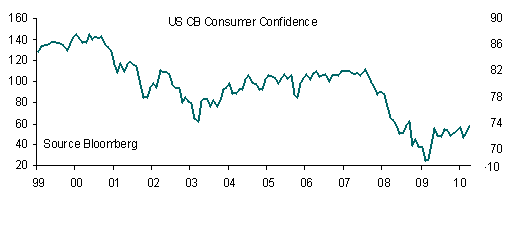
Hungary’s government attempted to diffuse worries about its finances, with the country’s Prime Minister listing measures including cutting public pay and prohibiting mortgages denominated in foreign currencies, in order to hit the 3.8% of GDP budget deficit target. There was also some good news in the US, with small business confidence (NFIB) rising to its highest level since September 2008 whilst ABC consumer confidence edged higher.

The US Beige Book and Fed Chairman Bernanke’s testimony on the US economy to Congress, mark the highlights today. The Beige Book is set to reveal further signs of economic recovery but with limited inflation pressures. Bernanke is likely to maintain a similar tone to comments he made yesterday, highlighting a “moderate” economic recovery, with unemployment likely to stay “high for a while”. His testimony will be scrutinized for the timing of rate hikes, and any elaboration on his comments about rates rising before the economy is at full employment.

Against the background of the many and varied uncertainties still afflicting markets maintain a sell on rallies view on risk trades is still the best option. EUR/USD will struggle to breach resistance around 1.2010 and remains susceptible to test support around 1.1826. GBP/USD could target fresh lows in a “negative reversal”, with potential to head back down to 1.3996.

Confidence has plummeted to extreme lows and it will be several months before appetite for risk trades returns. The AUD and NZD as well as many Asian currencies will struggle over the interim period before their appreciation trend finally resumes.

In contrast to the weakening of risk currencies, CHF strength is showing little sign of letting up. Switzerland recorded a massive 50% jump in FX reserves in May to CHF 232 billion from CHF 153 billion in April. This is not usually market moving data but the scale of the jump in reserves is huge and it is not just due to valuation changes. The Swiss National Bank (SNB’s) effective abandonment of defending a particular level in EUR/CHF turned into more a smoothing operation but this did not stop the bank from massive FX interventions. Despite the interventions EUR/CHF dropped by 0.8% over the month.

Aside from alleviating upward pressure on the CHF the interventions had an indirect effect of reducing the pain of holders of CHF mortgages. E.g. around 30% of Hungary’s bank loans and 60% of mortgages are denominated in CHF but countries across Europe have plenty of CHF denominated loans, especially Austria. Although Hungary announced steps to meet its deficit targets its woes are far from over.

The CHF has appreciated by around 3% since the beginning of May versus HUF, exacerbating the pain for CHF borrowers in the country. The fact that CHF strength shows no sign of letting up on the back of strong data and safe haven flows, the pain for these borrowers will only add to the problems for banks and borrowers alike in Europe.
Switching risk on and off

There are several words that can be used to describe current highly risk averse market dynamics including panicked, nervous, fickle, tense, jittery, risky, volatile etc, all of which spark negative thoughts in the minds of investors. Aside from real worries such as renewed banking sector concerns, especially in Europe and in particular with regard to Spanish savings banks, there are also plenty of rumours afflicting market sentiment. In this environment deriving fact from fiction is not particularly easy whilst battling against the heavy weight of negative sentiment.

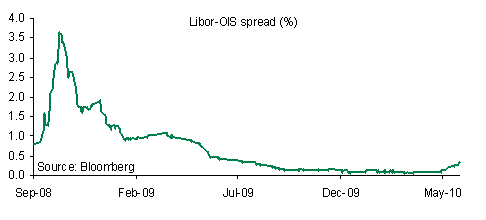
Although the pull back in risk appetite over recent weeks looks small compared to the peak in risk aversion during the financial crisis, the pace of the drop in markets has been dramatic and the withdrawal of risk seeking capital has been particularly aggressive. For example, in less than one month Asian equity markets have registered an outflow of around half of the total equity capital flows so far this year. Worryingly and despite the backstop in terms of central bank liquidity provision there are signs of renewed tensions in the money markets, with the libor-OIS spread and TED spread widening over recent days.

One of the most interesting observations in the current environment is that risk aversion has been increasing despite encouraging economic data. Not only has economic data been positive but in general has been coming in above consensus, showing that the market has underestimated the bounce in growth in the second quarter. Why is positive data not soliciting a more positive market reaction? Recent data is perhaps being seen as backward looking, and there is growing concern about the likely downdraft on economic activity in H2 2010, especially in Europe as deficit cutting measures bite.

News on the budget front in Europe has been relatively positive too, with Greece registering a sharp decline in its deficit, as well as announcing plans to tighten tax administration procedures. Meanwhile, the Italian cabinet reportedly approved a package of measures to reduce its deficit. On the flip side budget cuts across Europe are leading to growing public opposition, testing the resolve of eurozone governments to pass austerity measures. The public opposition means that the real test is in the implementation and execution of austerity measures. Signs of progress on this front will be key to turn confidence in the EUR around.

The USD remains king in the current environment and any pull back is likely to be bought into though Moody’s ratings agency’s warnings that the US AAA sovereign rating may come under pressure if there was no improvement in the US fiscal position, highlights the risks over the medium term to this currency. The EUR is set to remain under pressure though it is worth noting that the pace of its decline appears to be slowing, leaving open the potential for some consolidation. Near-term technical support for EUR/USD is seen at 1.2142 but a broader range of around 1.18.23-1.2520 is likely to develop over coming weeks.

What To Watch This Week

The end of last week proved to be a calmer affair than the preceding few days. There was some encouraging news on the Greek front, with Germany finally approving its share of the European Union (EU) aid package whilst Greece appeared to be on track with its budget deficit reduction as the country recorded a cash deficit of EUR 6.3billion in the first four months of the year, a 42% reduction compared to a year earlier. EU officials also agreed on tougher sanctions for countries breaching austerity rules.

There were plenty of negatives to offset the good news however, as European business surveys including the German IFO index and flash eurozone purchasing managers indices (PMIs) revealed some loss of momentum in growth as well as increased divergence. European banking sector concerns intensified as the Bank of Spain was forced to take control of CajaSur, a small savings bank holding 0.6% of total Spanish banking assets, which faced difficulties due to distressed real estate exposure. Its woes highlighted the problems faced by many Spanish savings banks due to property market exposure.

US data releases this week will confirm that economic recovery gathered steam in Q2. May consumer confidence data is likely to record a small gain, due in large part to improving job market conditions, whilst the Chicago PMI is set to retrace slightly in May, albeit from a healthy level. Both new and existing home sales are set to record gains in April, the former following a sizeable gain in March although the drop in house prices likely to be revealed by the Case-Shiller index will continue to fuel doubts about the veracity of the turnaround in the US housing market.

In Europe there is not much in terms of first tier releases and highlights include sentiment data such as German Gfk and French consumer confidence indices, and the May French business confidence indicator. The data are likely to be mixed, and as indicated by last week’s surveys will reflect a relatively healthy Q2 2010, but a worsening outlook for the second half of the year.

In the absence of UK data today there will be plenty of attention on the details of plans by Chancellor Osborne to cut GBP 6 billion from the budget deficit. The measures will be small change ahead of the emergency budget package on June 22nd when much bigger cuts are expected. Nonetheless, the first step today will be a crucial test of the new government’s ability to convince ratings agencies and markets that it is serious about reducing the burgeoning fiscal deficit.

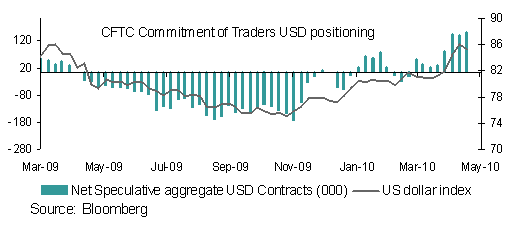
Following the massive positioning adjustments of the last week markets will look somewhat calmer over coming days but risk aversion is likely to remain elevated, suggesting little respite for most currencies against the USD. The recent moves have left net aggregate USD positioning registering an all time high according to the CFTC Commitment of Traders data, in the latest week, but after the slight retracement lower in the USD index, it is set to make further gains over coming days.

It was notable that EUR and GBP looked more composed at the tail end of the week whilst attention turned to the liquidation of long positions in CHF, AUD, NOK and SEK. These risk currencies are set to remain under pressure but there will be little respite for EUR which is set to drift lower, albeit a less aggressive pace than over recent weeks and a re-test of EUR/USD technical support around 1.2296 is likely. GBP/USD has showed some resilience over recent days but remains vulnerable to further downside pressure, with 1.4310 immediate support.

Q1 Economic Review: Elections, Recovery and Underemployment

I was recently interview by Sital Ruparelia for his website dedicated to “Career & Talent Management Solutions“, on my views on Q1 Economic Review: Elections, Recovery and Underemployment.

Sital is a regular guest on BBC Radio offering career advice and job search tips to listeners. Being a regular contributor and specialist for several leading on line resources including eFinancial Careers and Career Hub (voted number 1 blog by ‘HR World’), Sital’s career advice has also been featured in BusinessWeek online.

As you’ll see from the transcript of the interview below, I’m still cautiously optimistic about the prospects for 2010 and predicts a slow drawn out recovery with plenty of hiccups along the way.

Sital: Mitul, when we spoke in December to look at your predictions for 2010, you were cautiously optimistic about economic recovery in 2010. What’s your take on things after the first quarter?

Click here to read the rest…

Optimism dissipates

Markets have been highly fickle so far this year. Optimism about strong recovery led by China – recall the fact that disappointment from the surprisingly weak US non-farm payrolls report in December was outweighed by strong Chinese trade data – has dissipated. Instead of rejoicing at China’s robust GDP report last week, which revealed a 10.7% rise in the fourth quarter of 2009, investors began to fret about whether China would have to move more aggressively to tighten monetary policy. Fuelling these fears was the release of Consumer price data which showed inflation rising above expectations to 1.9% YoY in China.

If such fears were not sufficient to hit risk appetite, US President Obama’s plan to limit the size and trading activities of financial institutions dealt another blow to financial stocks. The plan followed quickly after the Democrats lost the state of Massachusetts to the Republicans and managed to shake confidence in bank stocks whilst fuelling increased risk aversion. Meanwhile, rumblings about Greece continue to weigh on markets and Greek debt spreads continued to widen even as global bond markets rallied.

Following the US administration’s plans to restrict banks’ activities the fact that the rise in risk aversion was US led rather than broad based led to an eventual pull back in the dollar which helped EUR/USD to avoid a break below 1.40. Risk trades including the AUD came under pressure as risk appetite pulled back. A drop in commodity prices did not help. The AUD was also hit by news that Australia’s Henry Tax Review would look to tax miners in the country. As a result AUD/USD dropped below 0.90 though this level is likely to provide good buying levels for those wanted to take medium term AUD long positions. The one currency that did benefit was the JPY which managed to drop below sub 90 levels.

The aftermath of the “Volker Plan” will reverberate around markets this week keeping a lid on equity sentiment. Meanwhile Greece will be in the spotlight especially its bond syndication. A bad outcome could be the trigger for EUR/USD to sustain a move below 1.40 though it looks as though it may find a bottom around current levels, with strong support seen around 1.4029. The German IFO business survey for January will be important to provide some direction for EUR and could be a factor that weighs on the currency if as expected it reveals some loss of momentum in the economy.

Aside from the Fed the other G3 central bank to meet this week is the Bank of Japan but unless the Bank is seen to be serious about fighting deflation, USD/JPY may remain under downward pressure against the background of elevated risk aversion. Below 90.0 there does appear to be plenty of USD/JPY buyers however, suggesting that further upside for the JPY will be limited. USD/JPY will find strong support around 88.84.

Much will depend on the key events in the US this week including the Fed FOMC meeting and the President’s State of the Union speech. USD bulls will look for some indication that the US government is serious about cutting the burgeoning budget deficit. Also watch out for the confirmation vote on the renomination of Bernanke as Fed Chairman which could end up being close. There is a heavy slate of data to contend with including new and existing home sales, consumer confidence, durable goods orders, the first glance at Q4 GDP and Chicago PMI.