EUR higher but resistance looms

EUR and risk currencies in general were buoyed by the passage of the austerity bill in the Greek parliament. The implementation bill is also likely to be passed later today opening the door for the disbursement of EUR 12 billion from the European Union / IMF from the EUR 110 bailout agreed for the country. Combined with news that German banks are progressing towards agreeing on a mechanism to roll over Greek debt alongside French banks as well as likelihood of an European Central Bank (ECB) rate hike next week, the EUR is set to remain supported over the short term.

Nonetheless, it once again looks as though a lot of good news is priced in and it would be surprising if EUR/USD could extend to above strong resistance around 1.4557 given the many uncertainties ahead, not the least of which includes the stance of ratings agencies on any Greek debt rollover.
USD/JPY is the only major currency pair that is correlated with bond yield differentials at present (2-year yields) and therefore it should not come as a surprise that USD/JPY has moved higher as the yield differential between the US and Japan has widened by around 10bps over the past week. Indeed, yesterday’s move above 81.00 was spurred by the move in yield differentials although once again the currency pair failed to build sufficient momentum to close above this level.
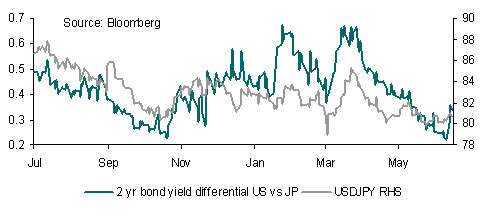
Further gains will require US bond yields to move even higher relative to Japan but perhaps the end of QE2 today may mark a turning point for US bond markets and currencies. The end of QE2 taken together with a jump in bond supply over coming months, will see US Treasury yields will move sharply higher, implying much more upside for USD/JPY.

AUD has bounced back smartly over recent days, with the currency eyeing resistance around 1.0775 versus USD. A general improvement in risk appetite has given the currency some support but markets will be unwilling to push the currency much higher ahead of the Reserve Bank of Australia (RBA) meeting next week. On the plus side, there are no rate hikes priced in for Australia over the remainder of the year, suggesting an asymmetric risk to next week’s meeting.

In other words, unless the RBA openly discusses rate cuts in the statement, the AUD will likely remain supported. Conversely any indication that a rate hike may be in prospect will be AUD supportive. In any case we continue to believe the AUD offers better value especially relative to NZD and maintain our trade idea to buy AUD/NZD.
US Dollar Finding Support

The US dollar is finding growing relief from the fact that the Fed is putting up a high hurdle before more quantitative easing (QE3) is even considered. As highlighted by Federal Reserve Chairman Bernanke last week he is not considering QE3 despite a spate of weak US data. Of course until US bond yields move higher the USD will fail to make much of a recovery and in turn this will need some improvement in US economic data.


The May retail sales release is unlikely to provide this with headline sales likely to undergo an autos related drop while core CPI released on Wednesday is set to remain benign in May. There will be better news on the US manufacturing front, with surveys and hard data likely to bounce back.

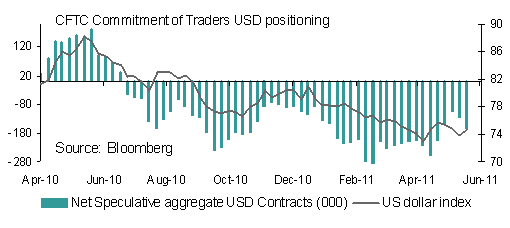
There is still plenty of scope for USD short covering as reflected in the fact that IMM USD positions fell further as of the 7th June, with the market still heavily short USDs. The USD index has likely found a short term bottom, with a break above the 50-day moving average level around 74.6874 in focus.

EUR has lost momentum , with the European Central Bank’s (ECB) confirmation of a July policy rate hike prompting a major sell off in the currency, even with interest rate markets barely flinching. The EUR is susceptible to developments regarding Greece and the news on this front is not good. Divisions between policy makers including the ECB about the extent of private sector involvement in a second bailout package threaten to prolong the pain.

Similarly divisions within the Greek parliament about further austerity measures needed to secure a second bail could also derail the process. Further negotiations this week will be closely scrutinised, likely taking more importance than data releases, with only the final reading of May inflation and industrial production of note this week.

As revealed by the CFTC IMM data, EUR long positions jumped early last week leaving plenty of scope for unwinding, something that is likely to take place this week. Nonetheless, support around the 30 May low of EUR/USD 1.4256 is likely to prove difficult to break on the downside this week.

GBP took a hit in the wake of yet more weak activity data in the form of May industrial and manufacturing production data. The economic news will be no better this week, with retail sales set to drop in May and CPI inflation set to rise further in April. The data will only add further to the confusion about UK monetary policy as the dichotomy between weak data and persistently high inflation continues.

Admittedly the weak data releases can at least partially be explained away by the Royal wedding and Easter holidays but this will provide little solace to GBP bulls. GBP will likely struggle against a firmer USD this week although its worth noting that GBP speculative position has been negative for 3-straight weeks, suggesting that at least there is less room for GBP position unwinding. GBP/USD is likely to hold above support around 1.6055 this week.

EUR Becomes The Anti USD

The USD is close to giving back the full extent of the gains it made during May. The USD index hit a low of around 72.696 on 4th May and looks on track to re-test this level.

It would be easy to say that the USD is being undermined by low US bond yields but whilst this is partly true only USD/JPY has had a significant correlation with bond yield differentials over the past 3-months.

The reality is that the EUR has become the anti USD at present. Whilst the EUR composes 57.6% of the USD index which would imply a high correlation between the USD index and EUR, it does not explain the fact that the correlation over the past 3-months is at an extremely high 0.98.

It is probably a relief for USD bulls that the currency is not being particularly influenced by yield differentials at present as it would be even weaker if it was so. US bond yields continue to be depressed by growth concerns, following a spate of weaker US data releases, culminating in the May jobs report last week.

Speculation about QE3 is similarly unhelpful for the USD but the prospects of this occurring are still very slim and notably whilst Bernanke highlighted the “frustrating slow” economic recovery in a speech last night he did not indicate a desire to embark on QE3.

Nonetheless, any clues about Fed policy will be closely scrutinised and this includes today’s Beige Book of regional economic conditions. Our expectation of a relatively downbeat report suggests that the USD will find no support from this source.

Ultimately USD recovery will require EUR weakness but the European currency appears to have regained its ‘Teflon’ coating as its resistance to bad news grows once again. The EUR was helped yesterday by a stronger than expected April retail sales report and will undoubtedly find further solace from confirmation of a strong start to the year in terms of Q1 GDP today.

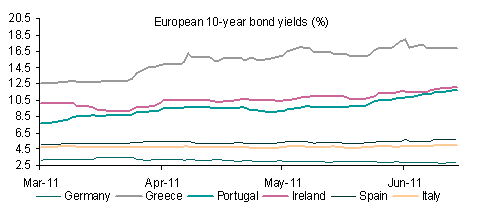
Overall direction continues to come from news in the eurozone periphery, however. The fact that officials appear to be inching towards an agreement in Greece has clearly been appreciated by the EUR. Moreover, potential ECB backing for debt rollovers by private investors will alleviate some concerns.

Nonetheless, at current levels, with EUR/USD on the path to its 4th May high around 1.4940 it appears that a lot is already priced in and the scope for disappointment is high.

US Ratings Under Threat

The USD succumbed to further pressure overnight as Moody’s Investor Service threatened to place the US Aaa rating on review for downgrade if there is no agreement reached on raising the US debt ceiling. Although the news prompted a rise in US Treasury yields it did little for the USD.

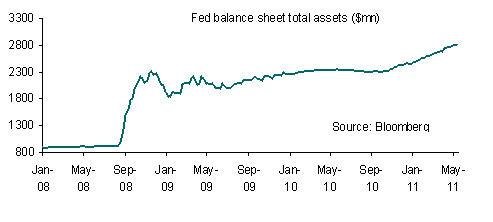
News that the Federal Reserve’s balance sheet expanded to a record $2.772 trillion in the week ending June 1 highlights the ongoing headwinds to the USD from Fed asset purchases. The fact that there is even talk of QE3 in the wake of weak US data suggests that the headwinds will not dissipate quickly.

Direction today will come from the US May jobs report though this is unlikely to deliver any good news for the USD. Forecasts for non-farm payrolls have likely been revised lower to sub 100k compared to the published consensus forecast of 165k following the weaker indications from the May ADP jobs report and ISM data this week. A weak payrolls outcome will only intensify worries about the depth and length of the US ‘soft patch’.

Although market expectations are also likely to have been downwardly revised, something that may cushion the blow to the USD, it will be difficult to get away from the fact that growth in Q2 is weaker than many had thought.

EUR was well supported overnight, boosted by a relatively successful Spanish bond auction yesterday and reports that officials have agreed in principle to a 3-year adjustment plan for Greece covering funding needs to 2013 although there was no confirmation of such an agreement.

As a result, EUR/USD tested 1.45 and looks supported ahead of today’s US payrolls data. EUR’s recovery in general has been impressive but gains above 1.45 are likely to prove more difficult even if an agreement on Greece is close to being achieved.

As usual Japan’s political gyrations are having little impact on the JPY as the currency is instead buffeted by risk aversion swings and yield differentials. In fact USD/JPY has been rather well behaved over recent weeks as indicated by implied options volatility.

Prime Minister Kan’s success in winning a no-confidence motion came at a cost and may provide very little political stability. Kan said will resign as soon as post-earthquake recovery efforts are completed and once he is gone there is likely to be some realignment of existing political parties.

As for the JPY it will remain unscathed by political events. Over the near term USD/JPY is likely to cling to the 81 handle but we maintain our bearish view on the JPY in the medium term under the assumption that there is a sharp widening in US – Japan bond yield differentials.

Euro Resilience To Fade

There will at least be a little more liquidity in FX markets today following yesterday’s public holidays in the US and UK. Whether this means that there will be a break out of recent ranges is another matter. Clearly global growth worries as well as eurozone peripheral debt concerns are having an important impact on market dynamics but are also providing conflicting signals.

On the one hand the USD ought to garner support from Europe’s problems but on the other, safe haven demand and growth concerns is bolstering demand for US Treasuries keeping US bond yields at very low levels despite the lack of progress on increasing the US debt ceiling and agreeing on medium to long term deficit reduction.

In the wake of a run of US data disappointments including April durable goods orders, Q1 GDP and weekly jobless claims last week, fears of a loss of momentum in the US economy have intensified. Manufacturing and consumer confidence surveys in the form of the May Chicago PMI and Conference Board consumer confidence survey today will be closely scrutinised to determine whether the ‘soft patch’ in the US economy will persist.

This will have important implications for the USD as worries about growth may feed into expectations that the Fed’s ultra loose monetary policy will be sustained for longer. As it is US 2-year bond yields have dropped to their lowest level this year.

Fortunately for the USD only USD/JPY and USD/CHF have maintained a statistically strong correlation with bond yield differentials although we expect the break in relationship for other currencies to prove temporary. In the case of USD/JPY, yield differentials have narrowed between the US and Japan, a factor playing for JPY appreciation.

Perhaps the fact that unlike the US Japanese data has on balance been beating expectations notwithstanding disappointing April household spending and industrial output data has helped to narrow the yield gap with the US. One explanation is that that worst fears of post earthquake weakness have not been borne out, suggesting that economic expectations have been overly pessimistic. In any case, USD/JPY 80 is still a major line in the sand for the currency pair.

The EUR continues to show impressive resistance, with EUR/USD breaking technical resistance around 1.4345, which opens up a test of 1.4423. Reports that Greece had failed to meet any of its fiscal targets and of harsh conditions set by European officials for further aid have failed to dent the EUR. Whether the market is simply becoming fatigued or complacent will be important to determine if the EUR can gain further.

A report in the WSJ that Germany is considering dropping its push for early rescheduling of Greek debt has given some support to the EUR too. Ongoing discussions this week are unlikely to prove conclusive however, with attention turning to meetings of European officials on 20th and 24th June. I still believe EUR gains will limited, with the break above 1.4345 likely to prove shortlived.