Stressing About European Stress Tests

Equities and risk appetite were bolstered by the relative success of the Spanish bond auction on Thursday. The results of the auction in which Spain sold EUR 3 billion in 10 year notes helped to stem some of the pressure on eurozone bond spreads, which despite the generalized improvement in market sentiment over recent days, had been continuing to widen.

Another key indicator that has been suggested that all is not well moving in the opposite direction to the improvement in many risk indicators is the Baltic Dry Index which has dropped by around a third since 26th May 2010.

Perhaps more significant in terms of providing sustainable support for markets was the news that the European Union agreed to publish the results of bank stress tests, slated for the second half of July. This could turn out to be a key stepping stone towards increasing the transparency of the eurozone banking sector.

However, doubts will remain until there is some clarity on the terms of the tests such as whether they include details of sovereign debt exposure. Also, if the stress tests reveal shortcomings in the banks in question it is unclear if government funding will be provided for them. Although the publishing of stress test results is a step in the right direction until these and other questions are answered it is difficult to see markets getting too excited.

It’s not all plain sailing for equity markets despite the relatively positive news in Europe as disappointing US data in the form of a surprise jump in weekly jobless claims and a bigger than expected drop in the June Philly Fed survey weighed in on the side of those expecting both a slow and jobless recovery in the US.

The CHF has been a key mover following the Swiss National Bank policy decision. The decision to leave interest rates unchanged was no surprise, but the change in rhetoric towards a less aggressive stance towards CHF strength opens up the floodgates for CHF buyers. will look to test its all time low around 1.3720.

Another central bank that has shown concern about a strengthening currency is the Bank of Japan but unlike the SNB Japan’s central bank has not intervened for several years. The BoJ in the minutes of its May meeting noted that it will “watch if Europe’s crisis strengthens JPY”, indicating some concern about JPY strength.

This sentiment that was echoed by the Japanese government in the release of Economic Growth Strategy aimed at avoiding an excessive rise in the JPY via fiscal and monetary steps to beat deflation. The JPY barely reacted to both the minutes and the growth strategy, with market players likely sceptical until concrete measures are actually implemented.

It still look like an environment of sell on rallies for the EUR and other risk currencies, with their gains likely to run out of steam over coming days. The next key technical level for EUR/USD is around 1.2454, a level that will prove a tough nut to crack.
Sell Risk Trades On Rallies

It seems that every time there is a bounce in risk appetite it quickly dissipates as worries about growth, fiscal deficits, sovereign debt, etc, return to dent sentiment. This was again the case overnight as markets sold off late in the US session, with an early bounce in sentiment proving too fragile to last. This pattern of trading is set to persist for a long while yet, with the overall tone of selling risk trades on rallies remaining in place.

Fears over a double dip global recession have increased since the release of Friday’s disappointing US jobs report even if it is too early to pass judgment based on the basis of one month’s data. Coupled with worries about slowing growth momentum in China, hopes that slower growth in the eurozone could be counterbalanced by firm growth elsewhere are being dashed. The problem is that despite a strong quarter of growth for most economies in Q2 2010 the outlook for the second half of the year is far more uncertain.

European Union officials sought to calm worries about the potential for renewed fiscal crises in the future by agreeing to monitor national budgets more closely and at an earlier stage whilst introducing a wider range of sanctions on excessive deficits. Unfortunately this is akin to the idiom about closing the stable door after the horse has bolted. The steps aren’t going to help resolve the current crisis. Evidence of implementation, execution and results on the deficit cutting front will help however, but this is a process that will take months rather than days or weeks.

A couple of factors may have prevented the EUR from extending losses overnight. 1) Germany announced EUR 80 billion in spending cuts along with 15,000 public sector job cuts. Germany also is pushing for a financial transactions tax on tap of the bank levy. 2) European finance ministers finalised details of the EUR 440 bn Financial Stability Facility which aims to sell AAA rated bonds to make loans to eurozone countries. The only question is the approval process. The statement on the funds operations only said that “national legal procedures to participate in the facility are well on track”. EUR/USD is likely to range between 1.1826 and 1.2110 over the short-term.

Switching risk on and off

There are several words that can be used to describe current highly risk averse market dynamics including panicked, nervous, fickle, tense, jittery, risky, volatile etc, all of which spark negative thoughts in the minds of investors. Aside from real worries such as renewed banking sector concerns, especially in Europe and in particular with regard to Spanish savings banks, there are also plenty of rumours afflicting market sentiment. In this environment deriving fact from fiction is not particularly easy whilst battling against the heavy weight of negative sentiment.

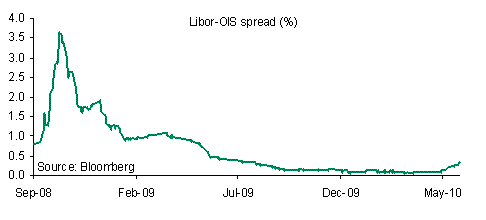
Although the pull back in risk appetite over recent weeks looks small compared to the peak in risk aversion during the financial crisis, the pace of the drop in markets has been dramatic and the withdrawal of risk seeking capital has been particularly aggressive. For example, in less than one month Asian equity markets have registered an outflow of around half of the total equity capital flows so far this year. Worryingly and despite the backstop in terms of central bank liquidity provision there are signs of renewed tensions in the money markets, with the libor-OIS spread and TED spread widening over recent days.

One of the most interesting observations in the current environment is that risk aversion has been increasing despite encouraging economic data. Not only has economic data been positive but in general has been coming in above consensus, showing that the market has underestimated the bounce in growth in the second quarter. Why is positive data not soliciting a more positive market reaction? Recent data is perhaps being seen as backward looking, and there is growing concern about the likely downdraft on economic activity in H2 2010, especially in Europe as deficit cutting measures bite.

News on the budget front in Europe has been relatively positive too, with Greece registering a sharp decline in its deficit, as well as announcing plans to tighten tax administration procedures. Meanwhile, the Italian cabinet reportedly approved a package of measures to reduce its deficit. On the flip side budget cuts across Europe are leading to growing public opposition, testing the resolve of eurozone governments to pass austerity measures. The public opposition means that the real test is in the implementation and execution of austerity measures. Signs of progress on this front will be key to turn confidence in the EUR around.

The USD remains king in the current environment and any pull back is likely to be bought into though Moody’s ratings agency’s warnings that the US AAA sovereign rating may come under pressure if there was no improvement in the US fiscal position, highlights the risks over the medium term to this currency. The EUR is set to remain under pressure though it is worth noting that the pace of its decline appears to be slowing, leaving open the potential for some consolidation. Near-term technical support for EUR/USD is seen at 1.2142 but a broader range of around 1.18.23-1.2520 is likely to develop over coming weeks.

Will the ECB intervene to support the Euro? (Part 2)

Click here to read Part 1

The last official intervention by the European Central Bank (ECB) in the currency markets took place in November 2000 and at the time the Bank stated that “the external value of the EUR does not reflect the favourable conditions of the euro area”. The ECB also noted the impact of a weaker EUR on price stability, with inflation at the time running above the ECB’s 2% threshold. This followed intervention a couple of months earlier in September 2000 when the ECB jointly intervened with the US Federal Reserve, Bank of Japan and other central banks in a concerted manner due to “shared concerns about the potential implications of recent movements in the euro exchange rate for the world economy”.

Conditions in the euro area could hardly be described as favourable at present, suggesting that this rationale would be very unlikely to be used to justify intervention. Conversely, a weaker EUR may actually contribute to making conditions in the eurozone more favourable. The rationale used for the September 2000 intervention holds more sway in the current environment. Nonetheless, the move in the EUR is very unlikely to do any serious damage to the world economy even if some Japanese exporters are suffering.

In the past the ECB has given various verbal warnings about the volatility of the EUR being too high, and this could potentially be utilized as rationale for FX intervention. However, implied volatility in EUR/USD is not particularly high when compared to the levels it reached during the recent financial crisis. Currently 3-month implied volatility is at its highest level since June 2009 but well below the peak in volatility recorded in December 2008. Clearly if EUR/USD volatility continues to rise there will be a greater cause for concern but at current levels the ECB is unlikely to even crank up verbal intervention let alone actual FX intervention.

One of the main benefits of the decline in the EUR is the support that it will provide to the eurozone economy. At a time when growth in Europe is slowing EUR weakness will be particularly welcome. Germany and other countries in Northern Europe will be major beneficiaries of EUR weakness given their export dependence. Given such benefits and the currently limited risks to inflation, the ECB is highly unlikely to intervene to strengthen the EUR.

Given the current very negative mood in the market, officials in Europe would do better to rectify some of the structural issues that markets are concerned about. This may provoke a more sustainable rally in the EUR but until there are concrete signs of progress on the fiscal front sentiment towards the EUR will remain negative. Against this background FX intervention to prop up the EUR would face more of a risk of failure, and in turn damage to the credibility of the ECB. This is perhaps as good a reason as any not to expect intervention.

Will the ECB intervene to support the Euro? (Part 1)

The EUR has lost around 23% since it all time high in April 2008 when it traded close to 1.6000. The EUR failed to rally even in the wake of the EUR 750 billion European Union / International Monetary Fund support package, a fact that has highlighted the weight of negative sentiment towards the currency. The latest blow to the currency came from the announcement of unilateral measures from Germany to ban naked short selling on sovereign debt and some financial stocks, actions that only highlighted the lack of policy co-ordination within the eurozone.

The rationale for further EUR/USD weakness is clear and justified partly by growth divergence within the eurozone countries, with Germany on the one extreme and weaker Southern European countries on the other. Moreover, relatively weaker overall growth in the eurozone compared to the US economy, a delay in interest rate hikes by the European Central Bank (ECB) and ongoing concerns about implementation and execution of deficit cutting plans, will also weigh on the EUR.

The EU/IMF support package and in particular ECB interventions in the Eurozone bond market have managed to alleviate some of the strain on European bond markets, but without similar intervention in the FX markets the EUR has become the release valve for Europe’s fiscal and debt problems. As a result the EUR’s fall has accelerated over recent weeks, only showing any sign of stability as fears of currency intervention increased.

The quickening pace of EUR depreciation has led to growing speculation of FX intervention by the ECB and other central banks to support the currency. I believe intervention is highly unlikely and see little reason for panic about the drop in the EUR. Once markets realise that there is indeed little risk of intervention the EUR will resume its downtrend.

One of the main reasons behind this view is that the EUR is not particularly “cheap” at current levels. In fact, “fair value” estimates based on the OECD measure of purchasing power parity (PPP) suggest that EUR/USD is around 5.6% overvalued at current levels, based on an implied PPP rate of around 1.17. Therefore, the drop in the EUR over recent months has only brought it back close to PPP fair value estimates.

Moreover despite the fact that there has been a large nominal depreciation of the EUR its trade weighted exchange rate has declined by much less, around 8.5% since the beginning of the year and around 11.3% since its high in October 2009. Although the trade weighted EUR is around its lowest level since October 2008, taking a longer term view shows that it is slightly above its average over the past 20-years.