Greece Bailed Out, Euro Unimpressed

After much debate eurozone ministers along with the International Monetary Fund (IMF), finally announced an emergency loan package for Greece amounting to  EUR 110 billion. In return for the bailout Greece agreed to enhanced austerity measures. The good news is that the package covers Greece’s funding requirements until 2012, and is sufficient to avoid debt restructuring and default. The loan package has also removed uncertainty ahead of bond redemption on May 19th.

One aim of the package was to prevent contagion to other eurozone countries, especially Portugal and Spain, where there has been growing pressure on local bond and equity markets. However, the path ahead is strewn with obstacles and it is too early to believe that the package has ensured medium term stability for the EUR.

The challenges ahead are two-fold, including both the implementation of the measures in Greece in the face of strong domestic opposition and the approval of the loans by individual country parliaments within the eurozone, both of which are by no means guaranteed.

The toughest approval process is likely to be seen in Germany where the government will face a grilling in parliament and a challenge in the constitutional court ahead of official approval of the package. European Union leaders are scheduled to meet on May 7th to discuss the parliamentary approval of loans to Greece whilst German officials meet on the same day.

Implementation risk is also high. Although the Greek government appears to be sufficiently committed, opposition within Greece is growing; various strikes planned over coming days. Aside from union opposition, the scale of the budgetary task ahead is enormous, having never been undertaken on such a large scale in recent history. The sharp decline in growth associated with the austerity measures will make the task even harder.

The EUR bounce on the news has been limited, with the currency failing to hold onto gains. The announcement seems to have triggered a “buy on rumour, sell on fact” reaction, with the size of the loan package falling within the broad estimates speculated upon over the last week. The lack of EUR bounce despite the fact that going into this week the CFTC Commitment of Traders report revealed record net short speculative positioning in EUR/USD, reveals the extent of pessimism towards the currency.
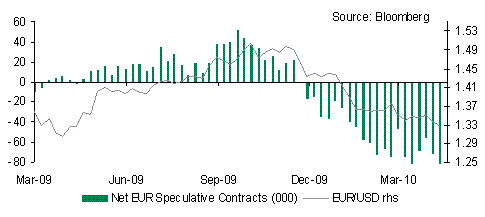
The EUR may benefit from a likely narrowing in bond spreads between Greece and Germany. Given that sovereign risk is being increasingly transferred from the periphery to the core, the net impact on bond markets may not be so positive for the EUR. Over the short-term there will be strong technical resistance on the upside around EUR/USD 1.3417 but more likely the currency pair will target support at around 1.3114.

The Herculean task ahead for the Greek government suggests that markets will not rest easy until there are credible signs of progress. Investors would be forgiven for having a high degree of scepticism given the degree of “fudging” involved in the past, whilst Greek unions will undoubtedly not make the government’s task an easy one by any means. Such scepticism will prevent a sustained EUR recovery and more likely keep the EUR under pressure.

As noted above the divergence in growth for the eurozone economy between Northern and Southern Europe will make policy very difficult. Moreover, the EUR is set to suffer from an overall weak trajectory for the eurozone economy, relative to the US and other major economies. The widening growth gap with the US will also fuel a widening in bond yield differentials, a key reason for EUR/USD to continue to decline to around or below 1.25 by the end of the year.
Greek bailout edges closer

A semblance of calm appears to have returned into the weekend following a fit of nervousness about all things Greece.  For currency markets this means that the EUR has recovered some composure after hitting 2010 lows around 1.3115 but direction next week will largely depend on the much anticipated announcement from European officials over coming days on the size and conditionality of a loan package to the country.   In return Greece is reported to be planning a EUR 24 billion package of additional measures to cut its burgeoning fiscal deficit.

Over recent days the consensus on how much funding Greece will need has increased to EUR 120 billion from the initial EUR 45 billion announced just over a couple of weeks ago.   Presumably the jump in size of assistance will be sufficient to convince markets that Greece’s default risk will be minimal, not just in the coming year but over the next few years.   It may also help to prevent further credit ratings downgrades following the decision by S&P ratings agency to downgrade Greece to junk status.  Moody’s left Greece on review for a downgrade but may also cut its ratings to junk if the situation does not improve. 

There are still many obstacles to an improvement in confidence towards Greece, however including the willingness of Germany to contribute to any aid package ahead of regional elections on May 9th and the ability of the Greek government to push through austerity measures in the face of growing social unrest in the country.   Moreover, the task ahead for Greece which aims at cutting the budget deficit down to 2% by 2013 is enormous having never been achieved in modern history.  Given the outlook for much weaker growth in the months and years ahead as well as growing domestic resistance in Greece, it will be all the more difficult. 

The likely announcement of an aid package over coming days will keep market sentiment relatively well supported and as reflected in the narrowing in Greek debt spreads, which seem to be trading more like equities, it is already having a positive impact.  Nonetheless, the bounce to markets will be limited and whilst a EUR 100-120 billion package will help to shore up confidence, there is just too much uncertainty remaining.  This points to continued volatility in the weeks ahead and very limited upside for EUR/USD and more likely a test of technical support around 1.3091 in the short-term then down to 1.2885.

Some Respite For The Euro

Following several days in which confidence in Greece’s ability to weather the storm was deteriorating, news that Greece asked for EU/IMF help helped to boost global markets and the EUR.  Meanwhile strengthening economic and earnings news helped to provide an undercurrent of support for markets, which boosted the end week rally in risk appetite.  

A 27% jump in US new home sales in March, a firm durable goods orders report as well better than expected earnings, with around 80% of companies reporting first quarter earnings beating expectations, highlight that US economic recovery is becoming increasingly well entrenched.  This is likely to be confirmed by the release of US Q1 GDP this week, set to register over 3% annualised quarterly growth.  

In Europe the picture is far more divergent, with exporting countries such as Germany doing well as evidenced from surveys such as the IFO and ZEW surveys, but in contrast the club med countries are not doing so well.  The highlights of the data calendar this week are April confidence indicators and the flash reading of Eurozone CPI.  Confidence indicators are likely to reveal some improvement, but despite Friday’s EUR/USD bounce, the data will be insufficient to prevent EUR/USD continue to move lower, with 1.3150 still a firm target over coming weeks.  

The official request for aid from Greece from the EU/IMF begins a new chapter in the long running saga for the country.  Greece will officially detail the amount of aid needed in a letter to the European Commission and European Central Bank who will then decide whether to approve it.  

A few dates to note are the maturing of EUR 8.5 billion in bonds on May 19, the completion of discussion with the IMF, EU and ECB on May 6 and state elections in Germany on May 9, which could throw a spanner in any financial support from Germany for Greece.   Meanwhile Greek unions are threatening further strikes to protest against austerity measures that Greece needs to carry out to win any aid package.   

Aside from Greece, attention will continue to be focussed on earnings but the main event of the week will be the Fed FOMC meeting on 27/28 April. Whilst a no change outcome is highly likely, with interest rates set to be left at between 0-0.25%, there will be plenty of attention on whether the Fed removes the comment that policy rates will remain low for an “extended period”. If the comment is removed the statement will be taken in somewhat of a hawkish context, which would boost the USD.

Greek debt blows out, EUR takes a hit

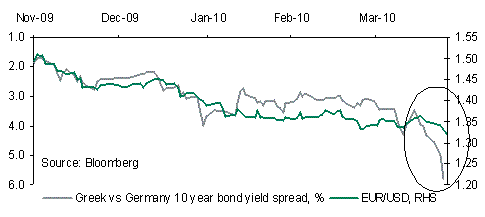
In light of the continued blow out in Greek bond yields, CDS and spreads versus German bonds, here is a chart of what it means for the EUR.   Unfortunately it’s not good news as it implies that EUR/USD should be trading closer to 1.20.   

The Eurostat report that Greece’s public sector deficit to GFP in 2009 was bigger than initially thought (13.6% compared to the original Greek government estimate of 12.7%) has done further damage.  Moody’s ratings downgrade of Greece to A3 dealt a further blow.  

This means that any attempt to reduce the deficit is now more difficult whilst the probability of a debt restructuring is growing , with rumours speculating that the haircut on Greek debt could be as much as 50%. 

Ouch.

The Good, The Bad And The Ugly

GOOD: Positive earnings. The biggest earnings news of the day was from Goldman Sachs reporting that profits almost doubled in Q1. Apple also beat estimates and its shares surged. 82% of US earnings have beaten expectation so far. There is still a long way to go in the earnings season but the growth/earnings story is helping to maintain the positive bias to risk trades. There will be plenty of attention on earnings, including AT&T, eBay, Morgan Stanley, Starbucks, Boeing and Wells Fargo.

Data releases remain upbeat, with the April German ZEW investor confidence survey beating consensus, whilst central banks delivered hawkish messages across the board including the Reserve Bank of Australia policy meeting minutes, which pointed to another interest rate hike in May. However, the biggest impact came from the Bank of Canada which unsurprisingly left rates at 0.25%, but removed the conditional commitment to keep policy on hold until the end of Q2, leaving a rate hike on June 1 very likely.

The CAD jumped on the back of the outcome, with USD/CAD dropping below parity. I continue to like CAD alongside the AUD and NZD and believe they will be the star performers over the coming months despite lofty valuations.    Near term targets for CAD, AUD and NZD vs USD are 0.9953, 0.9407, and 0.7195, respectively. 

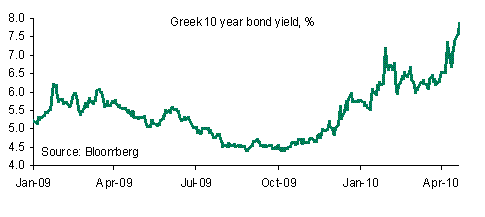
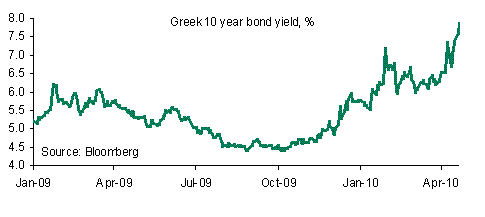
BAD: Talks between Greek officials and the IMF, ECB and EU on the conditions for a EUR 45 billion bailout loan will also be of interest although completion of talks could take weeks and in the meantime the situation is unlikely to improve, with Greece needing around EUR 10 billion to cover obligations by end May. Greek bond yields jumped to fresh record highs around 7.84% yesterday whilst the spread over German bunds also widened. Moreover, although Greece’s sale of EUR 1.95 billion in 13-week paper yesterday was heavily oversubscribed the, the yield was high at 3.65% which was far higher than the 1.67% yield at a similar sale in January.

In contrast to the likes of the CAD, AUD and NZD, the EUR is set to continue to suffer and as reflected in the widening in Greek bond spreads and high funding costs, Greek woes will keep plenty of pressure on the currency, with EUR/USD set to fall to support around 1.3300 in the short-term.

UGLY: UK regulator FSA will conduct a formal investigation of Goldman Sachs. The FSA will work closely with the US Securities and Exchange Commission SEC, which has accused the bank of Fraud though this has vehemently denied by Goldman Sachs. Although the negative market impact of the fraud case has been outweighed by good earnings and data the fallout is spreading. Some European politicians have even called for governments to stop working with the bank.