FX / Economic Preview

The European Union (EU) aid package for Greece and extension of collateral requirements by the European Central Bank (ECB) helped return a semblance of confidence to markets. Although the probability of a Greek default now looks extremely small, further austerity measures, fiscal issues in other EU countries and the negative impact on growth that all of this implies, suggest that Europe will be plagued by various problems for some time yet.

As a result of more favourable market conditions Greece is set to launch a syndicated bond issues today or tomorrow of up EUR 5 billion according to press reports. Attention will also turn to Greek debt rollovers, beginning with EUR 8.2 billion on April 20.

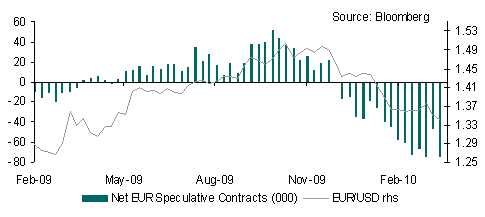
Improving sentiment following the Greece deal has extended to the EUR, with the currency bouncing off its lows around 1.3267. EUR/USD will now look to break through resistance around 1.3446, which would set up a test of 1.3516. There is plenty of scope for short-covering to help the EUR as reflected in the latest IMM Commitment of Traders’ report (a gauge of speculative market positioning) which revealed net EUR positions reaching yet another record low in the week to 23rd March. Whilst sovereign/official buying interest may keep EUR/USD supported this week the currency pair is best played as a sell on rallies.
A similar assessment applies for GBP. Speculative sentiment for the currency also hit a record low in the latest week but unlike the Greek deal helping the EUR, last week’s UK budget has done little to boost GBP’s prospects. Moreover, a report in the Financial Times highlighting hedge funds bets against GBP, suggests that there are still plenty of headwinds against the currency.

Volumes are set to thin out this week ahead of upcoming holidays, whilst the US March jobs report at the end of the week will likely prevent moves out of current ranges ahead of its release. The consensus forecast is for a 190k increase in non-farm payrolls though much of this is likely to reflect hiring for the 2010 US consensus and a rebound from adverse weather effects in February.

In Europe March economic confidence surveys will be watched closely to determine how much damage Greece and general fiscal woes are having on sentiment. Some improvement, in line with the Eurozone Purchasing Managers Index (PMI) and the German IFO business confidence survey, is expected, which will help to give further, albeit limited relief to the EUR.

The Japanese data slate kicked off the week in good form, with the release of February retail sales data, revealing its biggest annual increase in 12-years. It is difficult to see the recovery in sales taking much greater hold given persistent deflation pressures however, and part of the gain probably reflects the government’s shopping incentive program.

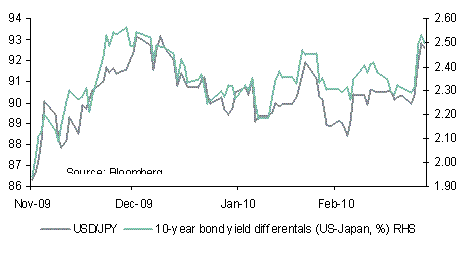
Aside from industrial production and jobs data in Japan the key release will be the results of the Q1 Tankan survey on Wednesday. The survey of manufacturers’ confidence is set to show further improvement. USD/JPY is likely to remain supported around 91.67 but will need a further widening in US/Japan 10-year bond yield spreads to push higher.
US Dollar Back On Top As Yields Rise

Two issues are driving markets and both are playing negatively for sentiment; the rise in G7 bond yields and the outcome of the EU summit. At a time when G7 bond yields have been pushing higher the poor response to the US $32 billion 7-year note sale contributed to a further increase in yield. The sale resulted in a yield of 3.374%, which was higher than expected, and a bid/cover ratio of 2.61. A combination of large US Treasury supply, medium term funding issues and signs of improving growth suggest no let up for US Treasuries.

The most reactive currency to yield differentials is currently USD/JPY. The 1-month correlation between USD/JPY and US/Japan bond yield differentials is a high 0.85. The spike in US 10-year Treasury yields especially relative to JGB yields (by around 21 basis points this week) is the main contributor to the jump in USD/JPY over recent days. Given the bearish outlook for US bonds in the near term, it suggests more upside for USD/JPY but also increasingly for other currencies against the USD as the importance of yield increases. Immediate USD/JPY technical resistance is seen around 93.21, with support at 91.87.

The other event of note yesterday was developments surrounding Greece in the European Union summit though in truth it was probably the strong comments by ECB President Trichet that had the bigger impact on EUR sentiment. The final EU communiqué noted the readiness for bilateral loans to Greece and substantial International Monetary Fund (IMF) financing in a Greek aid mechanism. Importantly and a likely sop to Germany, any aid will not contain a subsidy for Greece. Aid by the EU and IMF will only be provided in the event of “very serious difficulties”.

The EU agreement means that no money will be forthcoming immediately, but at least there will be a back stop should Greece have financing difficulties over coming weeks, which will act as an important safety net ahead of substantial Greek debt rollovers. This news was supplemented by the fact that ECB will not raise its minimum collateral requirements at the end of the year, which means that Greek debt will not be excluded in the event of a ratings downgrade. This is good news for Greece.

The combination of the fact that Greece will have to borrow money only at market rates, ongoing worries about other EU countries fiscal problems and European Central Bank (ECB) President Trichet putting somewhat of a dampener on sentiment by criticizing IMF involvement in the deal, will keep the EUR under pressure. Although Trichet later reversed his comments, the damage was already done and any relief to EUR/USD will be short-lived. The currency pair is increasingly poised for a further downside move, with the next target at 1.3213 on the path towards an eventual test of 1.3000.

Greek Saga Rumbles On – Does Anybody Care?

The debate over Greece continues to rumble on. France and Spain requested a separate summit meeting of the 16 heads of eurozone countries immediately before the full 27-member EU summit starting tomorrow but this was met with resistance. Meanwhile, Germany has called for “a substantial contribution” from the IMF towards a Greek aid package, whilst maintaining that no EU deal will be reached for Greece at the summit.

Frankly, the whole Greek saga has become extremely boring, with the lack of agreement about how to fix it doing little to inspire confidence. In particular the fractured opinion amongst EU leaders highlights the difficulties in reaching an agreement in a union made up of so many conflicting interests. At most the summit may agree on the conditions for a rescue package for Greece rather than a package itself. This will leave markets unimpressed,

US new home sales data today is likely to paint a slightly better picture with a small gain expected, albeit following the 11.2% plunge in the previous month. Sales will be helped by the extension of the home buyer tax credit. The US February durable goods orders report is also released today, with a small increase expected. A smaller gain in transport orders suggests that the 2.6% jump last month will not be repeated.

In Europe, the key release is the March German IFO business climate survey and a rebound is likely following February’s decline, helped by warmer weather and a weaker EUR. Flash readings of Eurozone March purchasing managers indices (PMIs) are also released but these are unlikely to extend gains from the previous month. Despite expectations of firmer data the EUR/USD is vulnerable to a further decline, with support around 1.3432 in sight for an imminent test.

Attention in the UK will turn to the pre-election Budget and particularly the government’s plans to cut spending and reduce the fiscal deficit. Failure to provide a credible blue print to restore fiscal credibility will damage confidence, heightening the risks of an eventual sovereign ratings downgrade and more pressure on GBP which appears destined for another drop below 1.50 versus USD.

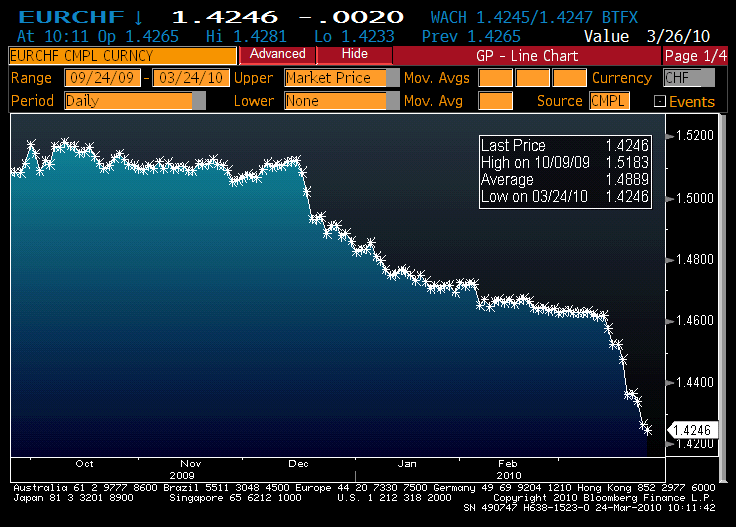
Most currencies have remained within ranges and the most interesting currency pair is EUR/CHF having failed to react to verbal warnings from the Swiss National Bank (SNB) about excessive CHF strength. EUR/CHF looks vulnerable to a further decline unless the SNB follows up rhetoric with action. Even if there is FX intervention by the SNB it may prove to be a temporary barrier to a market with an eye on the psychologically important 1.4000 level.

Despite the pressure on the Japanese government and Bank of Japan (BoJ) to engineer a weaker JPY, export performance has proven resilient, with exports jumping 45.3% on the year in February, helped by the strength of demand from Asia. Unfortunately this is doing little to end Japan’s deflation problem and even if there is less urgency for a weaker JPY to boost exports, JPY weakness will certainly help to reduce deflationary pressures in the economy. USD/JPY is stubbornly clinging to the 90.00 level, with little inclination to move in either direction.

US/China Tensions Ratchet Higher

FX policy tension is a theme that looks to be making a come back. The potential for CNY revaluation continues to be hotly debated, with international pressure on China intensifying. For its part China continues to resist such calls, but growing speculation that the US will label China a “currency manipulator” in the semi-annual US Treasury report on 15 April suggests that the issue will remain very much on the radar screen.

Tensions have ratcheted higher in the wake of a proposed bill by US senators targeting countries with “fundamentally misaligned currencies” and those needing “priority action”. Any country that is targeted would then have a year to correct its currency or face a case at the World Trade Organisation. If China is labelled as a currency manipulator it could also result in anti dumping regulations.

Much of the increase in tension may be attributable to politicking ahead of the November mid-term Congressional elections but it is clear that the issue is not going away quickly. Chinese Premier Wen’s strong comments over the past weekend denying any need for revaluation of the CNY suggests that the stakes will get even higher over coming months.

It is looking increasingly difficult for the US administration to ignore Congress’ calls for stronger action on FX. Moreover, US President Obama’s pledge to double US exports within 5-years will require some USD weakness, but the USD will need to weaken against Asian currencies led by China and not just against the usual culprits such as the EUR.

There is little sign of this happening anytime soon as Asian central banks continue to intervene to prevent their currencies from strengthening. Nonetheless despite China’s insistence that it does not believe the CNY is undervalued China is likely to be edging closer to an eventual revaluation in the CNY sometime in Q2 2010 as it combined a stronger currency with higher interest rates and tighter lending to curb inflation. A stronger CNY will also spur other Asian central banks to allow stronger currencies.

A deterioration in the China/US relationship could have potentially significant FX implications. The latest US Treasury TIC report this week showed that China reduced its holdings of US Treasuries for the third straight month in January. Should China feel that it needs to retaliate against a more aggressive US trade or FX stance it could reduce its holdings of US Treasuries further.

What To Watch This Week

A “crisis over” mode is being adopted across markets as worries about Greece wane and economic data provides support to recovery hopes, whilst importantly allaying fears of a “double-dip”. Equities, bonds and currencies are reacting accordingly; equities are close to year highs, bond yields have risen and spreads have narrowed, whilst the USD and JPY are weaker, and conversely risk currencies are stronger. Even EUR/USD pushed higher on its way to 1.3800 as a number of stops were cleared and shorts were squeezed.

The coming weeks will be important to determine whether there is any staying power in the upward move in risk assets. A lot of the February data in the US will likely be obscured by bad weather however, including industrial production figures this week, leaving markets with little to go on. In Europe, the key release is the March German ZEW investor confidence survey, and better news in Greece, will likely prevent a sharper decline in confidence.

After both the Swish National Bank (SNB) and Reserve Bank of New Zealand (RBNZ) unsurprisingly left policy unchanged last week this week sees the turn of the US Federal Reserve and Bank of Japan (BoJ). Neither central bank is likely to shift policy but the Fed statement will be looked upon for guidance on the timing of rate hikes. The comment in the FOMC statement that the Fed Funds rate is expected to remain low for an “extended period” is set to be retained, even if some FOMC members are itching to remove it soon.

The BoJ meeting will be particularly interesting. I have just returned from a week long trip in Japan and on the ground there is plenty of speculation that the BoJ will take extra action to combat deflation and weaken the JPY. Additionally comments by Japan’s Prime Minister and Deputy PM have highlighted the potential for action to weaken the JPY although the usual market hesitation to sell JPY into fiscal year end and repatriation talk may mean a weaker JPY path is not straightforward.

Greece will not move too far from the spotlight, with EU officials likely to give the official stamp of approval on Greece’s deficit cutting measures and plenty of discussion at the Eurogroup Finance Minister’s meeting and Ecofin meeting early in the week. Moreover, weekend press reports suggest that a bailout up to EUR 25 billion is close to being agreed. Other topics of conversation will include the possible formation of a European Monetary Fund, though this looks like it will be a non-starter given the many objections to it.

Overall, risk appetite is set to continue its upward trajectory, likely keeping the USD on the back foot. Some deterioration in USD sentiment was reflected in the fact that net long aggregate USD speculation positioning has turned negative again according to the latest CFTC Commitment of Traders (IMM) report. Much in terms of FX direction will depend on what the FOMC says rather than does tomorrow.

EUR/USD may take a crack at resistance around 1.3840 on improving Greek news but it is difficult to see much upside from current levels. The one to watch will be the JPY, especially if the BoJ embarks on aggressive actions at this week’s meeting, leaving USD/JPY plenty of scope to test resistance around 92.16.