Asian currencies vulnerable to equity outflows

Asian currencies are set to continue to trade cautiously. One big headwind to further appreciation is the fact that there has been a substantial outlook of equity capital over recent weeks. Over the last month to date Asian equity markets have registered an outflow of $3.3 billion in outflows. However, whilst Taiwan, South Korea, Thailand and India have seen outflows Indonesia, Philippines, and Vietnam have registered inflows.

The net result is that equity capital inflows to Asia so far this year are almost flat, a stark contrast from 2009 and 2010 when inflows were much higher at the same point in the year. The odds for further strong inflows do not look good, especially as the Fed ends QE2 by the end of June. While a sharp reversal in capital flows is unlikely, it also seems unlikely that Asia will register anywhere near as strong inflows as the last couple of years.

This will have a significant impact on Asian currencies, whose performance mirrors capital flows into the region. Almost all Asian currencies have dropped against the USD so far this month and could remain vulnerable if outflows continue. Given the relative stability of the USD over recent weeks and imminent end to QE2, the better way to play long Asia FX is very much against the increasingly vulnerable EUR.

The THB has been the worst performing currency this month but its weakness has been attributable to upcoming elections on July 3, which has kept foreign investor sentiment cautious. Thailand has seen an outflow of $812mn from its equity market this month. Polls show the PM Abhisit’s party trailing the opposition and nervousness is likely to persist up to the elections at least. THB weakness is not likely to persist over coming months, with USD/THB forecast at 29.2 by year end.

USD/KRW has been whipsawed over the past week but made up ground despite a continued outflow of equity capital over recent days. KRW has been particularly resilient despite a firmer USD environment and a drop in consumer sentiment in June. Next week the KRW will likely continue to trade positively, helped by a likely firm reading for May industrial production on Thursday. USD/KRW is set to trade in a 1070-1090 range, with direction likely to come from Greece’s parliament vote on its austerity measures.

TWD has traded weaker in June, having been one of the worst performing currencies over the month. USD/TWD does not have a particularly strongly correlation with movements in the USD or risk aversion at present but the currency has suffered from a very sharp outflow of equity capital over recent weeks (biggest outflow out of all Asian countries so far this month). Next week’s interest rate decision on Thursday by the central bank (CBC) will give some direction to the TWD but a 12.5bps increase in policy rates should not come as a big surprise. TWD is likely to trade with a weaker bias but its losses are likely to be capped around the 29.00 level versus USD.
Fed’s status quo fuels caution

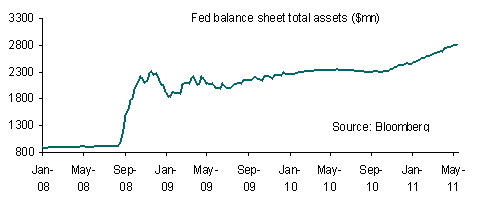
The Fed’s status quo did little to stir markets overnight although there was a decidedly negative tone to equities and commodities, perhaps spurred by the downgrading of US growth forecasts. The fact that the Fed did not indicate that it is considering further asset purchases but instead will keep its balance sheet at around $,2800 billion also acted as a drag on markets.

The major concern for markets remains the depth and length of the current ‘soft patch’. The Fed believes it will be temporary and we concur, but clearly the slide in equity markets over recent weeks, suggests that there has been a divergence between stock market expectations and reality. The USD however, may actually be finding a medium term bottom, with the fact that the Fed is not considering QE3,

The downbeat Fed stance combined with a cautious reaction to the Greek government’s passage of a confidence motion indicates that markets will remain cautious over the near term. Indeed, comments by the Greek opposition that they will not support further austerity measures dashed any hopes of unity and will add another obstacle towards an easing in Greek tensions.

As it is the continued wrangling between European officials over private sector participation in any debt rollover as well as uncertainty over how ratings agencies will react, threatens to keep sentiment under pressure. The EUR has remained surprisingly resilient but its muted reaction to the passage of the confidence motion has given way to some weakness and the currency remains a sell on rallies.

GBP was a major underperformer weighed down by the relatively dovish Bank of England MPC minutes in which some members were even discussing further asset purchases. The currency faces further risks from a the CBI reported sales data for June where a decline in sales is likely to be reported. GBP/USD looks vulnerable to a drop below its 200 day moving average around 1.6027.

Contest of the uglies

Although there is plenty of event risk in the form of the Greek confidence motion today market sentiment has taken a turn for the better as a ‘risk on’ mood has filtered through. There was little justification in the turn in sentiment aside from some reassuring comments from the EU’s Juncker but clearly markets are hoping for the best.

The contest of the ugly currencies continues and recently the EUR is running neck and neck with the USD. News that a final decision on a further tranche of aid for Greece and a second bailout package will not take place until early July was not digested well by European markets, although EUR/USD managed to show its resilience once again overnight.

EUR/USD looks like it will settle into a range over the short-term, with support around the 100 day moving average of 1.4170 and resistance around the 15 June high of 1.4451. A weak German June ZEW investor confidence survey may result in the EUR facing some resistance but the data is likely to be overshadowed by events in Greece.

Although Greece continues to dominate the headlines, the looming Fed FOMC meeting and press briefing tomorrow may just keep USD bulls in check especially given the likelihood of downward growth revisions by the Fed and no change in policy settings. Ahead of this news on the housing market is likely to remain bleak, with a likely drop in May existing home sales as indicated by pending home sales data.

USD/JPY continues to flirt with the 80 level but as yet it has failed to sustain a breach below this level. Contrary to speculation the JPY is not particularly reactive to risk aversion at present but instead continues to be driven higher by narrowing US – Japan bond yield differentials. This is pretty much all due to declining US Treasury yields rather than any increase in Japanese bond (JGB) yields.

However, while Japanese officials continue to back off the idea of FX intervention, even at current levels, data releases such as the May trade balance yesterday continue to build a strong case for weakening the JPY. Even economy minister Yosano sounded worried on the trade front in his comments yesterday. Despite such concerns, it will take a renewed widening in bond yield differentials to result in renewed JPY weakness which will need an improvement in US data to be forthcoming.

US Dollar Finding Support

The US dollar is finding growing relief from the fact that the Fed is putting up a high hurdle before more quantitative easing (QE3) is even considered. As highlighted by Federal Reserve Chairman Bernanke last week he is not considering QE3 despite a spate of weak US data. Of course until US bond yields move higher the USD will fail to make much of a recovery and in turn this will need some improvement in US economic data.


The May retail sales release is unlikely to provide this with headline sales likely to undergo an autos related drop while core CPI released on Wednesday is set to remain benign in May. There will be better news on the US manufacturing front, with surveys and hard data likely to bounce back.

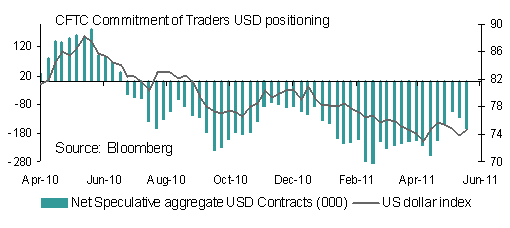
There is still plenty of scope for USD short covering as reflected in the fact that IMM USD positions fell further as of the 7th June, with the market still heavily short USDs. The USD index has likely found a short term bottom, with a break above the 50-day moving average level around 74.6874 in focus.

EUR has lost momentum , with the European Central Bank’s (ECB) confirmation of a July policy rate hike prompting a major sell off in the currency, even with interest rate markets barely flinching. The EUR is susceptible to developments regarding Greece and the news on this front is not good. Divisions between policy makers including the ECB about the extent of private sector involvement in a second bailout package threaten to prolong the pain.

Similarly divisions within the Greek parliament about further austerity measures needed to secure a second bail could also derail the process. Further negotiations this week will be closely scrutinised, likely taking more importance than data releases, with only the final reading of May inflation and industrial production of note this week.

As revealed by the CFTC IMM data, EUR long positions jumped early last week leaving plenty of scope for unwinding, something that is likely to take place this week. Nonetheless, support around the 30 May low of EUR/USD 1.4256 is likely to prove difficult to break on the downside this week.

GBP took a hit in the wake of yet more weak activity data in the form of May industrial and manufacturing production data. The economic news will be no better this week, with retail sales set to drop in May and CPI inflation set to rise further in April. The data will only add further to the confusion about UK monetary policy as the dichotomy between weak data and persistently high inflation continues.

Admittedly the weak data releases can at least partially be explained away by the Royal wedding and Easter holidays but this will provide little solace to GBP bulls. GBP will likely struggle against a firmer USD this week although its worth noting that GBP speculative position has been negative for 3-straight weeks, suggesting that at least there is less room for GBP position unwinding. GBP/USD is likely to hold above support around 1.6055 this week.

Euro weaker despite hawkish ECB

The bounce in EUR/USD following the European Central Bank (ECB) press statement following its unchanged rate decision proved short-lived with the currency dropping sharply as longs were quickly unwound, with EUR/USD hitting a low around 1.4478. The sell off occurred despite the fact that the ECB delivered on expectations that it would flag a July rate hike, with the insertion of “strong vigilance” in the press statement.

The reaction was a classic ‘buy on rumour, sell on fact’ outcome and highlights just how long EUR the market was ahead of the ECB meeting. Interestingly the interest rate differential (2nd futures contract) has not widened versus the USD despite the hawkish ECB message and in any case interest rate differentials are not driving EUR/USD at present as reflected in low correlations.

This leaves the EUR susceptible to Greek developments and the news on this front is less positive. ECB President Trichet ruled out any direct participation (ie no rollover of ECB Greek debt holdings) in a second Greek bailout whilst potentially accepting a plan of voluntary private participation in any debt rollover. The ECB’s stance is at odds with that put forward by German Finance Minister Schaeuble pressuring investors to accept longer maturities on their Greek debt holdings.

In contrast the USD appears to be finding growing relief from the fact that the Federal Reserve is putting up a high hurdle before QE3 is considered. As highlighted by Fed Chairman Bernanke earlier this week the Fed is not considering QE3 despite a spate of weak US data. This was echoed overnight by the Fed’s Lockhart and Plosser, with the former noting that there would need to be a substantially weaker economy and the latter noting that there would have to be a “pretty extraordinary” deterioration in the economy to support QE3.