All Eyes On Greece

I remain a skeptic but market sentiment continues to improve, helped by firmer data and expectations that Greece’s woes are on the path to being resolved. Greece is expected to announce further austerity measures including further spending cuts and tax hikes, which will be aimed at appeasing EU concerns and passing the March 16th test set by the EU. This could pave the way for some form of debt guarantee scheme and a better reception to a likely sale of up to EUR 5 billion in 10 year Greek bonds.

These measures will allow the EUR to recover some of its recent losses in the short term after dropping to new 2010 lows against the USD around 1.3435, but gains are likely to be limited given the many uncertainties remaining including fiscal problems in other European countries and weak growth ahead. If EUR/USD can sustain a break above the 20-day moving average level around EUR/USD 1.3630 it will put the next resistance level of 1.3747 into target, which given record short EUR speculative positioning may happen quite quickly. I suggest rebuilding short EUR positions on a move to this level.

Commodity currencies continue to be favoured and despite only a brief spike following the RBA’s decision to hike interest rates yesterday AUD/USD has managed to traverse the 0.90 level and looks well placed to build on its gains helped by a firm 0.9% QoQ reading for Australian GDP in Q4. Nonetheless, AUD/USD 0.9147 looks like a near term cap on the currency. For bullish commodity currency trades the NZD may offer a little better value and short AUD/NZD may be the way to go from here. Note that NZD positioning is below the 3-month average according to positioning data. In contrast to the RBA, the Bank of Canada left interest rates unchanged, but its statement highlighted that the prospect of quantitative easing had receded, which has effectively lifted a weight off the shoulders of the CAD.

All of this leaves the USD on the back foot, with further direction coming from the US February ADP jobs report, ISM non-manufacturing survey and Fed’s Beige Book. The ADP data and ISM employment component will give further clues to Friday’s February US jobs report for a 50k drop in payrolls is expected. Service sector Purchasing Managers’ Indices (PMIs) will also be released across the eurozone and the UK and both are likely to sustain moves into expansion territory.

The rebound in EUR/USD was a trigger for further selling in USD/Asian currencies. Asian currencies remain highly correlated with local equity market performance and have benefited from a strong return of equity portfolio inflows over recent days. Only Vietnam has registered outflows this week, with South Korea and Taiwan registering the biggest inflows. Indeed, South Korea has seen the biggest inflows of portfolio capital compared to other Asian countries so far this year, with inflows of around $933 million.

There is not much data in the region to provide direction for Asian currencies today though the South Korean industrial production report will be closely watched. Despite a small monthly drop expected, output likely expanded at very healthy 40%+ pace annually. Overall, USD/Asians are likely to remain under downward pressure in line with the general pressure on the USD, but direction will continue to come from equity markets.
Is EUR/USD Parity Inevitable?

Reading this article in the WSJ “Hedge Funds Try ‘Career Trade’ Against Euro“, it would seem that there is an increasing amount of investors, especially hedge funds, looking for the EUR to fall to parity against the USD.  It is hard to believe that only a few months ago it looked as though the EUR was heading back towards its previous highs around 1.60 hit in April 2008. 

Following the surge in the USD during the financial crisis EUR/USD dropped to below 1.25 in November 2008 and then managed to eek out some gains as risk appetite improved and the USD came under pressure during most of 2009.

The picture towards the end of 2009 reversed as initially investors covered short USD positions and then bought USDs on rising risk aversion and growing problems in Greece.  The trend looks well set now and a move even lower beckons for EUR/USD.  

So how low will it go?  It is tempting to say that record short speculative positioning in EUR/USD means that the market is already stretched and like an elastic band pulled too far the EUR could rebound sharply.  On the other hand the band could also snap and in the case of EUR/USD this would imply a collapse in the currency as other investors join the bandwagon of selling EUR.

It is difficult to see any quick resolution to the problems in Europe at present.  Growing social/ labour unrest in the wake of austerity measures to cut burgeoning fiscal deficits highlight that implementing budget cuts mean tough political choices.   Greece has borne the brunt of this unrest but it appears to be spreading across Europe.   

In the past countries could devalue their way out of their debt problems but this solution is not available to individual countries in the eurozone.  Another option is to inflate your way out of the debt but again this is something that the European Central Bank (ECB) will not tolerate and could do much greater long term damage.  

So the only viable solution is to cut spending, raise taxes, implement reforms and raise retirement ages, all of which will fuel plenty of tensions in the countries concerned.  The difficulty of raising taxes was highlighted by the fact that even Greek tax inspectors have gone on strike, a fact which makes a mockery out of the government’s plans.  

Assuming that austerity measures are actually carried out it will mean that growth in Greece and many of the other bigger countries in Europe that carry out these measures will weaken further, making a “double-dip” scenario for the eurozone economy more likely.  

The bottom line is that it is extremely difficult to see the EUR make a sustainable recovery against this background.  Yes, the market is positioned short but so what? We may see short positioning increase further before any stability in the EUR is achieved.   

The last time EUR/USD was at parity was in December 2002.  Given the lack of alternatives in Europe at present another test of parity does not look as inconceivable as it did only a few months ago.

Disappointments Galore

Well the calm at the beginning of the week did not last very long.  Although the overnight price action can hardly be labelled as panic given both FX and equity volatility remain relatively well behaved, there is no doubt that worries are creeping back into the market psyche.  It seems that markets are once again trading on each piece of news and for the most part the news is not encouraging.  

A plethora of disappointments will set a negative tone for markets today.   Risk has come off the table in the wake of the worse than expected February German IFO business confidence survey and US Conference Board consumer confidence.   Cautious comments by Bank of England Governor King in which he kept the door open to further quantitative easing and a ratings downgrade of four of the largest Greek banks has added to the damage.

The German IFO was likely dealt a temporary blow by severe weather conditions.   The 10.5 point fall in US consumer confidence from an already relatively low level had no mitigating factors however, and revealed a deterioration in job market conditions, which combined with renewed weakness in jobless claims, does not bode well for next week’s US payrolls report, pointing to a decline of around 40k in February payrolls.

Overall, the market mood has darkened and there is little to turn sentiment around in the near term.  In prospect of likely weak reading for US payrolls next week and continuing worries about European fiscal/debt problems any improvement in risk appetite is likely to be limited.  This will help bond markets, the USD and JPY but most risk trades will face pressure. 

It is still worth being selective in FX markets.  The EUR remains the weak link and is set to struggle to make any headway, with upside likely to be restricted to resistance around 1.3747.  Similarly GBP is set to struggle in the wake of King’s comments as well as ongoing economic and deficit concerns, with GBP/USD vulnerable to a drop to around 1.5293.   In contrast, Asian currencies and commodity currencies look far more resilient.

Risk Appetite Puts Dollar On The Back Foot

Markets look somewhat calmer going into this week helped by comments by Fed members who noted that the discount rate hike did not signal a shift in monetary policy, something which is likely to be repeated by Fed Chairman Bernanke in his testimony to Congress on Wednesday and Thursday.  A tame US January CPI report last Friday helped too, giving further support to the view that the Fed will not hike the Fed Funds rate for some time yet; a rate hike this year seems highly unlikely in my view.  

Data this week will be conducive to a further improvement in risk appetite and despite the lingering concerns about Greece the EUR may find itself in a position to extend gains.  In Europe all eyes will be on the February German IFO survey and eurozone sentiment indicators, which following the surprising strength in the manufacturing Purchasing Managers Indices (PMIs), are likely to reveal solid gains. 

The main highlights in Japan this week includes January trade data and industrial production. The trade numbers will be particularly important to determine whether the rebound in exports due in large part to robust Asian demand, has continued whilst the bounce back in exports will be a key factor in fuelling a further gain in industrial output. 

In the US aside from the testimonies by Fed Chairman Bernanke there are plenty of releases on tap including consumer confidence, new and existing home sales, durable goods orders and a likely upward revision to Q4 GDP.  For the most part the data will show improvement and play for a further improvement in risk appetite. 

FX direction will depend on whether markets focus on the potentially positive USD impact of a reduction in USD liquidity or on the likely firmer tone to risk appetite this week.  Given expectations of firmer data and the soothing tone of the Fed, risk currencies will likely perform better, with crosses such as AUD/JPY favoured.  The USD will likely be placed on the back foot, especially given the very long market positioning in the currency.

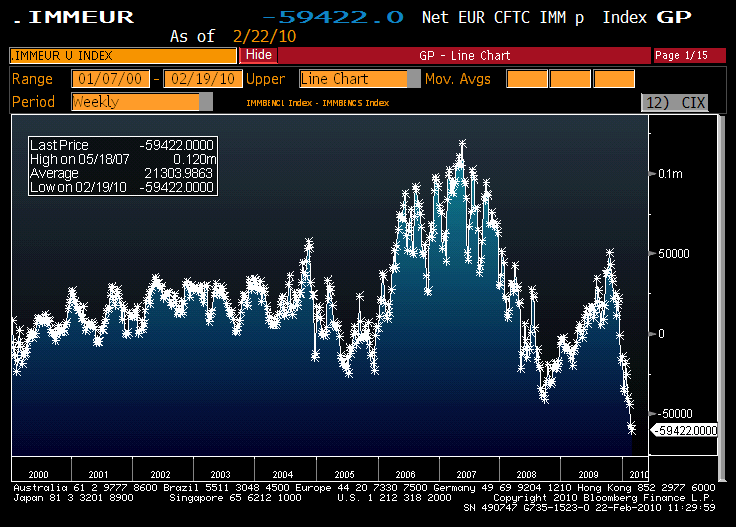
The EUR will be helped by the fact that speculative market, according to the CFTC IMM data, holds record short positions in the EUR (as of the week ended 16 February) giving plenty of potential for short-covering.   The more timely Tokyo Financial Exchange (TFX) data also reveals that positioning in EUR/JPY has continued to be scaled back.  

CFTC Commitment of Traders (IMM) data – Net EUR speculative positioning

EUR/USD bounced smartly from its lows around 1.3444 on Friday, partly reflecting some short covering and the drop in FX volatility suggests the market is more comfortable with EUR/USD around these levels.  A positive IFO survey and improved risk appetite could see EUR/USD test resistance around 1.3774, its 20 day moving average, over coming days.  Ongoing Greek concerns suggest that any EUR bounce will be limited, however. 

USD/JPY looks well supported and although data this week will suggest that exports are improving despite JPY strength, the relatively more aggressive stance of the Fed compared to the BoJ, long JPY positioning, and improved risk appetite, give plenty of scope for the JPY to extend losses, with technical USD/JPY support seen around 91.28.

Fed discount rate move boosts dollar

The Fed’s move to hike the discount rate by 25bps has set the cat amongst the pigeons.   Although the move was signalled in the FOMC minutes yesterday a hike in the discount rate was not expected to happen so soon.  The Fed sees the modifications which also include reducing the typical maximum maturity for primary credit loans to overnight, as technical adjustments, rather than a signal of any change in monetary policy. 

Nonetheless, the market reaction has been sharp, with the USD strengthening across the board and short term interest rate and stock futures falling.  Although the reaction looks overdone and will likely be followed by some consolidation over the short term, the move will be interpreted as the beginning of a move towards monetary policy normalisation despite the Fed’s insistence that this is not the case.  The firm USD tone is set to remain in place for now but the bulk of the strengthening has likely already occurred following the announcement.  

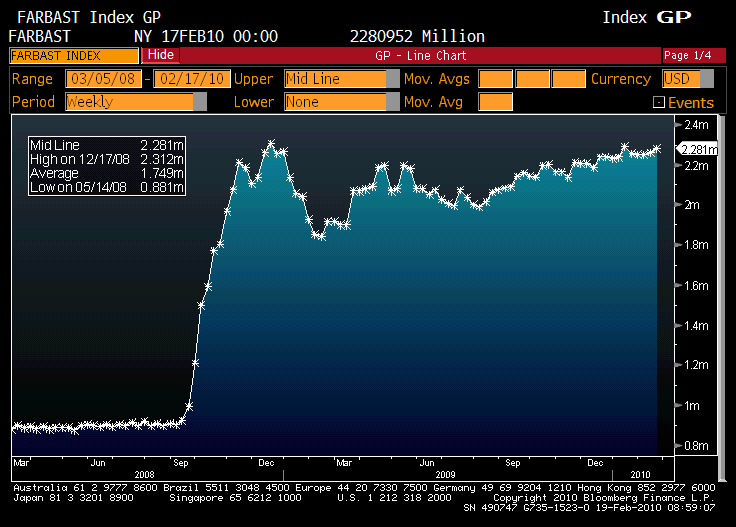
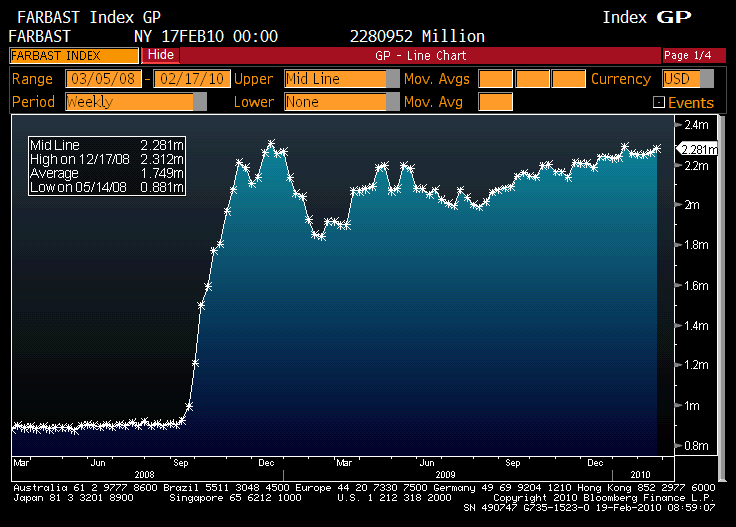
The Fed’s desire to reduce the size of its burgeoning balance sheet, which at $2.3 trillion is roughly around three times its size before the financial crisis began, will imply further measures to reduce USD liquidity over the coming months.   A withdrawal of liquidity could have positive implications for the USD but given that the Fed is still some months away from hiking the Fed Funds rate, interest rate differentials will not turn positive for the USD for a while yet. 

The move has however, changed the complexity of the FX market and likely shifted currencies into new lower ranges against the USD.  There were plenty of reasons to sell EUR even before the Fed move and the discount rate hike inflicted further damage on EUR/USD which dropped below the key psychological level of 1.35.  GBP and commodity currencies were also big losers, with GBP/USD below 1.55.  Key technical support levels to watch will be EUR/USD 1.3422, GBP/USD 1.5374 and AUD/USD 0.884.

US Federal Reserve Balance Sheet ($trillion)