The week ahead

There are plenty of events to chew on over coming days including central bank decisions in Japan tomorrow and New Zealand on Wednesday. The Bank of Japan is unlikely to ease policy further so soon after its actions to boost loan growth while in contrast the RBNZ is set to begin its hiking cycle. On the data front US releases will still be weather impacted to some extent although February retail sales is likely to post a small gain. Moreover, Michigan confidence is set to rise, boosted by higher equity prices.

In Europe, attention will focus on industrial production releases in January, with French and Spanish IP data due to be released today. Overall production is likely to have expanded at a healthy clip of 0.4% MoM in the Eurozone as indicated by survey data. Finally, Australian jobs data is set to show some improvement on Thursday as the pace of deterioration in job market conditions slows.

In Asia the reverberations from the weaker Chinese data will likely impact sentiment across the region. Exports dropped by whopping 18.1% in February while imports rose more strongly than expected at 10.1% yielding a trade deficit of USD 22.99 billion. Central bank decisions in Korea and Thailand are on tap this week. Thailand is a close call, with risks of another policy rate cut but we expect the BoT to stay on hold. Currencies in Asia strengthened last week led by the IDR and INR. Gains this week will be morel limited, especially against the background of higher US yields.
Chinese data casts a shadow over markets

The better than expected reading for January US jobs growth (175k versus 149k consensus) helped to buoy asset markets at the end of the week, with major US equity indices posting gains. The uptick in the US unemployment rate to 6.7% was also not perceived badly as it will put less pressure on the Fed to change its forward guidance. The jobs data helped to overcome concerns over ongoing tensions between the West and Russia over Ukraine.

Consequently the USD strengthened as US yields rose, with the 10 year Treasury yield almost touching 2.82%. The most sensitive currency pair to higher US yields is USD/JPY and further upside traction is likely. The main exception to the USD rebound was the EUR, which continued to benefit from the ECB’s lack of policy easing or dovish commentary at its policy meeting last week.

Chinese data released over the weekend will prove to be less constructive for asset markets at the turn of this week, however, with a surprise trade deficit registered over February and slowing inflation to a 13 month low. Exports dropped by whopping 18.1% in February while imports rose more strongly than expected at 10.1% yielding a trade deficit of USD 22.99 billion.

Posted in China, US. Tags: , , . Leave a Comment »

CNY / CNH pressure continues

CNY/CNH the downward pressure is unlikely to abate in the near term. The desire to 1) implement two way risk, 2) higher volatility and 3) curb strong capital inflows 4) prepare for band widening, will not end quickly. A resumption of a strengthening trend in CNY / CNH will undo these aims quickly as inflows resume. Hence, if China really wants to instigate significant volatility in the currency the weakening trend is set to continue for a while to come.

At what level does the weakness in the CNY stop? Well my quantitative model already suggests that USD/CNY has already overshot its short term fair value (6.0904) but the bottom line is that this overshoot may persist for several weeks. Nonetheless, CNY has reversed all of its strength versus USD from early October and further weakness may be less rapid.

Further out, the CNY is likely to resume a stronger tone but this may be some weeks away. China continues to benefit from large foreign exchange reserves and a healthy external balance and this will eventually result in upward pressure on the currency. A move back to around 6.00 versus USD by year end remains likely but China’s authorities will want to ensure that the market does not believe that the path there will be a one way street.

China worries inflicting damage globally

A combination of worries on both sides of the pond has inflicted damage on risk assets globally. US equities closed lower, Treasury yields dropped, USD was weaker while gold prices rose. In Asia, China growth concerns, overexpansion of credit, and currency weakness are increasingly infiltrating markets globally.

Meanwhile in the US, consumer confidence surprisingly slipped in February, albeit from a high level while the annual pace of house price gains slowed slightly in December. The data added a further layer of pressure on stock markets and US January new home sales data will not help matters as it is likely to give further evidence of slowing housing momentum.

While it is now easy to blame much of the weakness in US economic data on adverse weather conditions hopes / expectations that US data will improve going forward will be tested soon. In the absence of first tier data today, attention will remain firmly fixed on events in China and in particular whether the CNY and CNH registers further declines.

Given all the attention on the Chinese currency, major currency markets have been lulled into tight ranges, with our measure of composite implied G3 FX volatility declining further. Our implied volatility index has now dropped to the lowest levels since the end of October last year.

USD/JPY is likely to face some downward pressure in the short term given the rise in risk aversion and lower US yields overnight. EUR/USD remains supported but remains susceptible to downside risks given the potential for easier monetary policy at the upcoming European Central Bank meeting next week.

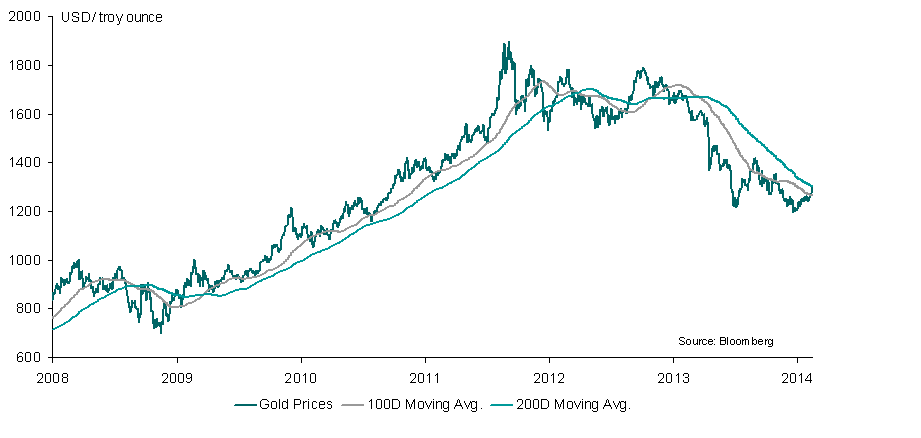
Gold breaches its 200 day moving average

AUDjobsGold prices have risen sharply since the beginning of the year, up over 8% year to date. Higher risk aversion, lower US yields and a weaker USD have boosted gold. Consequently gold prices are trading around their 200 day moving average level around 1303.70. This could prove significant, with a close above the 200 day moving average important to sustain any short term uptrend,

Encouraging signs for gold bulls
ETF investor demand appears to have stabilised over recent weeks while CTFC IMM demand appears to be picking up. This data suggests that Investors are tentatively moving back into gold. The poor performance of equity markets since the start of the year has indeed made gold look more attractive as an investment while lower yields mean that the opportunity cost of holding gold has lessened.

Chinese demand for gold increases sharply
Additionally gold demand from China has picked up strongly. China Gold Association data showed that Chinese demand for gold jumped 41% to 1,176 tonnes last year. Chinese demand likely overtook India’s last year. Oddly Chinese import and production data were even stronger, making it possible that China bolstered its reserves with gold last year.

Indian restrictions hit demand
India restricts demand for gold via import restrictions. However, there is a lot of pressure domestically to remove these restrictions and a review is scheduled to take place at the end of the fiscal year at end March 2014. If these restrictions are removed or at the least weakened, Indian gold imports could increase sharply but it seems unlikely that imports will rise as strongly as previous years.

Moreover, the Indian government will want to avoid an adverse impact on India’s current account deficit, suggesting that a complete removal of gold import restrictions is unlikely. However, in the meantime the restrictions are having a major impact on Indian gold demand which dropped sharply last year.

Gold rally to fade
Risk appetite has already improved sharply over February and while I continue to expect bouts of volatility in the weeks and months ahead I do not expect to see sustained periods of elevated risk aversion. Therefore any boost to gold from rising risk aversion is set to prove temporary in the months ahead.

Secondly global inflation pressures remain well contained. Inflation for the major economies is likely to remain benign. Only in Japan is inflation expected to pick up but this is an aim of policy and is not expected to result in a bout of gold buying to hedge against such inflation risks. Therefore, gold demand as an inflation hedge will not take place.

Two major drivers of the gold price are US bond yields and the US dollar. Both are highly correlated with gold price gyrations, with gold falling as US yields and the USD rise and vice-versa. Both yields and the USD are set to rise over the coming months. Consequently any short term gold price gains are unlikely to hold, with the metal set to resume its decline.