AUD helpd by RBA, JPY slipping, GBP buoyed

Firm August purchasing managers’ confidence indices from China to Europe have helped to maintain a positive bias to risk assets overnight although the Labor Day holiday limited trading activity. Attention centred on China’s service sector PMI, with a slight decline revealed to 53.9 in August. Elsewhere Australia’s central unsurprisingly kept monetary policy on hold. Later on the US ISM manufacturing survey is set to add to a run of negative US data surprises, with a decline expected in August, albeit with the index remaining in expansion territory. The employment component will be scrutinised for clues to Friday’s August non-farm payrolls report.

AUD faced today’s RBA policy meeting having bounced in the wake of an improvement in risk appetite, a jump in July building approvals and a rise in Chinese manufacturing confidence. Ahead of the RBA meeting July retail sales data disappointed versus expectations but weakness in AUD was reversed following the unchanged RBA decision and neutral statement. Indeed, the fact that the statement was not more dovish comes as a relief to AUD bulls. As a cut in the cash rate was not priced in nor expected by analysts the impact overall should be limited, however. While the door is kept open to further rate cuts the prospects of further easing are declining. AUD looks well supported, with the next resistance seen around 0.9070.

USD/JPY is finding some upside traction as risk appetite improves and prospects of the implementation of a sales tax in Japan gathers steam. “Abenomics” got a shot in the arm as consultative panels favoured moving ahead with the 5% sales tax in April. Additionally, the yield differential between the US and Japanese 10 year bonds remains above 200bps, sufficient in my view to spur capital outflows from Japan and a weaker JPY. The high level of speculative net JPY shorts may frustrate the move lower in the JPY although it’s worth noting that there is a long way to go before short positions hit their all time extreme levels. USD/JPY may find some near term resistance around the 2 August high at 99.95 but gains are likely to be sustained over coming weeks.

GBP is finding support on a number of fronts ahead of this week’s Bank of England policy meeting. Firstly on the data front, the trend has remained positive, with the August manufacturing PMI beating expectations (57.2 versus 55.0 consensus), with data in the form of PMI construction and Halifax house prices likely to be positive for GBP today too. News that the UK’s Vodafone is planning to sell its US mobile phone business to Verizon Communications will also act as a boost to GBP given the large cash element involved in the sale. I prefer to play long GBP versus EUR in the short term, especially given the outperformance of UK data and relative positioning in the currency pair.
Equity outflows from Asia accelerate

A slate of better than expected US data releases including May durable goods orders, new home sales and June consumer confidence data (the latter two releases reaching their highest levels since 2008) helped to boost risk appetite, spurring equity markets higher and the VIX ‘fear gauge’ lower.

Firmer US data came alongside soothing comments from China’s central bank PBoC, about liquidity conditions in the banking sector, with an official noting that it will keep money market rates at “reasonable levels”. The European Central Bank’s Draghi added to the fray by noting that Outright Monetary Transactions (OMT) was even more essential now, highlighting the ongoing backstop provided by potential ECB peripheral bond purchases.

Meanwhile the positive US data releases helped to push Treasury yields higher, with the 10 year yield breaching 2.6%. Commodities remained under pressure, with higher yields in particular weighing on gold prices.

The calendar is rather light today and will provide little market direction, with an Ecofin meeting in Europe, UK spending review and US Q1 GDP revision in tap. Expect some positive follow through from the firmer tone to European and US equities overnight which will support risk assets including EM currencies although concerns about tapering are from over.

The rout in equity markets over recent weeks has had a devastating impact on equity flows to Asia. The outflow of equity portfolio capital from Asia accelerated sharply over June. Month to data Asia has recorded $10.2 billion in outflows, a massive move out of the region given that total inflows year to data have now dropped to $8.7 billion. One more month at this pace of outflows would see Asia registering net outflows for the year.

Indonesia, South Korea and Taiwan have been hit the most over June but no country has recorded net equity inflows. Year to date India has registered the strongest equity inflows of $14.7bn while South Korea has registered the biggest outflows of $7.3bn.

US dollar running rampant

A calmer tone looks like it will settle over markets today after recent sharp volatility. However, little relief to the pain inflicted on markets from tapering fears is likely this week. Weaker growth and funding concerns in China added another layer of uncertainty to the market psyche although comments from China’s central bank the PBoC about “fine tuning” may help to allay fears of a wider credit crunch.

Meanwhile across the pond Fed officials are probably quite frustrated by the market reaction to last week’s FOMC statement. There will be plenty of Fed speakers on tap this week to provide clarification, with markets looking for some soothing comments. Given the varying and diverse views among Fed officials such hopes may be dashed.

Data releases both in the US and Europe will be encouraging in terms of recovery expectations but will do little to ease the angst over tapering. In the US durable goods orders and new homes sales will record gains in May while June consumer sentiment indices will remain at relatively high levels.

In Europe, aside from the European council meeting this week the German IFO business confidence survey today and economic sentiment gauges later in the week are set to rise in June. In Japan the main CPI inflation gauge will stabilize in May although reaching the 2% inflation targets remains as difficult as ever while industrial production is set to decline in May due to still fragile foreign demand.

Most asset markets will continue to track bonds, with equities, and commodities remaining under pressure and the USD supported by higher US yields. Notably 10 year Treasury yields spiked to over 2.5%, a sharp increase over the week. Consequently the USD’s firm tone was expressed across a broad swathe of currencies, with Scandinavian, Latam and commodity currencies among the worst performers.

Emerging market and commodity currencies are set to suffer from continued capital outflows while the USD runs rampant. However, many currencies look oversold and over the near term some stabilisation is likely as they benefit from a slightly better risk tone at the turn of the week. As indicated by the latest CTFC IMM data, the USD long positioning has been cut back, suggesting scope for further gains. EUR positioning has turned net long for the first time in four months implying no further room for short covering.

Growth fears intensify

A bad day for risk assets yesterday threatens to extend further. Weaker than forecast data releases in China and the US weighed heavily on market sentiment supporting the theory that the global economy is repeating the pattern of Q1 strength followed by weakness over the remainder of the year. Growth worries helped to exacerbate the fall in gold prices with the precious metal dropping by 15.5% this month alone while dragging down other commodity prices.

There are plenty of data releases today including CPI inflation in the US, Eurozone and UK as well as the German ZEW investor confidence survey, US industrial production and housing starts. Given market sensitivity to weak data any disappointment will reinforce the risk off tone but this seems unlikely as the data in general is likely to be somewhat better.

AUD was thumped by weaker Chinese data releases and a deterioration in risk appetite. Although the drop has been steep over recent days AUD is unlikely to fall much further, with plenty of appetite for the currency around 1.0300. Nonetheless, AUD/USD has dropped below its 100 day moving average level 1.0414 a breach of which threatens to mark a stronger down move.

For those investors wanting to re-enter long AUD positions I prefer to play the currency on the crosses, especially versus NZD which has also suffered recently. My quantitative model of AUD/NZD suggests some upside scope in the currency pair, with short term fair value seen around 1.24.

USD/JPY’s pull back has extended further as Bank of Japan governor Kuroda’s policy announcement effect has faded and risk aversion has picked up. I look for any slippage in USD/JPY to be limited however, with my quantitative model suggesting that short term fair value for USD/JPY is around 95.68. The currency pair has been undermined by the drop in US Treasury yields over recent weeks resulting in a reduced US yield advantage over Japan.

Moreover, the upcoming G20 meeting this week has also provoked some hesitancy among JPY bears given expected comments aimed at Japan not to engineer a competitive devaluation of its currency. Technical indicators suggest that the primary trend remains higher for USD/JPY, with a break below 96.07 required to signal a change in short term trend.

Is gold losing its lustre?

Hopes and expectations of more Fed quantitative easing in the wake of a run of weak US data, including the US May jobs report, has been attributable to the bounce in gold prices over recent weeks. However, Fed Chairman Bernanke dampened such hopes in his speech to Congress, in which he did not indicate a desire to move towards more QE. The Fed is unlikely in my view to embark on more QE any time soon.

Clearly, should the Fed implement more QE it will help to renew the attraction of gold. Once again markets will see the consequences of Fed QE as a means to debase the USD. A shift in Fed stance cannot be ruled out if US economic conditions worsen further and/or the Eurozone crisis escalates. Assuming no more QE and no more USD debasement, gold prices ought to decline over coming months.

One of the biggest factors putting downward pressure on gold prices has been the strength of the USD. While I do not expect the USD to continue to strengthen at the same pace as it has done recently, further gradual gains in the currency are likely. My FX forecasts predict a further small gain for the USD index by the end of the year but I also believe that the recent run up in the USD may have been too rapid. Assuming that the USD continues on a gradual upward trajectory I expect it to exert a negative influence on gold prices.

Gold appears to have lost its sensitivity to risk aversion. Indeed, gold’s relationship with risk has actually inverted over recent months, with a negative but significant relationship registered over the past 3 months between gold prices and my Risk Aversion Barometer. In other words as risk aversion goes up, gold prices actually drop.

The lack of reaction to higher risk aversion shows that the lustre of gold as a safe haven has faded as investors pull capital out of this as well as many other asset classes. However, gold’s drop is not unusual when compared to other commodity prices, with oil and copper prices falling too and gold maintaining a strong correlation with these commodities.

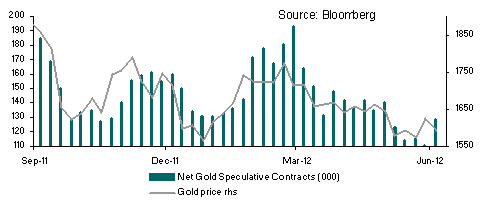
Some deterioration in sentiment towards gold prices has been reflected in the drop in speculative appetite for the commodity. Speculative demand for gold hit a cyclical high in August 2011 but since then there has been a steady reduction in appetite for gold from these investors. Indeed, CFTC IMM data reveals that speculative gold positioning dropped well below its three-month average. However, positioning is still well above its all time lows reached in February 2005, suggesting if anything, there is scope for more declines.

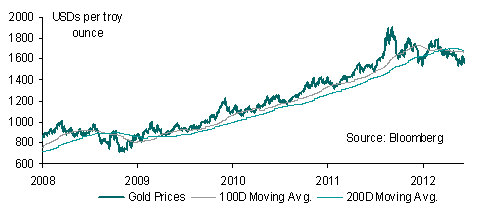
On top of the drop in speculative appetite for gold the technical picture has turned bearish. Since March 2009 at the height of the financial crisis the 100 day moving average price of gold had been trading above the 200 day moving average. On 27 March 2012 the 100 day moving average crossed below the 200 day moving average. Moreover, gold is now trading below both the 100 and 200 day moving average prices which sends a bearish technical message. Over the near term some key levels to look for are the 100 day moving average around 1658 on the topside and trendline support around the 1530 level on the bottom.

Another determinant of gold prices is demand from India and China. Growth in both countries is slowing, suggesting that gold demand is also weakening. While I certainly do not expect a collapse in demand from either country I have no doubt that compared to last year the strength of demand will be softer over coming months. Although I still look for a soft landing in China the Indian economic picture has clearly deteriorated while the Indian rupee has weakened. A weaker INR means that has become increasingly more expensive to import gold to India for domestic purchasers.

Overall, a weaker real demand picture taken together with reduced speculative appetite implies little support for gold prices. Moreover, a firmer USD in general will continue to weigh on prices. Perhaps a dose of inflation would help gold prices but there is little risk of this given the still sizeable amount of excess capacity in major economies.

Uncertainty about QE will help to limit any downside pressure on gold prices but elevated risk aversion will provide little assistance to gold. If however, the Eurozone and global picture deteriorates further gold will find itself with a lifeline but only if this means more currency debasement and a Fed engineered lower USD. If not, a further decline is on the cards and I forecast a drop in gold prices to around USD 1475 by the end of the year.