Yuan band widening, Euro still under pressure, Yen firm

The big news over the weekend was the widening in China’s CNY trading band to 1% from 0.5% previously. It is unlikely to have much of an impact on global markets, with the move not particularly surprising.

China clearly wants to add more two-way risk to the market and in this way the it allows the CNY to better reflect daily market conditions. Nonetheless, CNY is currently seen around equilibrium and appreciation pressure is limited , suggesting that intra day volatility will remain limited.

The USD index is trading around the middle of its range for the year and FX volatility has declined. Recent data disappointments have taken the shine off the USD and revitalized the debate on more Fed quantitative easing. Bouts of risk aversion have given some support to the USD but this has to be balanced against weaker US data.

It will require a renewed rise in US bond yields and an increase in risk aversion before the USD can strengthen anew. Data over coming days may offer some support but whether releases including retail sales, manufacturing surveys and industrial production prove sufficiently strong to boost US bond yields is debatable, suggesting another week of benign USD action.

EUR/USD remains close to its recent lows and is showing little inclination to move back up towards the top of its 1.30-1.35 range. Renewed worries about Spain’s fiscal/debt position as well as opposition to reforms in Italy threaten to keep the EUR restrained.

Data releases may actually regain some attention over coming days however, with the key April German ZEW and IFO surveys scheduled for release. The former is expected to fall slightly while the latter is expected to remain close to the March level.

Given that both surveys have been rising over recent months the outcomes will not prove particularly worrying. However, little change expected in both surveys suggests that the EUR will find little support either. EUR/USD technical support is seen around 1.2974.

Another trade deficit expected in March in Japan will support a JPY bearish view but in reality much of the reason for the deficit is not related to the strength of the JPY but rather external demand weakness and strong energy imports.

Nonetheless, the rise in the JPY over recent days will have fuelled renewed concerns among Japanese policy makers while piling on the pressure on the Bank of Japan to be more aggressive on its policy stance.

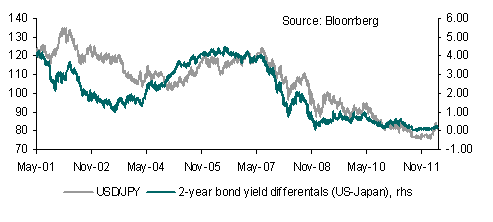
I suspect USD/JPY may have further to fall in the short term as its move corresponds with the narrowing in the US yield advantage over Japan. A drop below USD/JPY 80 looks increasingly on the cards.
Euro and Yen capitalise on weaker Dollar

Equities continued their bounce back overnight helped by a reiteration from Fed officials that US monetary policy will remain highly accommodative through late 2014. Risk assets overcame a weaker than expected report on US jobless claims, with a smaller than expected trade deficit in February ($46 billion) helping sentiment. The launch of a North Korean missile which apparently failed did little to dent sentiment. Nonetheless, Spanish concerns continue to weigh on its markets, bucking the trend of improvement elsewhere.

Today’s data slate has little in terms of first tier data on tap, with inflation releases in Europe and the US in focus. The bigger influence will be a slate of Chinese data including Q1 GDP. The market has already priced in a good number (around 9% YOY) and therefore there is a risk of disappointment, which could hit risk assets. Also watch out for earnings from US financials including JP Morgan and Wells Fargo. So far US earnings have been positive, although admittedly its early days yet.

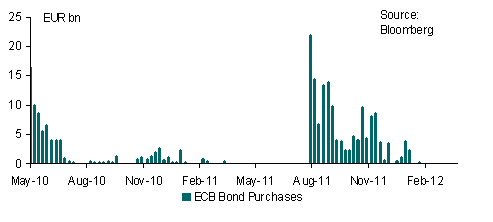
Downward pressure on EUR/USD has lessened for the time being and any further decline will be limited in the short term. While it is evident that the boost to markets provided by the European Central Bank’s Long Term Refinancing Operation (LTRO) has faded, EUR bears have been dealt a blow from renewed prospects of securities market purchases.

Italy’s debt auction yesterday provided little help to the EUR but at least it was not cause of further selling pressure. Concerns about Spain continue but any further downside pressure on EUR/USD will be restricted to technical support around the 1.3004 level (March 15 low), with EUR/USD set to remain in a 1.30-1.32 range.

JPY has pulled back sharply against the USD over the past month as I repeatedly warned. But before I blow my own trumpet any further I would note that further downside risks to USD/JPY remain in place although the room is now more limited than in previous weeks. According to my quantitative model a drop to around 79.00 is likely to mark a low in USD/JPY.

Warnings by the Bank of Japan of more “powerful” monetary easing have helped to prevent further JPY strengthening over recent sessions. However, a renewed narrowing in the US 2-year bond yield advantage over Japan will likely limit any upside for USD/JPY as reflected in the extremely strong correlation between USD/JPY and yield differentials over the past 3-months.

Germany Caught in the Contagion

Equity markets came off their lows overnight despite a 236 point drop in the Dow Jones, but sentiment remains extremely fragile and any let up in pressure on risk assets will prove temporary. A weak bond auction in Germany highlights the severity of contagion across Europe. If the core is being hit then there is no safe haven in Europe anymore. On a positive note it might just make German officials finally realise that they need to act quickly to provide solutions to the crisis.

Weak data notably outside the US adds to the malaise, with in particular China’s HSBC November weaker purchasing managers’ indices coming in below the 50 boom/bust level. Europe’s weaker purchasing managers indices highlight the prospects of looming recession while the news in Germany is not only bad on the bond front bad also on the data front. Today’s German November IFO survey will continue in the same vein, with further weakness in this business survey expected.

Bearing in mind the US Thanksgiving holiday today thin liquidity will mean that conditions are ripe for exaggerated market moves. EUR/USD has already sustained a drop below the important 1.3500 level as even the underling strong Asian demand appears to have been pulled back. More downside is expected but technicals suggests that it will be hard trudge lower, with near term support seen around 1.3285 (10 day Bollinger Band). The near term range is likely to be 1.3285-1.3505 although given the US holiday the range may be even tighter.

Aside from the IFO attention today will focus on a meeting between Chancellor Merkel, President Sarkozy and Prime Minister Monti. As usual expect a lot of hot air but little action. Also note there is a general strike in Portugal today protesting against austerity measures in the country.

Sell Risk Currencies on Rallies

The Federal Reserve FOMC outcome and Greece’s travails failed to dampen the recovery in risk appetite overnight. The Fed highlighted downside risks to growth and revised lower its forecasts. However, positively for risk appetite the Fed left open further policy easing options, hinting at more quantitative easing if needed.

Meanwhile European leaders tightened the noose around Greece by cutting off EUR 8 billion in aid payments and threatening to cut of all aid if the country’s referendum now scheduled for December 4 fails to endorse the EU rescue package announced last week.

At the emergency meeting of European leaders yesterday Greece’s Prime Minister also admitted that the referendum will not only decide the fate of the rescue package but also whether Greece wants to remain in the eurozone. Greece was not only the eurozone country in focus as Italy continues to be racked by political uncertainties, with Prime Minister Berlusconi failing push through legislation on structural reforms ahead of the G20 meeting beginning today.

The risk rally is highly unlikely to last, with the EUR, commodity and high beta emerging market currencies to face further pressure. Although the immediate market focus will be on the G20 meeting beginning today the fact that leaders are now seriously beginning to consider the prospects of a Greek exit from the eurozone while taking a tougher stance on the country highlights how important the December 4 referendum will be.

Ahead of the vote markets will remain highly nervous and risk aversion will remain elevated. Consequently risk assets are set to face further pressure. Moreover, the fact that China has downplayed the prospects of further bond purchases from the EFSF bailout fund suggests there will be no help from this quarter any time soon.

Aside from the G20 meeting markets will pay attention to Draghi and Co. at the European Central Bank (ECB) today as well as bond auctions in France and Spain but we do not look for much excitement from the ECB despite the increased uncertainty within the eurozone. While an interest rate cut today cannot be ruled out given the increased market uncertainty the ECB is likely to wait until December before cutting policy rates.

Asian currencies at multi-year highs

Asian currencies are stronger in the wake of a sharp improvement in risk appetite following the approval of Greece’s austerity measures. The rally in Asian FX is revealed in the ADXY (an index of Asian currencies) index which is approaching a test of its 2nd May high around 119.26 around its highest level since August 1997. Technical indicators have turned more bullish, with the ADXY breaking above its key moving average levels (20, 50 & 100 day) and the 14-day relative strength index also turning higher.

The Asian FX rally has been led by the KRW, the Asian currency that has had the highest correlation with risk over the past few weeks. Given that risk aversion has dropped sharply since mid June it is no surprise that this currency has strengthened the most. USD/KRW is trading around its lowest level since August 2008. Strong equity capital outflows had kept the KRW on the back foot over much of June but there has been a bounce back in flows recently. However, USD/KRW is likely to find it tough to break below 1060 over the short-term, especially given likely resistance from the local authorities.

The THB, the worst performing Asian currency in June, has rapidly reversed some of its losses. The THB looks set to consolidate its gains following a decisive election result which saw the opposition Puea Thai Party gain control of parliament. The biggest relief for markets was the fact that the outcome was relatively clear cut, suggesting a potentially a smooth handover of power. Nonetheless, the currency has already jumped and after having dropped to around 30.40 from a high of around 31.01 USD/THB is likely to trade off gyrations in risk appetite.

The fact that the USD has lost some ground in the wake of firmer risk appetite and better news in Greece has also allowed Asian currencies to strengthen although it’s worth noting that amongst Asian currencies only the MYR has maintained a significant correlation with the USD index over the past 3-months. In other words, although USD weakness has helped to facilitate Asian currency strength, the recent strengthening in Asian FX is more likely to have been due to a rebound in capital inflows to the region.

Further Asian FX gains are likely over the near term especially as China continues to fix the CNY higher versus USD but given the recent rapid gains in some currencies, there is a risk of growing official resistance and intervention to slow or stem Asian FX gains. Moreover, the end of QE2 in the US suggests that the downside risks for the USD in general are not likely to be as prevalent, with a potential recovery in the USD over H2 likely to stand in the way of strong Asian FX gains over coming months.