Upside risks to US payrolls

An encouraging run of US data releases over recent weeks became even more solid overnight. In particular the December ADP private sector jobs report revealed a whopping 297k increase, its highest ever reading. Although the outsized gain may be attributable to distortions such as seasonal factors it will lead many to scramble to revise higher estimates for non-farm payrolls to around 200k+ (consensus currently is 150k). Similarly the December ISM non-manufacturing survey came in higher than expected at 57.1, its highest reading since May 2006. Notably the employment component softened in contrast to the ADP data.

Whilst the US outlook appears to be improving the eurozone picture is looking decidedly shaky. Peripheral bonds remain under pressure as reflected in the renewed widening in German-Greek spreads whilst Portugal’s sale of 6m bills revealed good demand but at a much higher yield (3.69% vs. 2.05% in September). Press reports that the Swiss National Bank has stopped accepting Irish government debt as collateral didn’t help matters whilst talk of conditions attached to any Chinese support for eurozone countries also weighed on sentiment.

Adding to concerns is the ongoing political impasse in Belgium where 7 months after elections there has yet to be a new government formed. The risk of a downgrade to the country’s credit ratings is high especially given the lack of progress on deficit reduction. Meanwhile on the data front the Eurozone service sector PMI was stronger than forecast in December at 54.2 but the country breakdown revealed more divergence in economic conditions. This was echoed in the manufacturing PMI. Divergence in growth is likely to widen further this year and whilst the strength of Germany may prevent a sharp slowing in overall growth in the eurozone, growing divergence will make the job of the ECB difficult.

The net result of firmer US data is a broadly stronger USD and higher Treasury yields. The EUR in contrast looks as though it is on the verge of a sharper decline below 1.3000, with technical support seen around 1.2969 whilst the JPY could see further weakness given the move in relative US/Japan bond yields. There will be little direction today from data with just Eurozone sentiment gauges and retail sales tap whilst in the US jobless claims will be in focus. However, there will probably be little movement ahead of the US jobs report tomorrow.
The Week Ahead

As markets make the last strides towards year end it appears that currencies at least are becoming increasingly resigned to trading in ranges. Even the beleaguered EUR has not traded far from the 1.3200 level despite significant bond market gyrations. Even news that inflation in China came in well above expectations in November (5.1% YoY) and increased prospects of a rate hike is likely to prompt a limited reaction from a lethargic market.

At the tail end of last week US data provided further support to the growing pool of evidence indicating strengthening US economic conditions, with the trade deficit surprisingly narrowing in October, a fact that will add to Q4 GDP growth, whilst the Michigan measure of consumer confidence registered a bigger than expected increase in November to its highest level since June.

The jump in consumer confidence bodes well for retail spending and highlights the prospects that US November retail sales tomorrow are set to reveal solid gains both headline and ex-autos sales driven by sales and promotions over the holiday season. Other data too, will paint an encouraging picture, with November industrial production (Wed) set to reveal a healthy gain helped by a bounce in utility output. Manufacturing surveys will be mixed with a rebound in the Empire manufacturing survey in December likely but in contrast a drop in the Philly Fed expected.

The main event this week is the FOMC decision tomorrow the Fed is expected to deliver few surprises. The Fed funds rate is expected to remain “exceptionally low for an extended period”. Despite some recent encouraging data recovery remains slow and the fact that core inflation continues to decelerate (CPI inflation data on Wednesday is set to reveal a benign outcome with core CPI at 0.6%) whilst the unemployment rate has moved higher means that the Fed is no rush to alter policy including its commitment to buy $600 billion in Treasuries including $105 billion between now and January 11.

In Europe there are also some key releases that will garner plenty of attention including the December German ZEW and IFO investor and manufacturing confidence surveys and flash purchasing managers indices (PMI) readings. The data are set to remain reasonably healthy and may keep market attention from straying to ongoing problems in the eurozone periphery but this will prove temporary at least until the markets are convinced that European Union leaders are shifting away from “piecemeal” solutions to ending the crisis. The EU leaders’ summit at the end of the week will be important in this respect. A Spanish debt auction on Thursday will also be in focus.

Assuming the forecasts for US data prove correct it is likely that US bond markets will remain under pressure unless the Fed says something that fuels a further decline in yield such as highlighting prospects for more quantitative easing (QE). However, following the tax compromise agreement last week this seems unlikely. Higher relative US bond yields will keep the USD supported, and as I have previously noted, the most sensitive currencies will be the AUD, EUR and JPY, all of which are likely to remain under varying degrees of downward pressure in the short term. The AUD will also be particularly sensitive to prospects of further Chinese monetary tightening.

US bonds sell off, USD rallies

US Treasuries didn’t like it but the compromise agreement to extend Bush era tax cuts, as well as a 13-month unfunded extension of long term unemployment benefits and a $120 billion payroll tax holiday will provide the US economy with further support and likely to lead to some upgrading of US growth forecasts. The agreement changes the dynamic of fiscal support for the US economy and means that the US is the only major country not tightening fiscal policy. It also implies less heavy lifting needed from the Federal Reserve.

Whilst some US taxpayers will not now face tax increases following the end of the year, the longer term question of fiscal adjustment and reform appears to have been postponed. US bond yields jumped on the news as the agreement effectively adds $1 trillion to US debt over the next couple of years. The contrasting fiscal stance with Europe could eventually haunt US markets as focus eventually return to US fiscal issues, with negative implications for the country’s credit ratings. However, at present, attention remains firmly fixed on European sovereign risk rather than US deficit fears.

There has been some relief to European debt markets, albeit temporarily, with debt markets ignoring the news that European Finance Ministers have not agreed to extend the size of the support fund (EFSF) and have also failed to agree on the introduction of recently touted “E-bonds”. ECB buying of peripheral bonds has given some support whilst the passage of the first votes of the Irish budget has eased tensions in its bond markets. Nonetheless as highlighted by the IMF, Europe’s ”piecemeal” response to the debt crisis in the region is insufficient to stem the crisis, suggesting that the current easing in pressure could prove short-lived.

The jump in US bond yields has given the USD some support but I wouldn’t overplay the impact on the USD of bond yields at present. Correlations reflecting the sensitivity of bond yields to various currencies remain relatively low suggesting that the influence of yield on FX is still limited. That said, the correlation is likely to increase over coming months as US yields move higher. The impact on USD/JPY is likely to be particularly sharp, with the currency pair likely to move higher over coming months. The USD has likely rallied due to the likelihood that the tax cut extensions will mean prospects of less quantitative easing by the Fed and prospects of relatively firmer US growth.

An ongoing concern for markets is the prospects of higher interest rates in China. As regular readers of Econometer many note, my blog posts have been a bit sporadic lately. This is not down to laziness but the fact that I have been on the road quite a bit travelling in Asia (and UK) visiting clients. One of the clear concerns that I have heard often repeated is the potential for China’s measures to curb real estate speculation, rising inflation, and lending, to slow China’s growth sharply and cause problems for the rest of the world. This is the topic of another post for another day, but against the background of such concerns the AUD and other high beta currencies are likely to fail to make much headway.

Edging Towards A Bailout

A confluence of factors have come together to sour market sentiment although there appeared to be some relief, with a soft US inflation reading (core CPI now at 0.6% YoY) and plunge in US October housing starts reinforcing the view that the Fed will remain committed to carry out its full QE2 program, if not more.

However any market relief looks tenuous. Commodity prices remain weak, with the CRB commodities index down 7.4% in just over a week whilst the Baltic Dry Index (a pretty good forward indicator of activity and sentiment) continues to drop, down around 21% since its recent high on 27 October. Moreover, oil prices are also sharply lower. Increasingly the drop in risk assets is taking on the form of a rout and many who were looking for the rally to be sustained into year end are getting their fingers burnt.

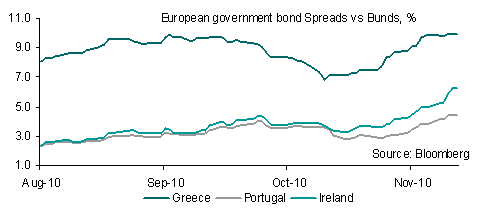
Worries about eurozone peripheral countries debt problems remains the main cause of market angst, with plenty of attention on whether Ireland accepts a bailout rumoured to be up EUR 100 billion. Unfortunately Ireland’s reluctance to accept assistance has turned into a wider problem across the eurozone with debt in Portugal, Greece and also Spain suffering. An Irish bailout increasingly has the sense of inevitability about it. When it happens it may offer some short term relief to eurozone markets but Ireland will hardly be inspired by the fact that Greece’s bailout has had little sustainable impact on its debt markets.

Ireland remains the primary focus with discussions being enlarged to include the IMF a well as ECB and EU. What appears to be becoming clearer is that any agreement is likely to involve some form of bank restructuring, with the IMF likely to go over bank’s books during its visit. Irish banks have increasingly relied on ECB funding and a bailout would help reduce this reliance. Notably the UK which didn’t contribute to Greece’s aid package has said that it will back support for Ireland, a likely reaction to potential spillover to UK banks should the Irish situation spiral out of control. Any bailout will likely arrive quite quickly once agreed.

Although accepting a bailout may give Ireland some breathing room its and other peripheral county problems will be far from over. Uncertainties about the cost of recapitalising Ireland’s bank will remain whilst there remains no guarantee that the country’s budget on December 7 (or earlier if speculation proves correct) will be passed. Should Ireland agree to a bailout if may provide the EUR will some temporary relief but FX markets are likely to battle between attention on Fed QE2 and renewed concerns about the eurozone periphery, suggesting some volatile price action in the days and weeks ahead.

Reports of food price controls of and other measures to limit hot money inflows into China as well as prospects for further Chinese monetary tightening, are attacking sentiment from another angle. China’s markets have been hit hard over against the background of such worries, with the Shanghai Composite down around 10% over the past week whilst the impact is also being felt in many China sensitive markets across Asia as well as Australia. For instance the Hang Seng index is down around 7% since its 8 November high.

Euro pressure mounts

The effects of eurozone peripheral bond concerns are cascading through eurozone markets and hitting risk appetite in the process. The EUR is a clear casualty having dropped further against the USD and versus other currencies. EUR/Asian FX remains a sell in the current environment. Contagion outside Greece, Portugal and Ireland had been limited but Italy and Spain have also seen a growing impact on their bond markets. Having broke below support around 1.3734, EUR/USD will target 1.3508 support.

Speculation that Ireland will be forced to follow Greece in seeking international financial support has intensified. Although Ireland has sufficient funds to last until next spring, yields on its debt are already higher than Greek debt before it received funds a few months back. Attention is firmly fixed on the country’s budget on 7 December and the prospects of an agreement between the government and opposition in its austerity plans.

Not helping is the fact that the Irish government has a very slim majority. Even if the budget is passed there is no guarantee that sentiment will improve given the negative impact of even deeper fiscal tightening announced last week will have on economic growth. Moreover, Germany’s insistence that the cost of any Greek style bailout should be borne mostly by private investors has only added to market tension. Even the European Central Bank is unlikely to provide much support, with ECB member Stark suggesting that ECB bond purchases will remain limited.

This leaves eurozone markets in a precarious state and the EUR continues to look heavy as further downside opens up. Moreover, the problems in peripheral Europe are beginning to have a broader impact on risk appetite, with equity markets slipping, although some of this was related to a weaker sales forecast from Cisco in the US. Nonetheless, spreading risk aversion could also dampen sentiment for Asian currencies, which is why selling EUR/Asian FX looks a better bet than selling USD/Asian FX over the short term.

In contrast sentiment for the US is undergoing an improvement. Data releases over recent weeks have generally beaten forecasts and there is even growing speculation that the Fed’s calibrated asset purchases may end up being smaller than planned. Such speculation has boosted the USD but it is premature to suggest that the Fed is on the verge of scaling back asset purchases even as the program of purchases gets going. Although there are clearly some FOMC members who are opposed to significant asset purchases the probability that the Fed remains set to carry out its full $600 billion of planned purchases.

Attention today will focus squarely on day 2 of the G20 meeting and any resolution to disputes over trade imbalances and currencies. Unfortunately none is likely to be forthcoming. Despite a reported 80 minute meeting between US and Chinese leaders little agreement was reached, with plenty of finger pointing remaining in place. It appears that the mantra of moving towards “market-determined exchange rates” and efforts at “reducing excessive imbalances” as agreed at the G20 meeting of finance ministers and central bankers will be as far as any agreement reaches. As a result markets will be left with very little to chew on.