Calming the Tiger

As markets enter the year of the Tiger a somewhat calmer tone appears to be ensuing, with risk appetite edging higher helping equities and the beleaguered EUR to recover some lost ground.  US stocks were helped by a firmer than expected reading for the Empire manufacturing survey (to 24.91 in Feb) and a slight uptick in the US NAHB (National Association of Home Builders) index (to 17 in Feb) but consumer confidence remained weak as indicated by the decline in the weekly reading of ABC Consumer Confidence (-49).  

On the other side of the pond the better than expected February ZEW survey (a survey of investor confidence) in Germany (45.1) helped sentiment although it still recorded a decline from the previous month as Greek fiscal/debt concerns weighed on financial market participants’ confidence.  The bigger impetus came from comments by Greek Finance Minister Papaconstantinou who said there would be no need to for a bailout of the country.

Tensions over Greece eased further following news that tax collectors in the country called off a planned strike, helping to allay some concerns that unions will block planned spending cuts.   On the policy front, the EU Council ratified Greece’s plans but with strings attached, giving the country one month to present a report on the timetable for implementing budget cuts for 2010 and three months to outline policy measures required to cut the deficit below 3% by 2012.

Meanwhile, commodity prices have pushed higher helping currencies such as the AUD and NZD to strengthen.  Moreover, the AUD was boosted by more hawkish interest rate expectations following the release of the minutes of the latest RBA policy meeting which indicated that the Reserve Bank was merely pausing in its rate cycle.  Expectations of a rate hike in March increased as a result.

Overall, the recent rally in the USD is looking increasingly overdone and some reversal is likely over coming weeks.  The fact that market positioning has reached extreme levels in particular in the case of the EUR highlights scope for some recovery in the currency, especially now that the worst case scenario of a Greek default has passed.  The outlook for commodity currencies is even more bullish as risk appetite improves further.     

If anything, data today is likely to give further support to the recovery story, with US industrial production and housing starts expected to post healthy gains.  The Fed FOMC minutes may offer some additional insight into the debate over the implementation of exit strategies but there is unlikely to be much elaboration from the recent comments by Fed Chairman Bernanke in his speech to the US Senate in which he hinted that a rise in the discount rate is not far off.  

Risk currencies including many Asian currencies are likely to benefit from the improvement in risk appetite over the short term.  EUR/USD will likely strengthen as more short positions are covered but will face strong technical resistance around 1.3839.   Asian currencies have been resilient to the recent rise in risk aversion and this is likely to continue over the coming weeks.  As risk appetite recovers currency plays including long AUD/JPY , and even some further upside in EUR/USD look favourable.
Optimism dissipates

Markets have been highly fickle so far this year. Optimism about strong recovery led by China – recall the fact that disappointment from the surprisingly weak US non-farm payrolls report in December was outweighed by strong Chinese trade data – has dissipated. Instead of rejoicing at China’s robust GDP report last week, which revealed a 10.7% rise in the fourth quarter of 2009, investors began to fret about whether China would have to move more aggressively to tighten monetary policy. Fuelling these fears was the release of Consumer price data which showed inflation rising above expectations to 1.9% YoY in China.

If such fears were not sufficient to hit risk appetite, US President Obama’s plan to limit the size and trading activities of financial institutions dealt another blow to financial stocks. The plan followed quickly after the Democrats lost the state of Massachusetts to the Republicans and managed to shake confidence in bank stocks whilst fuelling increased risk aversion. Meanwhile, rumblings about Greece continue to weigh on markets and Greek debt spreads continued to widen even as global bond markets rallied.

Following the US administration’s plans to restrict banks’ activities the fact that the rise in risk aversion was US led rather than broad based led to an eventual pull back in the dollar which helped EUR/USD to avoid a break below 1.40. Risk trades including the AUD came under pressure as risk appetite pulled back. A drop in commodity prices did not help. The AUD was also hit by news that Australia’s Henry Tax Review would look to tax miners in the country. As a result AUD/USD dropped below 0.90 though this level is likely to provide good buying levels for those wanted to take medium term AUD long positions. The one currency that did benefit was the JPY which managed to drop below sub 90 levels.

The aftermath of the “Volker Plan” will reverberate around markets this week keeping a lid on equity sentiment. Meanwhile Greece will be in the spotlight especially its bond syndication. A bad outcome could be the trigger for EUR/USD to sustain a move below 1.40 though it looks as though it may find a bottom around current levels, with strong support seen around 1.4029. The German IFO business survey for January will be important to provide some direction for EUR and could be a factor that weighs on the currency if as expected it reveals some loss of momentum in the economy.

Aside from the Fed the other G3 central bank to meet this week is the Bank of Japan but unless the Bank is seen to be serious about fighting deflation, USD/JPY may remain under downward pressure against the background of elevated risk aversion. Below 90.0 there does appear to be plenty of USD/JPY buyers however, suggesting that further upside for the JPY will be limited. USD/JPY will find strong support around 88.84.

Much will depend on the key events in the US this week including the Fed FOMC meeting and the President’s State of the Union speech. USD bulls will look for some indication that the US government is serious about cutting the burgeoning budget deficit. Also watch out for the confirmation vote on the renomination of Bernanke as Fed Chairman which could end up being close. There is a heavy slate of data to contend with including new and existing home sales, consumer confidence, durable goods orders, the first glance at Q4 GDP and Chicago PMI.

High yield / commodity currencies take the lead

Although equity markets continue to tread water the appetite for risk looks untarnished. So far into the new-year the winners are commodity / high yield plays as well as emerging market assets. The AUD, NOK, NZD and CAD have been the stars on the major currency front, with only GBP registering losses against the USD so far this year. The move in these currencies has been well supported by resurgent commodity prices; the CRB commodities index is up close to 10% since its low on 9 December.

There is little reason to go against this trend and the USD index is set to continue to lose ground as risk appetite improves further. I highlighted the upside potential in high yield / commodity currencies in a post titled “FX Prospects for 2010” and stick with the view that there is much further upside. I still prefer to play long positions in these currencies versus JPY which I believe will come under growing pressure as the year progresses.

Economic data has also been supportive, especially in Australia, supporting the AUD’s yield advantage. Although comments from the central bank towards the end of last year downplayed expectations of much further tightening, data releases support the case for another rate hike at the 2 February RBA meeting, with a fourth consecutive hike of 25bps to 4.00% likely at the meeting.

There will be some important clues from next week’s jobs data in Australia but judging by the solid gain in November retail sales, which rose 1.4% versus consensus expectations of 0.3%, and 5.9% jump in building approvals, the case for a rate hike has strengthened.  AUD/USD will now set its sights on technical resistance around 0.9326. 

AUD/USD has the highest sensitivity with relative interest rate differentials – correlation of 0.85 with Australia/US interest rate futures differentials over the past month – and so unsurprisingly the AUD rallied further as markets reacted to the strong retail sales data. I believe Australian interest rates will eventually get back up to 6% – pointing to more upside for AUD/USD as this is more than is priced in by the market.

It is fortunate for the USD that the correlation between the USD index and interest rate expectations remains low but nonetheless the December 15 FOMC minutes may have provided another excuse to sell the currency. The minutes were interpreted as slightly dovish by the market, with many latching on to the comments that some members of the FOMC debated the potential to expand the scale of asset purchases and continuing them beyond the first quarter.

“Risk On”- Which Currencies Will Benefit?

It was a “risk on” beginning of the week as equity markets rallied, commodities prices rose, and G10 bonds and USD came under pressure. Stronger manufacturing PMIs helped to boost confidence in the global economic recovery, with solid PMIs revealed in China, and across the rest of Asia, UK, and the US. The US ISM manufacturing which rose to its highest since April 2006 also revealed a rise in the unemployment component, consistent with view of an unchanged reading for December payrolls.

In the Eurozone the PMI matched the flash release and remained in expansion territory though there was some slippage in Germany, Spain, and Italy, underscoring the likely underperformance of the Eurozone economy relative to expectations of faster recovery in the US. Nonetheless, the PMIs continued to show a picture of expansion, with the Eurozone PMI at its highest in 21-months.

The USD lost ground against the background of improved risk appetite and looks set to fall further abruptly ending its short covering rally. The USD appears to be finding little support from interest rate expectations, with the correlation between most currencies and relative interest rate differentials remaining relatively low for the most part (just -0.04 over the past 3-months between the USD index and US rate futures).  The correlation between the USD and US 10-year bond yields looks somewhat stronger however, and could offer some relief to the USD if yields continue to push higher.

Speculative (CFTC Commitment of Traders) data reveals just how massive the shift in USD positioning has been over recent weeks, with net aggregate USD positioning (vs EUR, JPY, GBP, AUD, NZD, CAD, CHF) registering its first net long USD position since May 2008. The swing in positioning has been dramatic, from -167k contracts on 15 September 2009 to +8.7k in the week ending 29th December 2009. The data also reveals the sharp deterioration in sentiment for the EUR to its lowest since September 2008. Likewise net JPY positions have shifted to their biggest net short since August 2008.

What does this imply? The market is very short EUR and JPY but the JPY has much further to go on the downside as it increasingly retakes the mantle of funding currency.  In any case compared to historical positioning JPY shorts are not so big suggesting more room to increase short positions.   

The EUR has moved into a short term uptrend, with the MACD (12,26,9) having crossed its signal line and positioning supports further upside. EUR/USD will need to take out strong resistance at 1.4459 (December 29) before it can embark on a more significant move higher. Asian currencies also look set to take more advantage of a resumption of USD weakness, especially in the wake of strong risk seeking capital flows into the region. KRW, TWD, IDR and PHP look bullish technically.

Gold / FX correlations

There is no shortage of cash rich investors in Asia even amidst the current troubles in Dubai. Indeed, sentiment in the gemstones market is particularly upbeat, with a rare five-carat pink diamond selling for a record HK$84.24 million in Hong Kong. Perhaps this is a good reflection of abundant liquidity and of course wealth in Asia and in particular China, with talk that mainland Chinese investors were strong participants in the diamond auction.

It’s not just diamonds that are selling for record prices; gold hit a fresh high above $1,200 and once again at least part of this is attributable to the appetite of Asian central banks as well as demand from China as the country tries to increase its gold reserves. The rise in gold prices has coincided with a bullish announcement from the world’s top gold producer that it has completely eliminated its market hedges earlier than forecast due to the positive outlook on prices and waning supply.

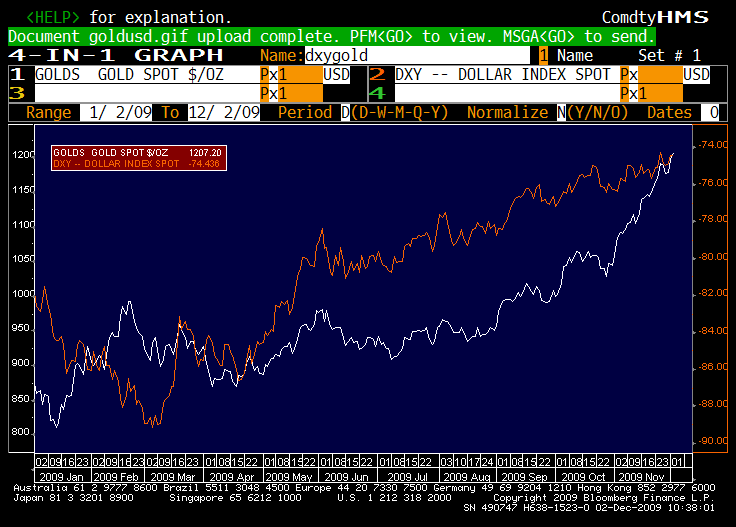
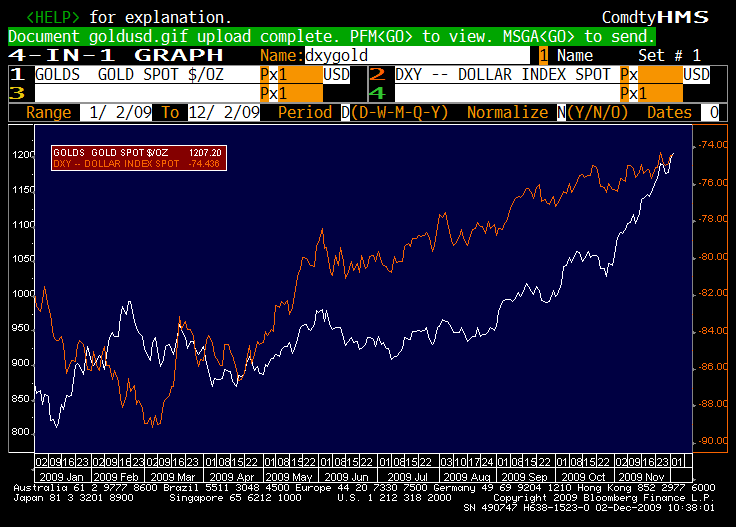
The correlation between gold prices and the USD remains very strong at -0.88 over the last 3-months, with firmer gold prices, implying further USD weakness. In fact, the gold / USD correlation has been consistently strong over the past few months and is showing little sign of diminishing.

Over the past 6-months the correlation has been -0.91 and over the past 1-month it was -0.75.  Assuming that anything above 0.70 can be considered statistically significant, the relationship shows that USD weakness has been well correlated with gold strength and that despite talk of a breakdown in the relationship it appears to remain solid. 

As long as the bullish trend in gold continues, the pressure on the USD will remain in place.  Adding to this pressure is the fact that risk is back on for now. Markets took the news of a fall in the ISM manufacturing index and in particular the drop in the employment component in its stride even though it supports the view of a weaker than consensus drop in payrolls in November when it is published on Friday.

There are still plenty of reasons to be cautious in the weeks ahead and although we appear to be back in a “risk on” environment markets are likely to gyrate between “risk on” and “risk off” over coming weeks. At least for now, the USD looks to remain under pressure but if risk aversion creeps back up as I suspect it may then the USD will see a bit more resilience into year end. 

Moreover, central banks globally are reaching the limits of their tolerance of USD weakness and will be tested once again, with EUR/USD back above 1.5000, EUR/CHF moving back below 1.5100 and the USD/JPY set to re-test 85.00 following the relatively benign measures announced by the BoJ in which the Bank did little to stem deflationary pressure or weaken the JPY.