Euro pricing in a lot of good news

Markets remain in limbo ahead of a potential Greek debt deal although US equities managed to eek out small gains overnight. Stocks in the US have entered a bull market helped by the dovish stance of major central banks.

The Federal Reserve’s commitment to maintain accommodative policy until the end of 2014 and the European Central Bank’s (ECB)3 year LTRO have been drivers of the rally in risk assets. The BoE will contribute to the easy stance of central banks, with an increase in UK quantitative easing set to be announced today. The ECB in contrast is set to remain in status quo.

Will it be a buy on rumour, sell on fact reaction for the EUR to a Greek debt deal? Over recent days anticipation has grown that a deal on debt writedowns and in turn a second bailout package will emerge soon. This has helped to propel EUR/USD higher, with the currency hitting a high of 1.3289 overnight.

So far a deal has been lacking but leaders are expected to approve a draft agreement on fresh austerity measures between the main Greek political parties today. This should pave the way a deal on debt restructuring and a new loan package for the country due to be discussed today between Eurozone finance officials.

However, the EUR has already priced in a lot of good news on this front and even agreements on the issues above may not see the currency push much higher, with strong resistance around EUR/USD 1.3388. Separately today’s ECB meeting is unlikely to provide much direction for the EUR, with the Bank set to maintain current policy settings.

USD/JPY has managed a recovery of sorts but still remains in the middle of multi month 75.5-78.5 range. Nonetheless, the momentum over the short term will continue to be for USD/JPY upside, with resistance around 77.49 targeted. News that the Japanese authorities conducted ‘stealth intervention’ to weaken the JPY in late October/early November will have emboldened JPY bears.

However, at the same time they should also be worried as it is clear that even after all the intervention the JPY remains overly strong. Reflecting this is the fact that speculative and margin trading JPY positioning is at a very high level.

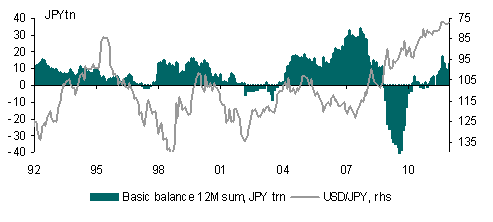
Moreover, while much has been made of the deterioration in Japan’s current account balance over recent months and the potentially negative impact on the JPY it should be noted that Japan’s basic balance (sum of direct investment + current account + portfolio flows) position remains healthy (for now) and is acting as an obstacle to JPY weakness.
Risk currencies flying high

The first month of 2012 passed rather more positively than anticipated and clearly was a good month for risky assets. Even the beleaguered EUR strengthened despite calls for an extended decline. Assets that were most heavily sold over 2011 were the biggest winners over January. Further signs of improvement in US economic data, receding fears of a China growth crash and even signs of tentative progress in the Eurozone debt crisis mean that sentiment may have finally turned a corner. This has been reinforced by the Fed’s commitment to maintain accommodative monetary policy until the end of 2014 and the ECB’s long term LTRO. I’m not entirely convinced but it wouldn’t pay to buck market optimism just yet.

Interestingly currency markets aren’t necessarily behaving as one would expect. In particular the JPY and CHF, both safe haven currencies, have not weakened despite an improvement in risk appetite. In contrast they have actually strengthened. Other currencies are behaving much as would be expected, especially high beta (risk sensitive) currencies, including AUD, NZD and many emerging market currencies, which have rebounded. Even the EUR has jumped past the 1.30 mark against the USD. Even the slow progress in agreeing on the magnitude of Greek writedowns has failed to dent confidence, with Eurozone peripheral bond yields dropping. Risk / high beta currencies are set to remain well supported over the short term.

Looking ahead the outcome of the US January jobs report at the end of the week as well as a final agreement on Greek debt will help determine whether the positive sentiment for risk assets will be maintained into next week. Meanwhile the USD looks as though it will remain under pressure especially given the continued downward pressure on US bond yields, which only continues to reinforce its role as a funding currency. This explains why both the JPY and CHF have stubbornly refused to weaken as narrowing US versus Japanese and Swiss bond yield differentials have kept these currencies under upward pressure. However, risks of FX intervention by both the Japanese and Swiss authorities suggests that upside may be limited.

US dollar remains under pressure

Hopes of progress on the Eurozone debt crisis and encouraging data in the US have helped boost market confidence. However, the slightly disappointing US Q4 GDP report (2.8% Qoq annualised growth) revealed the markets continued vulnerability while Fitch’s downgrade of six Eurozone countries’ sovereign ratings brought a dose of reality back to the region.

Nonetheless, the Eurozone Central Bank (ECB) unlimited 3-year loans to banks and Fed hints at quantitative easing (QE3) have provided markets with a fillip and will help underpin risk assets over coming weeks. If Greek debt talks are wrapped up this week markets will take further solace but the European Union (EU) Summit beginning today will need to deliver on rubber stamping recent agreements for positive sentiment to be maintained.

This is a big week for US data releases and in turn the USD. Heavy weight data including January non-farm payrolls, ISM manufacturing confidence and consumer confidence readings are on tap over coming days. Although payrolls will not be as strong as in December the trend of data releases will continue to be one of improvement as likely to be revealed in the forward looking confidence surveys this week.

The USD may not benefit as much as it would otherwise have done given that the Fed has committed to easy monetary policy for a long while to come to end 2014. It is becoming increasingly clear that firmer activity data may still not prevent a further round of quantitative easing and attendant USD downside risks. Against this background a cautious stance on the USD over coming days is warranted, with the USD index likely to remain under near term pressure.

More Bad News In Europe

Several pieces of bad news soured sentiment at the end of last week undoing much of the good news since the beginning of the year and dashing hopes of a relatively swift resolution to Eurozone’s ills. S&P ratings agency downgraded nine Eurozone countries’ credit ratings leaving 14 on negative outlook. In particular France and Austria, which lost their triple AAA status while not particularly surprising, comes as a major blow to efforts to resolve the crisis. The downgrade puts at risk the EUR 180 billion in credit guarantees underpinning the EUR 440 EFSF bailout fund.

Separately the breakdown of talks on Greek debt restructuring and criticism by the Euuropean Central Bank (ECB) on a new draft of a treaty to ensure fiscal discipline added to the malaise, with the ECB noting that proposed revisions amount to a “a substantial watering down”. Such criticism will likely be an obstacle to the ECB stepping up its peripheral debt buying potentially threatening any decline in bond yields. It is difficult to see sentiment improving this week, with risk aversion set to remain elevated as Eurozone leaders attempt to restore confidence. In contrast, US data continues to support evidence of economic recovery, albeit gradual and this week’s releases including industrial production and manufacturing surveys will likely add to this.

The EUR slid further at the end of last week reversing earlier gains, as the bad news mounted in the Eurozone. Ratings downgrades, breakdown of Greek debt talks and ECB criticism over watered down fiscal rules, combined to make a dangerous concoction of negative headlines. The news put an end to the EUR’s short covering rally, leaving the currency vulnerable too further declines this week. Speculative sentiment according to IMM data reached another all time low last week (-155k net positions), suggesting that any good news could lead to a strong bounce as short positions are covered.

However, it is difficult to see where such news will come from and even a small expected bounce in the German January ZEW investor confidence survey this week will do little to detract from the negative news on the policy front. A meeting between Merkel, Monti and Sarkozy will be eyed closely as they prepare for a meeting of European Union (EU) Finance Ministers and markets will be looking for aggressive action to turn confidence around. Debt sales in In the meantime EUR/USD will continue to languish but strong technical support is seen around 1.2588.

The Devil is in the details

The “partial solution” delivered by European Union (EU) leaders last week has failed to match the high hopes ahead of the EU Summit. Nonetheless, the deliverance of a “fiscal compact”, acceleration of the European Stability Mechanism (ESM) to July 2012 , no forced private sector participation in debt restructuring (outside Greece), and possible boost to the International Monetary Fund (IMF) of up to EUR 200 billion, are steps in the right direction. The fact that UK Prime Minister Cameron threw a spanner in the works to veto a joint proposal to revise the EU Treaty should not detract from the progress made.

Nonetheless, the measures may not be sufficient to allay market concerns, with disappointment at the lack of European Central Bank (ECB) action in terms of stepping up to the plate as lender of the last resort still weighing on sentiment. Data will add to the disappointment this week as “flash” Eurozone purchasing managers indices (PMI) drop further in December.

This week events in the US will garner more attention, including the Federal Reserve FOMC meeting, November inflation and retail sales data plus manufacturing confidence gauges as well as November industrial production on tap. The Fed will not shift its policy stance at this meeting but may sound a little more upbeat on the economy following recent firmer data. Inflation will likely remain subdued while the other data will continue to show gradual recovery.

Overall, the market is likely to thin further as the week progresses and holidays approach, with ranges likely to dominate against the background of little directional impetus. Our call to sell risk assets on rallies remains in place, however. The EUR will likely struggle to make much headway in the current environment, especially given that many details of the EU agreement still need to be ironed out and once again the risk to market confidence lies in implementation or lack of it. A range of EUR/USD 1.3260-1.3550 is likely to hold over the short term.