Is gold losing its lustre?

Hopes and expectations of more Fed quantitative easing in the wake of a run of weak US data, including the US May jobs report, has been attributable to the bounce in gold prices over recent weeks. However, Fed Chairman Bernanke dampened such hopes in his speech to Congress, in which he did not indicate a desire to move towards more QE. The Fed is unlikely in my view to embark on more QE any time soon.

Clearly, should the Fed implement more QE it will help to renew the attraction of gold. Once again markets will see the consequences of Fed QE as a means to debase the USD. A shift in Fed stance cannot be ruled out if US economic conditions worsen further and/or the Eurozone crisis escalates. Assuming no more QE and no more USD debasement, gold prices ought to decline over coming months.

One of the biggest factors putting downward pressure on gold prices has been the strength of the USD. While I do not expect the USD to continue to strengthen at the same pace as it has done recently, further gradual gains in the currency are likely. My FX forecasts predict a further small gain for the USD index by the end of the year but I also believe that the recent run up in the USD may have been too rapid. Assuming that the USD continues on a gradual upward trajectory I expect it to exert a negative influence on gold prices.

Gold appears to have lost its sensitivity to risk aversion. Indeed, gold’s relationship with risk has actually inverted over recent months, with a negative but significant relationship registered over the past 3 months between gold prices and my Risk Aversion Barometer. In other words as risk aversion goes up, gold prices actually drop.

The lack of reaction to higher risk aversion shows that the lustre of gold as a safe haven has faded as investors pull capital out of this as well as many other asset classes. However, gold’s drop is not unusual when compared to other commodity prices, with oil and copper prices falling too and gold maintaining a strong correlation with these commodities.

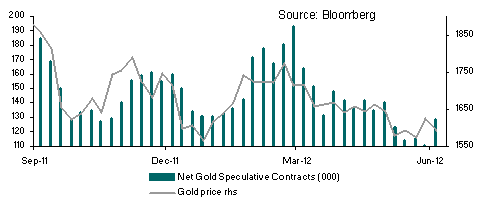
Some deterioration in sentiment towards gold prices has been reflected in the drop in speculative appetite for the commodity. Speculative demand for gold hit a cyclical high in August 2011 but since then there has been a steady reduction in appetite for gold from these investors. Indeed, CFTC IMM data reveals that speculative gold positioning dropped well below its three-month average. However, positioning is still well above its all time lows reached in February 2005, suggesting if anything, there is scope for more declines.
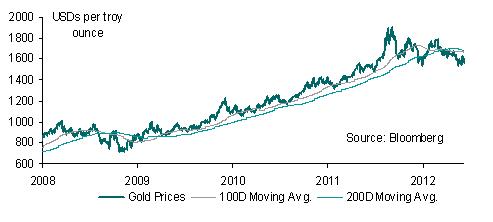
On top of the drop in speculative appetite for gold the technical picture has turned bearish. Since March 2009 at the height of the financial crisis the 100 day moving average price of gold had been trading above the 200 day moving average. On 27 March 2012 the 100 day moving average crossed below the 200 day moving average. Moreover, gold is now trading below both the 100 and 200 day moving average prices which sends a bearish technical message. Over the near term some key levels to look for are the 100 day moving average around 1658 on the topside and trendline support around the 1530 level on the bottom.
Another determinant of gold prices is demand from India and China. Growth in both countries is slowing, suggesting that gold demand is also weakening. While I certainly do not expect a collapse in demand from either country I have no doubt that compared to last year the strength of demand will be softer over coming months. Although I still look for a soft landing in China the Indian economic picture has clearly deteriorated while the Indian rupee has weakened. A weaker INR means that has become increasingly more expensive to import gold to India for domestic purchasers.

Overall, a weaker real demand picture taken together with reduced speculative appetite implies little support for gold prices. Moreover, a firmer USD in general will continue to weigh on prices. Perhaps a dose of inflation would help gold prices but there is little risk of this given the still sizeable amount of excess capacity in major economies.

Uncertainty about QE will help to limit any downside pressure on gold prices but elevated risk aversion will provide little assistance to gold. If however, the Eurozone and global picture deteriorates further gold will find itself with a lifeline but only if this means more currency debasement and a Fed engineered lower USD. If not, a further decline is on the cards and I forecast a drop in gold prices to around USD 1475 by the end of the year.

GBP rebounds, RBNZ warns about NZD strength

The Fed unsurprisingly left policy on hold while lowering projections for unemployment and raising forecasts for higher near term inflation. The economy is still expected to grow at a ‘moderate’ pace in coming quarters, with the majority of FOMC members anticipating the first tightening in 2014 or beyond. The one sop to markets was the fact that the Fed is prepared to do more in terms of policy enhancement if needed. This helped to buoy risk assets overnight leaving the USD on the back foot. Data releases are thin on the ground today leaving markets to consolidate gains in a relatively ‘risk on’ environment.

GBP came tumbling down from its highs following news that the UK economy entered a technical recession after GDP surprisingly contracted by 0.2% in Q1. However, the drop was short lived, with GBP/USD recovering from its losses, helped by a stellar reading for UK Nationwide consumer confidence in March. Notably however, Nationwide cautioned that the bounce in confidence could be short lived and we would be cautious of reading too much into the data. GBP gains against the EUR look as though they have reached its limit, and our models suggest that EUR/GBP is trading close to short term ‘fair value’.

There was no change in policy from the RBNZ as expected, with policy rates on hold at 2.5%. However, governor Bollard did attempt to talk the NZD lower while highlighting concerns about the global outlook. Concerns about kiwi strength will raise the spectre of FX intervention although it may also mean a delay in rate hikes. The statement was relatively more positive on the domestic outlook. Although rates are ‘appropriate’ according to the RBNZ we still think there is a good chance of a rate hike in Q3. The NZD ignored Bollard’s comments, firming on the back of improved risk appetite. We still see downside risks to the currency, especially as the current risk environment remains fragile.

US dollar restrained, Swiss franc too strong

Better than expected March US new home sales, stable consumer confidence and firmer than consensus earnings, all contributed to boost markets overnight. In Europe, decent demand for Dutch, Spanish and Italian debt auctions helped to reassure markets in the region. Apple earnings added to the good news, contributing to more than 82% of S&P 500 companies topping estimates so far for Q1 2012 earnings.

Despite encouraging news on the data and earnings front US equities only registered small gains, failing to echo the larger gains in European equity markets, suggesting that investors remain cautious. Ahead of the Fed FOMC outcome today trading is likely be relatively restrained, with the risk rally struggling to make much headway.

The Fed FOMC rate decision will be critical to determine USD direction over coming sessions. Assuming that the Fed does not alter its policy setting but instead only tinkers with its economic forecasts, the USD will escape any further selling pressure. Any reference or hint to further quantitative easing would play negative for the USD but I do not expect this to occur.

If anything I expect the USD to edge higher over coming sessions as risk aversion continues to rise. An expected drop in March durable goods orders today will not give the USD much help, however. I don’t expect the FOMC outcome to mark an end to speculation of more QE, and in this respect the USD will continue to be restrained until there is more clarity on the economy and in turn Fed thinking.

EUR/CHF continues to flat line close to the 1.20 line in the sand implemented by the Swiss National Bank (SNB). Renewed tensions in the Eurozone have if anything renewed the appeal of the CHF, making the job of the SNB even more difficult. The fact that risk aversion has been rising suggests CHF demand will remain firm in the short term. CHF demand is occurring in the face of speculation of a shift in FX stance.

Although the SNB has not hinted at any change in the level of the EUR/CHF floor, market speculation that the SNB will move it higher, possibly to around 1.30 from 1.20, has intensified. The problem for the SNB is that the CHF is substantially overvalued and this in turn is fuelling persistent deflationary risks as reflected in six straight months of declining CPI. Against this background it would not be surprising if the EUR/CHF floor is lifted.

EUR resilience, AUD hit by soft inflation

A distinctly downbeat tone to risk assets in the wake of disappointing manufacturing sentiment surveys in Europe and China and political uncertainties in Europe threatens to engulf markets today. There is very little on the data and events front that will change this as markets refocus to the outcome of the Fed FOMC meeting tomorrow. Consequently risk assets will remain under a degree of pressure in the short term unless the Fed delivers any fresh hints of more quantitative easing tomorrow.

A round of weaker than expected readings for Eurozone purchasing managers indices has led to a renewed wave of pessimism towards the Eurozone economy and selling in Eurozone assets. The collapse of the Dutch government over budget cuts and the results of the first round of French elections only added to the malaise. Once again however, the EUR remains resilient and has hardly flinched in the wake of bad news in the region.

I believe it is only a matter of time before the EUR succumbs to growing pressure, especially given a likely widening in its growth gap versus the US. Today’s bond auctions in Spain, Italy and Netherlands will be in focus but ought to provide little relief for the EUR, with the currency likely to edge towards 1.3057 support versus USD.

Australian Q1 CPI inflation data came in much softer than expected, with the trimmed mean CPI coming in at 0.3%, half the consensus expectation and well within the Reserve Bank of Australia’s target range. The data seals the case for the RBA to pull the trigger at its 4 May monetary policy meeting. The main imponderable is the magnitude of the rate cut. A 25bps cut had already been priced in but speculation of a 50bps move is likely to have grown.

Nonetheless, I believe the market is overly dovish, with a lot of easing already priced in (100bps in the current cycle). I don’t agree with market pricing, suggesting that eventually the AUD will recover as rate expectations correct. However, wariness ahead of the RBA meeting and deterioration in risk appetite will keep the AUD under restrained in the near term. AUD/USD support is seen around 1.0226, with a break below this leading to a test of 1.0145.

Limbo ahead of Fed FOMC meeting

A mixed session overnight leaves markets with little direction ahead of the Bank of Japan and Federal Reserve FOMC meetings today. There was no stimulus for markets from the meeting of European officials yesterday while Greece’s debt swap has failed to boost confidence.

Overall there is a real hesitancy for investors to take positions, with both volumes and volatility remaining very low. For instance the VIX volatility gauge has dropped to its lowest level since May 2011 while my measure of composite FX volatility continues to languish at relatively low levels compared to last year.

The USD has little to fear from the Fed FOMC meeting tonight. If anything it may even benefit from a less downbeat statement from Fed Chairman Bernanke following the meeting. Growing speculation that the Fed will embark on some form of sterilised quantitative easing, i.e. not printing any more money, bodes well for the USD too.

Ahead of the FOMC decision a firm February retail sales report will help add to the plethora of evidence revealing stronger signs of US recovery. A key indicator to watch in this respect is the (National Federation of Independent Business (NFIB) report of small business confidence which should also strengthen. Importantly for the USD the data should also help to maintain pressure on US bonds, keeping yields elevated and in turn the USD supported.

The BoJ meeting today will not deliver any surprises, an outcome that will likely leave the JPY largely unmoved. Speculative sentiment for the JPY has shifted negatively as reflected in the latest CFTC IMM report which reveals the biggest short position in the currency since April last year.

Crucial in pushing the JPY weaker has been the widening in bond yield differentials with the US, thanks largely to a rise in US bond yields. The 2-year yield gap is now around 20 basis points, the highest gap since August 2011. This will help to keep USD/JPY supported but my quantitative models suggest that the upmove may be overdone in the short term, with a correction lower in prospect to technical support around 81.44.