Switching risk on and off

There are several words that can be used to describe current highly risk averse market dynamics including panicked, nervous, fickle, tense, jittery, risky, volatile etc, all of which spark negative thoughts in the minds of investors. Aside from real worries such as renewed banking sector concerns, especially in Europe and in particular with regard to Spanish savings banks, there are also plenty of rumours afflicting market sentiment. In this environment deriving fact from fiction is not particularly easy whilst battling against the heavy weight of negative sentiment.

Although the pull back in risk appetite over recent weeks looks small compared to the peak in risk aversion during the financial crisis, the pace of the drop in markets has been dramatic and the withdrawal of risk seeking capital has been particularly aggressive. For example, in less than one month Asian equity markets have registered an outflow of around half of the total equity capital flows so far this year. Worryingly and despite the backstop in terms of central bank liquidity provision there are signs of renewed tensions in the money markets, with the libor-OIS spread and TED spread widening over recent days.
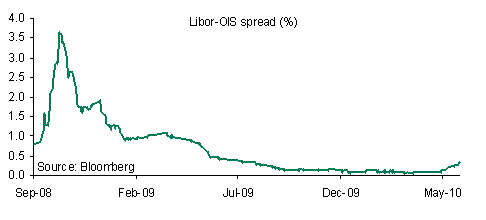
One of the most interesting observations in the current environment is that risk aversion has been increasing despite encouraging economic data. Not only has economic data been positive but in general has been coming in above consensus, showing that the market has underestimated the bounce in growth in the second quarter. Why is positive data not soliciting a more positive market reaction? Recent data is perhaps being seen as backward looking, and there is growing concern about the likely downdraft on economic activity in H2 2010, especially in Europe as deficit cutting measures bite.

News on the budget front in Europe has been relatively positive too, with Greece registering a sharp decline in its deficit, as well as announcing plans to tighten tax administration procedures. Meanwhile, the Italian cabinet reportedly approved a package of measures to reduce its deficit. On the flip side budget cuts across Europe are leading to growing public opposition, testing the resolve of eurozone governments to pass austerity measures. The public opposition means that the real test is in the implementation and execution of austerity measures. Signs of progress on this front will be key to turn confidence in the EUR around.

The USD remains king in the current environment and any pull back is likely to be bought into though Moody’s ratings agency’s warnings that the US AAA sovereign rating may come under pressure if there was no improvement in the US fiscal position, highlights the risks over the medium term to this currency. The EUR is set to remain under pressure though it is worth noting that the pace of its decline appears to be slowing, leaving open the potential for some consolidation. Near-term technical support for EUR/USD is seen at 1.2142 but a broader range of around 1.18.23-1.2520 is likely to develop over coming weeks.

Will the ECB intervene to support the Euro? (Part 1)

The EUR has lost around 23% since it all time high in April 2008 when it traded close to 1.6000. The EUR failed to rally even in the wake of the EUR 750 billion European Union / International Monetary Fund support package, a fact that has highlighted the weight of negative sentiment towards the currency. The latest blow to the currency came from the announcement of unilateral measures from Germany to ban naked short selling on sovereign debt and some financial stocks, actions that only highlighted the lack of policy co-ordination within the eurozone.

The rationale for further EUR/USD weakness is clear and justified partly by growth divergence within the eurozone countries, with Germany on the one extreme and weaker Southern European countries on the other. Moreover, relatively weaker overall growth in the eurozone compared to the US economy, a delay in interest rate hikes by the European Central Bank (ECB) and ongoing concerns about implementation and execution of deficit cutting plans, will also weigh on the EUR.

The EU/IMF support package and in particular ECB interventions in the Eurozone bond market have managed to alleviate some of the strain on European bond markets, but without similar intervention in the FX markets the EUR has become the release valve for Europe’s fiscal and debt problems. As a result the EUR’s fall has accelerated over recent weeks, only showing any sign of stability as fears of currency intervention increased.

The quickening pace of EUR depreciation has led to growing speculation of FX intervention by the ECB and other central banks to support the currency. I believe intervention is highly unlikely and see little reason for panic about the drop in the EUR. Once markets realise that there is indeed little risk of intervention the EUR will resume its downtrend.

One of the main reasons behind this view is that the EUR is not particularly “cheap” at current levels. In fact, “fair value” estimates based on the OECD measure of purchasing power parity (PPP) suggest that EUR/USD is around 5.6% overvalued at current levels, based on an implied PPP rate of around 1.17. Therefore, the drop in the EUR over recent months has only brought it back close to PPP fair value estimates.

Moreover despite the fact that there has been a large nominal depreciation of the EUR its trade weighted exchange rate has declined by much less, around 8.5% since the beginning of the year and around 11.3% since its high in October 2009. Although the trade weighted EUR is around its lowest level since October 2008, taking a longer term view shows that it is slightly above its average over the past 20-years.

Shock and Awe

The Greek crisis spread further last week, not only to Portugal and Spain, but in addition to battering global equity markets, contagion spread to bank credit spreads, OIS-libor and emerging market debt. In response, European Union finance ministers have rushed to “shock and awe” the markets by formulating a “crisis mechanism” package with the International Monetary Fund (IMF). The package includes loan guarantees and credits worth as much as EUR 750 billion. The support package can be added to the EUR 110 billion loan package announced last week.

In addition, the US Federal Reserve (Fed) announced the authorisation of temporary currency swaps through January 2011 between the Fed, European Central Bank (ECB), Bank of Canada (BoC), Bank of England (BoE) and Swiss National Bank (SNB) in order to combat in the “the re-emergence of strains” in European markets. Separately, the ECB will conduct sterilised interventions in public and private debt markets, a measure that was hoped would be announced at the ECB meeting last week, but better late than never. The ECB did not however, announce direct measures to support the EUR.

The significance of these measures should not be underestimated and they will go a long way to reducing money market tensions and helping the EUR over the short-term. Indeed, recent history shows us that the swap mechanisms work well. The size of the package also reduced default and restructuring risks for European sovereigns. However, the risk is that it amounts to a “get out of jail free card” for European governments. A pertinent question is whether the “crisis mechanism” will keep the pressure on governments to undertake deficit cutting measures.

The Greek crisis has gone to the heart of the euro project and on its own the package will be insufficient to turn confidence around over the medium term. In order to have a lasting impact on confidence there needs to be proof of budget consolidation and increasing structural reforms. Positive signs that the former is being carried out will help but as seen by rising public opposition in Greece, it will not be without difficulties whilst structural reforms will take much longer to implement. Confidence in the eurozone project has been shattered over recent months and picking up the pieces will not be an easy process.

Some calm to markets early in the week will likely see the USD lose ground. There was a huge build up of net USD long positioning over the last week as reflected in the CFTC IMM data, suggesting plenty of scope for profit taking and/or offloading of USD long positions. In contrast, EUR positioning fell substantially to yet another record low. Some short EUR covering is likely in the wake of the new EU package, but EUR/USD 1.2996 will offer tough technical resistance followed by 1.3114.

The EU/IMF aid package will help to provide a strong backstop for EUR/USD but unless the underlying issues that led to the crisis are resolved, EUR/USD is destined to drop further. Perhaps there will be some disappointment for the EUR due to the fact that the package of support measures involves no FX intervention. This could even limit EUR upside given that there was speculation that “defending the EUR” meant physically defending the currency. In the event the move in implied FX volatility over the last week did not warrant this.

Some Respite For The Euro

Following several days in which confidence in Greece’s ability to weather the storm was deteriorating, news that Greece asked for EU/IMF help helped to boost global markets and the EUR.  Meanwhile strengthening economic and earnings news helped to provide an undercurrent of support for markets, which boosted the end week rally in risk appetite.  

A 27% jump in US new home sales in March, a firm durable goods orders report as well better than expected earnings, with around 80% of companies reporting first quarter earnings beating expectations, highlight that US economic recovery is becoming increasingly well entrenched.  This is likely to be confirmed by the release of US Q1 GDP this week, set to register over 3% annualised quarterly growth.  

In Europe the picture is far more divergent, with exporting countries such as Germany doing well as evidenced from surveys such as the IFO and ZEW surveys, but in contrast the club med countries are not doing so well.  The highlights of the data calendar this week are April confidence indicators and the flash reading of Eurozone CPI.  Confidence indicators are likely to reveal some improvement, but despite Friday’s EUR/USD bounce, the data will be insufficient to prevent EUR/USD continue to move lower, with 1.3150 still a firm target over coming weeks.  

The official request for aid from Greece from the EU/IMF begins a new chapter in the long running saga for the country.  Greece will officially detail the amount of aid needed in a letter to the European Commission and European Central Bank who will then decide whether to approve it.  

A few dates to note are the maturing of EUR 8.5 billion in bonds on May 19, the completion of discussion with the IMF, EU and ECB on May 6 and state elections in Germany on May 9, which could throw a spanner in any financial support from Germany for Greece.   Meanwhile Greek unions are threatening further strikes to protest against austerity measures that Greece needs to carry out to win any aid package.   

Aside from Greece, attention will continue to be focussed on earnings but the main event of the week will be the Fed FOMC meeting on 27/28 April. Whilst a no change outcome is highly likely, with interest rates set to be left at between 0-0.25%, there will be plenty of attention on whether the Fed removes the comment that policy rates will remain low for an “extended period”. If the comment is removed the statement will be taken in somewhat of a hawkish context, which would boost the USD.

Shaping up to be a “risk on” week

It’s most definitely turning into a “risk on” week. On the earnings front both JP Morgan Chase and Intel beat forecasts whilst data releases did not disappoint either. In particular, US retail sales came in much stronger than expected. The Fed’s Beige Book also gave markets some good news to chew on. The reports from the twelve Federal Reserve Districts noted that economic activity “increased somewhat” since the March 3rd report.

The positive tone will continue today with the release of the March industrial production data, expected to show a strong gain over the month (consensus 0.7%), whilst both the Empire State and Philly Fed manufacturing surveys are set to post small gains in April, consistent with strengthening manufacturing activity in the months ahead.

Fed speakers have also been helpful for market sentiment. Fed Chairman Bernanke sounded a little more upbeat on the economy but highlighted the “significant restraints” remaining in the US economy. Bernanke maintained the “extended period” of low rates statement despite some speculation that the Fed was verging on removing this. The net impact of the testimony, improved data and earnings and firmer risk appetite is to keep the USD on pressure. In contrast, commodity currencies including AUD, NZD and CAD, will benefit, both from firmer risk appetite and an upturn in commodity prices.

Despite the positive reception to Greece’s debt auction there is not a lot of faith in the ability of Greece to weather the storm. Reports that Greece will need far more funding than has been initially promised by the EU/IMF – potentially as high as EUR 90 billion over coming years – together with worries about selling the loan package to the public in Germany and other eurozone countries, as well EU comments that Portugal will need further fiscal consolidation, have not done much good for confidence. Technically EUR/USD will see plenty of resistance around 1.3692.

After Singapore’s move to tighten monetary policy via the SGD revaluation, and following close on the heels of India, Malaysia and Vietnam, attention has turned to who’s next in line. South Korea must be a prime candidate, especially following data yesterday revealing a drop in the unemployment rate. Of course, China is very much in the spotlight and is set to embark on monetary tightening measures as well as CNY revaluation soon.

India is set to move again as early as next week, with inflation data today likely to seal the case for another hike (consensus 10.37% in March). The risk remains however, that many Asian central banks are moving too slowly to curb building inflation pressures and may find that they ultimately need to tighten more than they otherwise would have done.

China’s heavy slate of data released will if anything fuel greater expectations of an imminent CNY revaluation as well as monetary tightening. China’s economy grew a very strong 11.9% in Q1, above already strong consensus expectations, whilst CPI rose 2.4% YoY in March.

The growth data alongside further evidence of accelerating real estate prices highlight the risks of overheating in the economy and the need to act quickly to curb inflation threats. Given this expectation, firm risk appetite, and more follow through from Singapore’s FX move, the outlook for other Asian currencies remains positive.