What To Watch This Week

A “crisis over” mode is being adopted across markets as worries about Greece wane and economic data provides support to recovery hopes, whilst importantly allaying fears of a “double-dip”. Equities, bonds and currencies are reacting accordingly; equities are close to year highs, bond yields have risen and spreads have narrowed, whilst the USD and JPY are weaker, and conversely risk currencies are stronger. Even EUR/USD pushed higher on its way to 1.3800 as a number of stops were cleared and shorts were squeezed.

The coming weeks will be important to determine whether there is any staying power in the upward move in risk assets. A lot of the February data in the US will likely be obscured by bad weather however, including industrial production figures this week, leaving markets with little to go on. In Europe, the key release is the March German ZEW investor confidence survey, and better news in Greece, will likely prevent a sharper decline in confidence.

After both the Swish National Bank (SNB) and Reserve Bank of New Zealand (RBNZ) unsurprisingly left policy unchanged last week this week sees the turn of the US Federal Reserve and Bank of Japan (BoJ). Neither central bank is likely to shift policy but the Fed statement will be looked upon for guidance on the timing of rate hikes. The comment in the FOMC statement that the Fed Funds rate is expected to remain low for an “extended period” is set to be retained, even if some FOMC members are itching to remove it soon.

The BoJ meeting will be particularly interesting. I have just returned from a week long trip in Japan and on the ground there is plenty of speculation that the BoJ will take extra action to combat deflation and weaken the JPY. Additionally comments by Japan’s Prime Minister and Deputy PM have highlighted the potential for action to weaken the JPY although the usual market hesitation to sell JPY into fiscal year end and repatriation talk may mean a weaker JPY path is not straightforward.

Greece will not move too far from the spotlight, with EU officials likely to give the official stamp of approval on Greece’s deficit cutting measures and plenty of discussion at the Eurogroup Finance Minister’s meeting and Ecofin meeting early in the week. Moreover, weekend press reports suggest that a bailout up to EUR 25 billion is close to being agreed. Other topics of conversation will include the possible formation of a European Monetary Fund, though this looks like it will be a non-starter given the many objections to it.

Overall, risk appetite is set to continue its upward trajectory, likely keeping the USD on the back foot. Some deterioration in USD sentiment was reflected in the fact that net long aggregate USD speculation positioning has turned negative again according to the latest CFTC Commitment of Traders (IMM) report. Much in terms of FX direction will depend on what the FOMC says rather than does tomorrow.

EUR/USD may take a crack at resistance around 1.3840 on improving Greek news but it is difficult to see much upside from current levels. The one to watch will be the JPY, especially if the BoJ embarks on aggressive actions at this week’s meeting, leaving USD/JPY plenty of scope to test resistance around 92.16.
The Ball Is In the EU’s Court

A run of data and events have continued this week’s theme of improving risk appetite. Greece lived up to expectations, with the government announcing a EUR 4.8 billion package of austerity measures amounting to around 2% of GDP. The US ADP jobs data was in line with expectations, with employment dropping by 20k in February, whilst ISM non-manufacturing index delivered an upside surprise to 53.0 in February, contrasting with a weaker eurozone Purchasing Managers Index (PMI).

Greece now believes it has lived up to its part of the bargain and the ball is now in the court of EU countries. However the issue of aid from the EU remains highly sensitive with little sign of any aid forthcoming from EU partners. Moreover, Germany dealt a blow to Greek hopes by stating that financial aid would not be discussed when the Greek Prime Minister visits tomorrow. Failure to provide such assistance could see Greece turn to the IMF. The key test will be the roll over of around EUR 22 billion of debt in April/May.

Markets have reacted positively to recent events, with Greek debt rallying and the EUR strengthening to a high of 1.3727 overnight amidst reports that regulators are investigating hedge fund trades shorting the EUR. The 17 February high of 1.3789 will provide strong resistance to further EUR/USD upside but the currency looks vulnerable to selling on rallies above its 20-day moving average around 1.3631. The EUR will be driven by news about any aid to Greece rather than data whilst the medium term outlook remains bearish.

In the US the steady but gradual recovery in the economy is continuing to take shape. The Fed’s Beige Book revealed that economic activity “continued to expand” but severe snowstorms restrained activity in several districts. Overall, the report revealed little new information following so soon after Fed Chairman Bernanke’s testimony. Today’s US releases are second tier, with a likely upward revision to Q4 non-farm productivity to around 6.5% and a 1.5% increase in January factory orders.

As has been the case recently the weekly jobless claims data will garner more attention than usual given that it has recently signaled deterioration in job conditions. One factor that could have distorted the claims as well as the payrolls data is harsh weather conditions in parts of the US. Indeed, this has led us to cuts in forecasts for February non-farm payrolls scheduled to be released tomorrow, with the real consensus likely to be much weaker than the -65k shown in the Bloomberg survey.

There are four central bank decisions of interest today no change is likely from all of them. Indonesia and Malaysia are both edging towards raising interest rates but are likely to wait until Q2 2010 before hiking. There will be no surprises if the Bank of England (BoE) and European Central Bank (ECB) leave policy unchanged too, but there will be particular interest in the ECB’s announcement on changes in liquidity provision and the BoE’s signals on the potential for further expansion in quantitative easing. A dovish signal from the BoE will deliver GBP a blow, leaving GBP/USD vulnerable to a drop back below 1.50.

Disappointments Galore

Well the calm at the beginning of the week did not last very long.  Although the overnight price action can hardly be labelled as panic given both FX and equity volatility remain relatively well behaved, there is no doubt that worries are creeping back into the market psyche.  It seems that markets are once again trading on each piece of news and for the most part the news is not encouraging.  

A plethora of disappointments will set a negative tone for markets today.   Risk has come off the table in the wake of the worse than expected February German IFO business confidence survey and US Conference Board consumer confidence.   Cautious comments by Bank of England Governor King in which he kept the door open to further quantitative easing and a ratings downgrade of four of the largest Greek banks has added to the damage.

The German IFO was likely dealt a temporary blow by severe weather conditions.   The 10.5 point fall in US consumer confidence from an already relatively low level had no mitigating factors however, and revealed a deterioration in job market conditions, which combined with renewed weakness in jobless claims, does not bode well for next week’s US payrolls report, pointing to a decline of around 40k in February payrolls.

Overall, the market mood has darkened and there is little to turn sentiment around in the near term.  In prospect of likely weak reading for US payrolls next week and continuing worries about European fiscal/debt problems any improvement in risk appetite is likely to be limited.  This will help bond markets, the USD and JPY but most risk trades will face pressure. 

It is still worth being selective in FX markets.  The EUR remains the weak link and is set to struggle to make any headway, with upside likely to be restricted to resistance around 1.3747.  Similarly GBP is set to struggle in the wake of King’s comments as well as ongoing economic and deficit concerns, with GBP/USD vulnerable to a drop to around 1.5293.   In contrast, Asian currencies and commodity currencies look far more resilient.

Risk Appetite Puts Dollar On The Back Foot

Markets look somewhat calmer going into this week helped by comments by Fed members who noted that the discount rate hike did not signal a shift in monetary policy, something which is likely to be repeated by Fed Chairman Bernanke in his testimony to Congress on Wednesday and Thursday.  A tame US January CPI report last Friday helped too, giving further support to the view that the Fed will not hike the Fed Funds rate for some time yet; a rate hike this year seems highly unlikely in my view.  

Data this week will be conducive to a further improvement in risk appetite and despite the lingering concerns about Greece the EUR may find itself in a position to extend gains.  In Europe all eyes will be on the February German IFO survey and eurozone sentiment indicators, which following the surprising strength in the manufacturing Purchasing Managers Indices (PMIs), are likely to reveal solid gains. 

The main highlights in Japan this week includes January trade data and industrial production. The trade numbers will be particularly important to determine whether the rebound in exports due in large part to robust Asian demand, has continued whilst the bounce back in exports will be a key factor in fuelling a further gain in industrial output. 

In the US aside from the testimonies by Fed Chairman Bernanke there are plenty of releases on tap including consumer confidence, new and existing home sales, durable goods orders and a likely upward revision to Q4 GDP.  For the most part the data will show improvement and play for a further improvement in risk appetite. 

FX direction will depend on whether markets focus on the potentially positive USD impact of a reduction in USD liquidity or on the likely firmer tone to risk appetite this week.  Given expectations of firmer data and the soothing tone of the Fed, risk currencies will likely perform better, with crosses such as AUD/JPY favoured.  The USD will likely be placed on the back foot, especially given the very long market positioning in the currency.

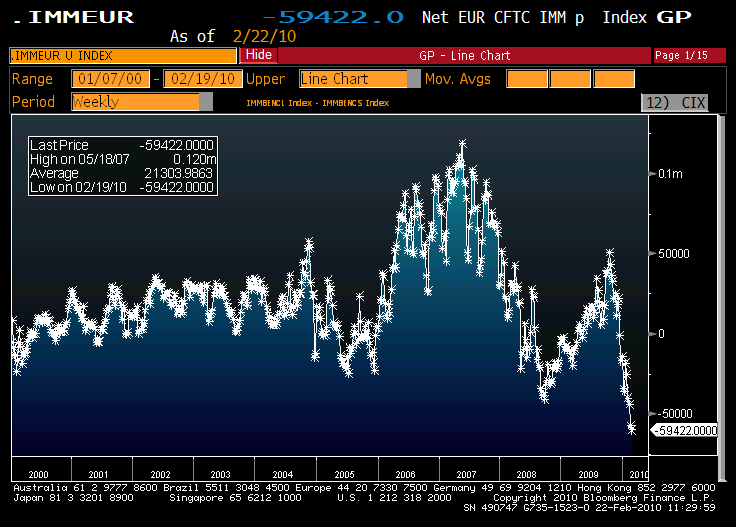
The EUR will be helped by the fact that speculative market, according to the CFTC IMM data, holds record short positions in the EUR (as of the week ended 16 February) giving plenty of potential for short-covering.   The more timely Tokyo Financial Exchange (TFX) data also reveals that positioning in EUR/JPY has continued to be scaled back.  

CFTC Commitment of Traders (IMM) data – Net EUR speculative positioning

EUR/USD bounced smartly from its lows around 1.3444 on Friday, partly reflecting some short covering and the drop in FX volatility suggests the market is more comfortable with EUR/USD around these levels.  A positive IFO survey and improved risk appetite could see EUR/USD test resistance around 1.3774, its 20 day moving average, over coming days.  Ongoing Greek concerns suggest that any EUR bounce will be limited, however. 

USD/JPY looks well supported and although data this week will suggest that exports are improving despite JPY strength, the relatively more aggressive stance of the Fed compared to the BoJ, long JPY positioning, and improved risk appetite, give plenty of scope for the JPY to extend losses, with technical USD/JPY support seen around 91.28.

Fed discount rate move boosts dollar

The Fed’s move to hike the discount rate by 25bps has set the cat amongst the pigeons.   Although the move was signalled in the FOMC minutes yesterday a hike in the discount rate was not expected to happen so soon.  The Fed sees the modifications which also include reducing the typical maximum maturity for primary credit loans to overnight, as technical adjustments, rather than a signal of any change in monetary policy. 

Nonetheless, the market reaction has been sharp, with the USD strengthening across the board and short term interest rate and stock futures falling.  Although the reaction looks overdone and will likely be followed by some consolidation over the short term, the move will be interpreted as the beginning of a move towards monetary policy normalisation despite the Fed’s insistence that this is not the case.  The firm USD tone is set to remain in place for now but the bulk of the strengthening has likely already occurred following the announcement.  

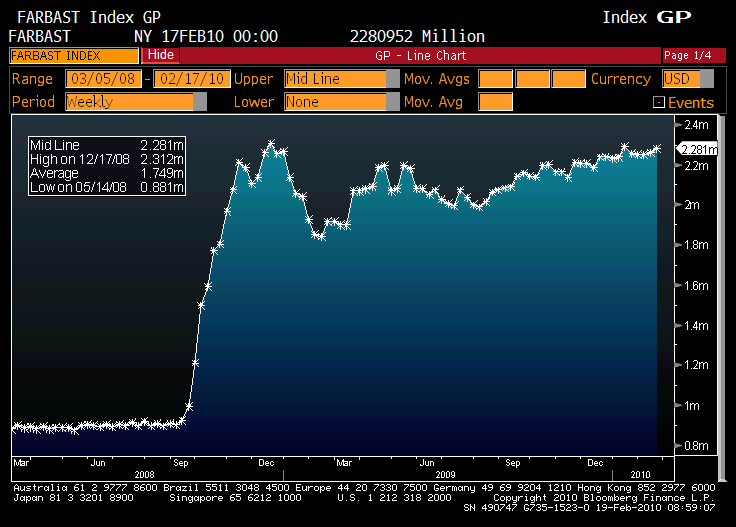
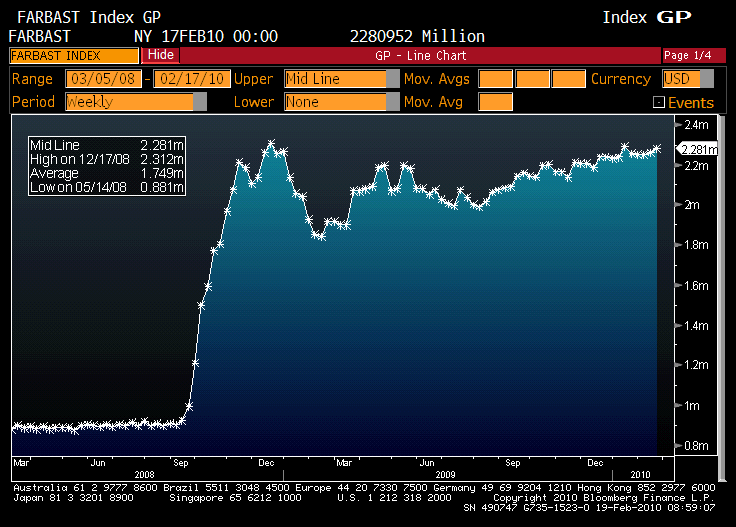
The Fed’s desire to reduce the size of its burgeoning balance sheet, which at $2.3 trillion is roughly around three times its size before the financial crisis began, will imply further measures to reduce USD liquidity over the coming months.   A withdrawal of liquidity could have positive implications for the USD but given that the Fed is still some months away from hiking the Fed Funds rate, interest rate differentials will not turn positive for the USD for a while yet. 

The move has however, changed the complexity of the FX market and likely shifted currencies into new lower ranges against the USD.  There were plenty of reasons to sell EUR even before the Fed move and the discount rate hike inflicted further damage on EUR/USD which dropped below the key psychological level of 1.35.  GBP and commodity currencies were also big losers, with GBP/USD below 1.55.  Key technical support levels to watch will be EUR/USD 1.3422, GBP/USD 1.5374 and AUD/USD 0.884.

US Federal Reserve Balance Sheet ($trillion)